Note Ban Most Disruptive Policy Innovation Since 1991: Former RBI Chief
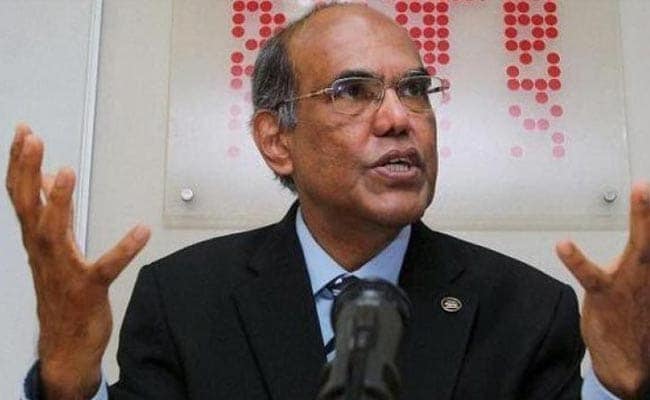
Hyderabad: Former Reserve Bank of India Governor D Subbarao on Thursday termed the demonetisation move as "creative destruction and the most disruptive policy innovation since 1991 reforms" that has helped destroy black money.
"On November 8, the Prime Minister (Narendra Modi) and the Reserve Bank have demonetised 86 per cent of currency in circulation overnight, which is what is arguably the most disruptive policy innovation in India since the 1991 reforms," he said.
"Demonetisation, in that sense, is creative destruction. But it is a very special type of creative destruction. Because what it has destroyed is a destructive creation - black money. So, you can understand that demonetisation is creative destruction of a destructive creation," Mr Subbarao said.
He was addressing an international conference organised by the Institute for Development and Research in Banking Technologies (IDRBT) here.
He added that demonetisation is "arguably" leading to a flurry of innovations in Indian financial sector by way of digitisation of payments.
"There are two perspectives. Extension of a global trend of financial technology which is upending the finance industry and discontinuous change in a low-income country from cash incentive economy to a less-cash economy. Either way, we will have disruptive innovations in India's financial sector," he explained.
Mr Subbarao said that though cost and benefit of this demonetisation exercise is a very contentious debate, the subject of policy innovation is not contentious.
According to him, the country witnesses a lot of disruptive innovations in finance in payment system.
The model of traditional banking has access to low-cost deposits and an advantage over other financial institutions, including fintech companies, the former RBI governor said.
"That advantage is going to be neutralised by the business model of these fintech companies which will beat on efficiency, service and trust," Mr Subbarao remarked.
He suggested the traditional banks should look into other avenues to compete by tying up with these companies or payments banks that are coming up.
He urged regulators to promote innovation and protect consumers and preserve financial stability.
"On the one hand, they have to make sure the stability is preserved and on the other hand, they should regulate tightly that innovation is not scorched. This balance is a very difficult judgement call," he added.
On microfinance, he said the model has benefited millions of low-income families in India, particularly in Andhra Pradesh (before the state bifurcation).
He recalled that RBI was in a dilemma at the time of 2010 crisis on whether to regulate the interest rates of MFIs and if so, what figure would be justified.

-
High US Salaries, No Green Card Certainty: The Financial Calculation Facing Indian H-1B Families

The suspension of PERM processing at eight technology employers does not cancel existing H-1B visas. What it does is force a question many Indian families have been avoiding: is the US salary worth tying your career and family plans to one employer?
-
Unhedged Position: Can India See An Indonesia-Style Time Correction?
The Nifty is trading below levels it first clocked in 2024. Is there, then, as I have suggested in the headline, potential that the current time correction drags on painfully for the next three-five, even ten years?
-
Navigating Friction And Energy Realities: An Analysis Of Marco Rubio's October Visit To India
Occurring at a critical juncture marked by stalled trade negotiations and escalating geopolitical pressures over global energy supplies, the visit offers a profound window into modern US-India relations.
-
India Exports Capital. Why Not Export Trusteeship?
The big question, then, is whether India can build an institution that global borrowers, investors, banks, and lawyers can trust, even without an Indian connection.
-
France's Economy & Politics Are In Crisis | The Reason Why
Let's look at how the French economy and politics evolved under Nicolas Sarkozy, Franois Hollande and Emmanuel Macron.
-
You May Inherit The Business. You Must Earn Its Credibility.
Succession tests the founder's ability to share authority as much as it tests the next generation's readiness to assume it.
-
Signing Deals Is One Thing; Making Them Work Is Another | The Week In Whys
Sometimes, things don't turn out as planned. Indian companies have lost some bids to rivals, some projects won't produce until 2030.
-
FOMC Wall, PERM Suspension, Hospital Stocks | Talking Points This Week
A PERM suspension would directly affect green-card sponsorship rather than H-1B visas, so the near-term earnings impact could remain relatively limited. The key question is whether this marks a new phase in US scrutiny of Indian IT.
-
Everything, Everywhere, All At Once: Dalal Street's Week To Forget | Joining The Dots
Visa curbs, a Starlink spat and cancer drug caps: what connects this week's shocks for Indian markets
-
India Is Going Abroad For Critical Minerals. But It May Take Years To Pay Off | The Reason Why
Although India's steps are in the right direction, they remain modest compared with India's growing dependence.









