Not The Right Time To Charge For Digital Payments: Nirmala Sitharaman
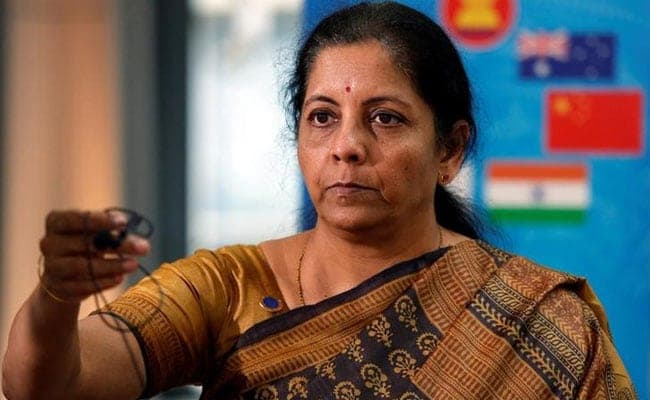
Union Finance Minister Nirmala Sitharaman said on Friday that the central government believes that this is not the right time to make digital payments chargeable.
Speaking at an event, Ms Sitharaman said, "We see digital payment as the public good. People should be able to access it freely so that the digitisation of the Indian economy becomes attractive. Also, through digitisation, we achieve a level of transparency which is so required."
"Therefore, we still think it is not the right time to make it chargeable. We are more and more pushing toward open digital transactions, digitisation and platforms which can enable great access. The RBI's recommendation is to a working paper and lets the working paper where it is," the Minister added.
Ms Sitharaman's statement came against the backdrop of the Reserve Bank of India (RBI) seeking feedback from the public on the various changes proposed in the payments system, including the possibility of imposing tiered charges on transactions done through the Unified Payments Interface (UPI).
However, the Government of India last week announced that it will not levy any charges on UPI (Unified Payments Interface) services.
As announced in the Statement on Developmental and Regulatory Policies dated December 08, 2021, the Reserve Bank of India (RBI) has released a discussion paper on "Charges in Payment Systems" for public feedback, RBI said in a statement. The discussion paper was released on August 17.
The focus of RBI's initiatives in the payment systems has been to ease frictions which may arise from systemic, procedural or revenue-related issues.
While many intermediaries exist in the payments transaction chain, consumer complaints are generally about high and non-transparent charges.
Charges for payment services should be reasonable and competitively determined for users while also providing an optimal revenue stream for the intermediaries.
It was considered useful to review the various charges levied in the payment systems by highlighting different dimensions and seeking stakeholder feedback.
The RTGS and NEFT payment systems in India are owned and operated by RBI.
Systems like IMPS, RuPay, UPI, etc., are owned and operated by the National Payments Corporation of India (NPCI), a not-for-profit entity promoted by banks.
The other entities, like card networks, PPI issuers, etc., are profit-maximising private entities.
Notably, the number of digital transactions in July was the highest ever since 2016. UPI reported 6.28 billion transactions amounting to Rs 10.62 trillion, according to data released by the National Payments Corporation of India (NPCI).

-
Where You Live Shapes How You Get To Work | The Reason Why

Two-wheelers are the most popular way to get to work in India, accounting for nearly 43% of workplace commutes.
-
High US Salaries, No Green Card Certainty: The Financial Calculation Facing Indian H-1B Families
The suspension of PERM processing at eight technology employers does not cancel existing H-1B visas. What it does is force a question many Indian families have been avoiding: is the US salary worth tying your career and family plans to one employer?
-
Unhedged Position: Can India See An Indonesia-Style Time Correction?
The Nifty is trading below levels it first clocked in 2024. Is there, then, as I have suggested in the headline, potential that the current time correction drags on painfully for the next three-five, even ten years?
-
Navigating Friction And Energy Realities: An Analysis Of Marco Rubio's October Visit To India
Occurring at a critical juncture marked by stalled trade negotiations and escalating geopolitical pressures over global energy supplies, the visit offers a profound window into modern US-India relations.
-
India Exports Capital. Why Not Export Trusteeship?
The big question, then, is whether India can build an institution that global borrowers, investors, banks, and lawyers can trust, even without an Indian connection.
-
France's Economy & Politics Are In Crisis | The Reason Why
Let's look at how the French economy and politics evolved under Nicolas Sarkozy, Franois Hollande and Emmanuel Macron.
-
You May Inherit The Business. You Must Earn Its Credibility.
Succession tests the founder's ability to share authority as much as it tests the next generation's readiness to assume it.
-
Signing Deals Is One Thing; Making Them Work Is Another | The Week In Whys
Sometimes, things don't turn out as planned. Indian companies have lost some bids to rivals, some projects won't produce until 2030.
-
FOMC Wall, PERM Suspension, Hospital Stocks | Talking Points This Week
A PERM suspension would directly affect green-card sponsorship rather than H-1B visas, so the near-term earnings impact could remain relatively limited. The key question is whether this marks a new phase in US scrutiny of Indian IT.
-
Everything, Everywhere, All At Once: Dalal Street's Week To Forget | Joining The Dots
Visa curbs, a Starlink spat and cancer drug caps: what connects this week's shocks for Indian markets









