Nobel Economics Prize To 3 US Economists For Global Banking Crisis Management
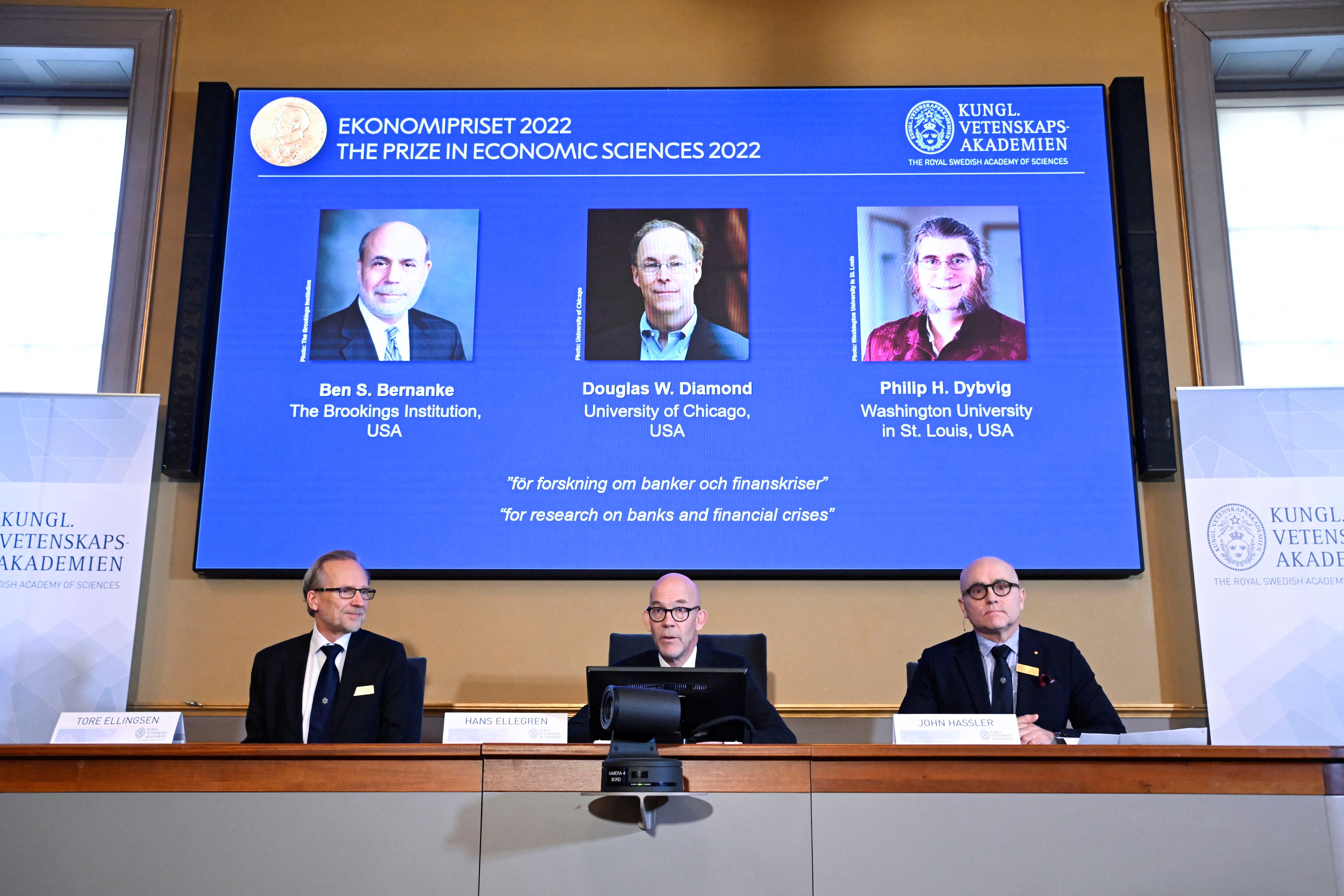
A trio of US economists including Former Federal Reserve chief Ben Bernanke won this year's Nobel Economics Prize on Monday for laying the foundation of how the world now manages global crises like the recent pandemic or the Great Recession of 2008.
The trio, who also include Douglas Diamond and Philip Dybvig, won for their research on how regulating the financial sector and propping up failing banks can stave off an even deeper economic crisis, such as the Great Depression of the 1930s.
"The actions taken by central banks and financial regulators around the world in confronting two recent major crises – the Great Recession and the economic downturn that was generated by the COVID-19 pandemic – were in large part motivated by the laureates' research," the Swedish Academy said in announcing this year's prize winners.
Governments around the world bailed out banks in 2008 and 2009, generating a torrent of criticism as ordinary consumers suffered with many losing their homes even as banks, a key culprit of the crisis, were saved.
But society on the whole benefited, the laureates' research suggests.
"Even though these bailouts have problems, ... they could actually be good for society," Diamond told a news conference with the Swedish Academy, arguing that preventing the collapse of a financial firm like Lehman Brothers would have made the crisis less severe.
Ironically Bernanke was the chair of the US Federal Reserve at the time of Lehman's collapse in 2008, which became one of the main catalysts of the world's biggest financial turmoil since the 1930s.
He argued at the time that there was no legal way to save Lehman so the next best thing was to let the bank fail and use the government's financial resources to prevent wider systemic failures.
BANK RUNS
The trio's main work focused on understanding the role of banks in the economy, particularly during financial crises and how banking failures can amplify and self-perpetuate a crisis.
"An important finding in their research is why avoiding bank collapses is vital," the academy added. "Their analyses have been of great practical importance in regulating financial markets and dealing with financial crises."
The Academy said that Bernanke showed with statistical analysis that bank runs led to bank failures and this was the mechanism that turned a relatively ordinary recession into the depression in the 30s, the world's most dramatic, and, severe crisis.
Bank runs can easily become self-fulfilling leading to the collapse of an institution and putting the entire financial sector at risk.
"These dangerous dynamics can be prevented through the government providing deposit insurance and acting as a lender of last resort to banks," the Academy said.
The trio join such luminaries as Paul Krugman and Milton Friedman, previous winners of the prize.
The majority of previous laureates have been from the United States.
The economics prize is not one of the original five awards created in the 1895 will of industrialist and dynamite inventor Alfred Nobel.
It was established by Sweden's central bank and first awarded in 1969, its full and formal name being the Sveriges Riksbank Prize in Economic Sciences in Memory of Alfred Nobel.
(Except for the headline, this story has not been edited by NDTV staff and is published from a syndicated feed.)

-
Midterm Rally Lasted A Day. The Hard Reality Of A Divided US May Last Two Years | Opinion

Between a contested AI boom, a debt ceiling that arrives in 2027 and a president with every incentive to act alone, the next two years may prove more volatile than the first day's rally suggests.
-
Blue Wave Will Derail the AI Trade but Won't Dismantle the AI Era | Unhedged Position
The Democrats' sweep of the US Congress will see politics collide with economic forces both over the long and short term.
-
It's Time To Take The GST Council's Bet On Trust Global
Payment records can prove India's services exports, and clear, proportionate rules can bring foreign digital sellers into the tax net.
-
Opinion | India at 38: From Innovation Overperformer to Innovation Powerhouse
India now has 453 VC-backed deep science startups, 18 of them late-stage, after 117 percent growth since 2020. Laurus Labs, at USD 9.3 billion, is the most valuable deep science company in any middle-income economy outside China.
-
Navigating Energy Crossroads: S Jaishankar's Call For Diversified Supply Chains At G20 Ministerial Meeting
As geopolitical fault lines continue to test maritime trade routes and commodity flows, Jaishankar's message remains pertinent: true economic resilience requires open markets, protected transit lines, and a genuine commitment to multilateral cooperation rather than coercion.
-
Indians Are Travelling, But Not Every Journey Is A Holiday | The Week In Whys
Pilgrims, patients and working women are the real travellers, and the system hasn't quite caught up with them.
-
Getting To Work Costs Women More | The Reason Why
It is not just about women paying more than men. It is about women paying much more in cities than in villages.
-
AI Bias In Investing Cannot Be Eliminated, But It Can Be Governed
Framing is a particularly important example as identical financial information presented in terms of gains rather than losses can lead an LLM to reach a different assessment.
-
Joining The Dots | Dark Skies, Steady Diya: Why Hope Holds This Diwali
With war, a weak rupee and foreign outflows weighing on sentiment, policymakers at the NDTV World Summit and market veterans at NDTV Profit Ignite: Diwali Edition offered the same advice: stay invested and filter out the noise.









