No Rate Relief For Existing Borrowers Even As Banks Cut Rates
Bank lending rates are finally falling. At least that is what banks are telling us. But if you haven't seen a drop in your EMI (equated monthly installment), read on.
A number of large lenders have announced a reduction in loan rates in recent days across products like home loans as they try and capture festive season demand. Banks have also cut their marginal cost of fund lending rates (MCLR) - a new interest rate framework introduced earlier this year.
There is a catch. A large part of the existing loans are still linked to the old base rate system, where the drop in rates has been slower. While banks give customers the option to switch their loans from base rate to MCLR, they charge a hefty fee of between 0.5-1 percent of the outstanding loan.
The result - relatively few borrowers are benefiting from the recent drop in rates.
According to Nitin Kumar, a fundamental analyst at brokerage firm Prabhudas Lilladher, a significant proportion of borrowers may not be benefiting as their loans remain linked to the old base-rate system rather than the MCLR. “For one large private sector bank, only about 15-20 percent of its retail book is priced according to the MCLR (marginal cost of funds lending rate),” he said while declining to name the bank.
A senior official at IDBI Bank, on condition of anonymity, agreed that a large portion of the bank's retail book is still pegged to the base rate. While ICICI Bank did not share the proportion of borrowers who have shifted to the MCLR, Chanda Kochhar, as part of the bank's earnings press conference, said that the option is available to all borrowers.
Emails sent State Bank of India and Axis Bank asking for details were not answered.
Why Old Loans Are Costlier
The crux of the matter is that the reduction in the base rates has not kept pace with the reduction in the MCLR. With the recent 10-15 basis point cut in MCLR by State Bank of India and HDFC Bank, the gap between the two rates has only widened.
A basis point is one hundredth of a percentage point.
In April this year, the RBI introduced the marginal cost of funds method for calculating lending rates because it felt that banks were taking too long to transmit lower rates under the base rate system. While a change in rates under the base rate mechanism was linked to the average cost of funds, the MCLR is calculated based on the marginal cost of funds.
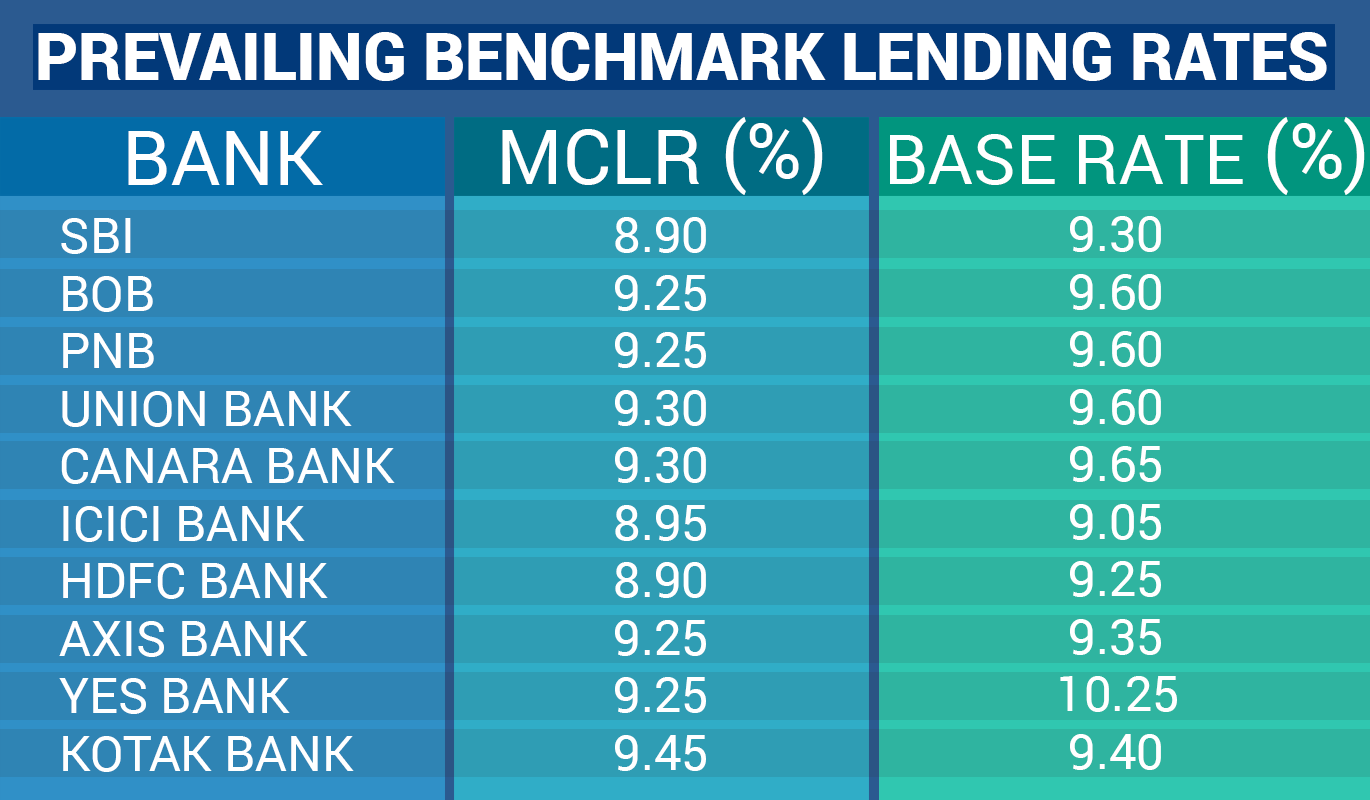
Since the start of this fiscal, the larger banks have cut their MCLR by 10-30 basis points. SBI's benchmark lending rate, after the most recent cut of 15 basis points, stands at 8.90 percent, while that of ICICI Bank is at 8.95 percent. HDFC Bank, on Monday, reduced its MCLR by 15 basis points to 8.90 percent, matching SBI.
Among the other public sector banks, Punjab National Bank, Canara Bank, and Union Bank have cut their MCLR by 15 basis points each. Private sector banks, such as Axis Bank, Yes Bank, and Kotak Mahindra Bank have reduced their MCLR by 10-35 basis points.
A number of these banks, however, have not reduced their base rate by the same proportion.
When the shift to MCLR happened, the RBI stipulated that borrowers who took loans before April 1 would continue to pay the rates determined by the base rate. They would, however, have the option of shifting to the MCLR determined rate at an agreed fee.
Existing loans and credit limits linked to the Base Rate may continue till repayment or renewal, as the case may be. Existing borrowers will also have the option to move to the Marginal Cost of Funds based Lending Rate (MCLR) linked loan at mutually acceptable terms.RBI's Final MCLR Guidelines
What It Costs To Shift To MCLR?
In order to shift from a base rate-linked loan to an MCLR-linked rate, a borrower would have to intimate the bank and then pay a one-time fee worth 0.5-1.0 percent of the outstanding loan amount, said Arnav Pandya, a certified financial planner.
“The bank providing MCLR rate considers the transferred loan as a new loan. Hence, the processing fee will be similar to a new loan, which is 0.5-1.0 percent of the outstanding loan amount,” said a spokesperson of online loan marketplace BankBazaar.
For borrowers who have not sought a shift to the MCLR-linked rate, assuming they opted for a floating rate, the rate of interest on their loans, would continue to be pegged to the base rate.
According to Pandya, a lot of retail borrowers have not shifted to MCLR from the base rate calculation because they're simply unaware of the distinction.
“Customers will have to be proactive in this case, because banks will not simply pass on the benefit,” said Pandya. “As an existing customer there are two things you can do: one you can shift to the MCLR by paying the one-time processing fee stipulated by the bank, and two, you can get another loan and pre-pay the existing one.”
Between the two options, Pandya said the first option would be preferable. He said the 30-basis-point gap between the two rates would make a huge difference to the final payout, especially if the remaining amount of the loan is large. This would make it very beneficial for customers to shift to the new calculation method, he said.
Customers may also have the option to negotiate a lower spread over the base rate for their individual loan if they are not keen to switch to an MCLR-linked loan, said Kartik Jhaveri, director at Transcend Consulting, a financial planning firm.
Transmission To Continue In Dribs And Drabs
“Initially transmission lagged, but the pace appears to have picked up because the cost of deposits has reduced,” said NS Venkatesh, executive director at Lakshmi Vilas Bank. “The credit cost in the banking system is still high. And the component of fixed deposits is also much higher. It's 65-70 percent of deposits, so the cost of funds will come down only slowly.”
The larger banks have transmitted more than the smaller banks, according to Venkatesh. He explains that smaller banks have a lower proportion of current account and savings account deposits which means they are sitting on costlier fixed deposits.

-
Navigating Friction And Energy Realities: An Analysis Of Marco Rubio's October Visit To India

Occurring at a critical juncture marked by stalled trade negotiations and escalating geopolitical pressures over global energy supplies, the visit offers a profound window into modern US-India relations.
-
India Exports Capital. Why Not Export Trusteeship?
The big question, then, is whether India can build an institution that global borrowers, investors, banks, and lawyers can trust, even without an Indian connection.
-
France's Economy & Politics Are In Crisis | The Reason Why
Let's look at how the French economy and politics evolved under Nicolas Sarkozy, Franois Hollande and Emmanuel Macron.
-
You May Inherit The Business. You Must Earn Its Credibility.
Succession tests the founder's ability to share authority as much as it tests the next generation's readiness to assume it.
-
Signing Deals Is One Thing; Making Them Work Is Another | The Week In Whys
Sometimes, things don't turn out as planned. Indian companies have lost some bids to rivals, some projects won't produce until 2030.
-
FOMC Wall, PERM Suspension, Hospital Stocks | Talking Points This Week
A PERM suspension would directly affect green-card sponsorship rather than H-1B visas, so the near-term earnings impact could remain relatively limited. The key question is whether this marks a new phase in US scrutiny of Indian IT.
-
Everything, Everywhere, All At Once: Dalal Street's Week To Forget | Joining The Dots
Visa curbs, a Starlink spat and cancer drug caps: what connects this week's shocks for Indian markets
-
India Is Going Abroad For Critical Minerals. But It May Take Years To Pay Off | The Reason Why
Although India's steps are in the right direction, they remain modest compared with India's growing dependence.
-
When Everyone Has AI, What Gives You An Edge?
India's young workforce is entering an uncertain world of work where powerful AI tools are becoming widely accessible. The advantage will belong to those who combine deep expertise with digital fluency, and the distinctly human capabilities that technology cannot manufacture.
-
Wrong Labels, High Pesticide Residues Holding Back Agri Exports | The Reason Why
India needs stronger domestic food-safety and labelling standards, with best practices becoming part of everyday business for farmers, traders and food companies.










