No Credit Quality Concerns With Adani Group Firms: SBI Official
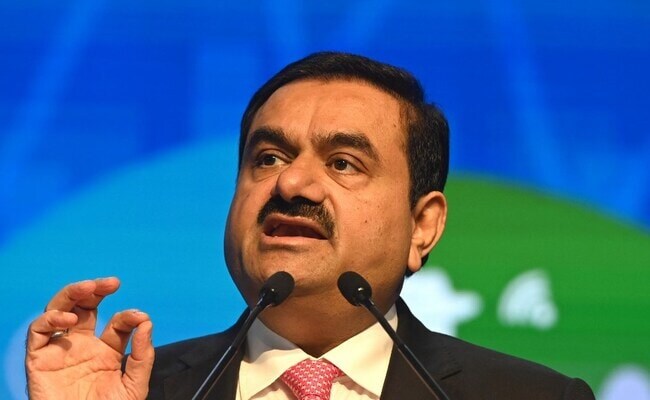
India's largest lender has not felt any credit quality concerns with exposures to Adani Group companies, according to a senior official at the bank.
While Adani Group companies have seen their stock lose value in the equity markets, it has not led to any concerns about a credit default by them. The exposures are backed by cash flows from revenue-generating assets, according to the official said on the condition of anonymity. Currently, the State Bank of India has adequate visibility on the future cash flows of these assets and is not concerned, the official said.
The bank does not have any pledged shares from Adani Group companies, which may lead to a margin call, the official said.
On Wednesday, Adani Enterprises decided to call off its Rs 20,000 crore further public offer, even after it was fully subscribed. The company said it will repay all the funds it has in escrow accounts. The decision was taken due to sharp volatility in the group's stocks with the board stating that it would not be "morally correct" to go ahead with the offer, it said.
"We will continue to focus on long-term value creation, and growth will be managed by internal accruals. Once the market stabilizes, we will review our capital market strategy," Adani Enterprises said in a statement to exchanges.
The decision to call off the FPO might impact investments in future projects, but these do not pose any immediate problems for SBI, the official quoted above said.
Total bank debt to the top five Adani Group companies is estimated to be over Rs 81,000 crore, CLSA said in a report on Jan. 26. This constitutes only 0.55% of banking sector loans. Overall debt to these five companies has risen from Rs 1.15 lakh crore as of March 2019 to Rs 2.11 lakh crore as of March 2022, CLSA said in its report. Most of this incremental debt was financed through dollar bonds,
The Reserve Bank of India has sought details of bank exposures to Adani Group companies in recent weeks, the SBI official said. This is part of the regulator's usual supervisory practices, where it keeps tabs on exposures to large borrowers, the banker said.
Another public sector banker, who also commented on the condition of anonymity, said that the group's financial position has not deteriorated enough to cause concerns among lenders. Unless there is a major change in the revenue generation capabilities of the group's firms, credit quality concerns will not arise, this second banker said.
Private sector lender IDFC First Bank clarified to the exchanges on Thursday that the bank's funded outstanding toward Adani Group companies is only 0.06% of its funded assets as of December 2022.
Non-funded working capital exposure to the Adani Group firms stands at 0.51% of the bank's assets, the majority of which is secured by way of letters of credit maturing in two to five months.
"The bank does not have any exposure to any offshore entities in the Adani Group or against the shares of the Adani Group companies," IDFC First Bank said in its exchange notification.
Adani Group stocks have taken a major hit after a report by international short seller Hindenburg Research, which questioned corporate structures in the group. The Adani Group hit back at the allegations with a detailed rebuttal last week. At 12:15 p.m. on Thursday, Adani Enterprises was trading at Rs 1,958.25 per share, down over 8% from Wednesday's close.
Disclaimer: New Delhi Television is a subsidiary of AMG Media Networks Limited, an Adani Group Company.
(Except for the headline, this story has not been edited by NDTV staff and is published from a syndicated feed.)

-
Unhedged Position: Can India See An Indonesia-Style Time Correction?

The Nifty is trading below levels it first clocked in 2024. Is there, then, as I have suggested in the headline, potential that the current time correction drags on painfully for the next three-five, even ten years?
-
Navigating Friction And Energy Realities: An Analysis Of Marco Rubio's October Visit To India
Occurring at a critical juncture marked by stalled trade negotiations and escalating geopolitical pressures over global energy supplies, the visit offers a profound window into modern US-India relations.
-
India Exports Capital. Why Not Export Trusteeship?
The big question, then, is whether India can build an institution that global borrowers, investors, banks, and lawyers can trust, even without an Indian connection.
-
France's Economy & Politics Are In Crisis | The Reason Why
Let's look at how the French economy and politics evolved under Nicolas Sarkozy, Franois Hollande and Emmanuel Macron.
-
You May Inherit The Business. You Must Earn Its Credibility.
Succession tests the founder's ability to share authority as much as it tests the next generation's readiness to assume it.
-
Signing Deals Is One Thing; Making Them Work Is Another | The Week In Whys
Sometimes, things don't turn out as planned. Indian companies have lost some bids to rivals, some projects won't produce until 2030.
-
FOMC Wall, PERM Suspension, Hospital Stocks | Talking Points This Week
A PERM suspension would directly affect green-card sponsorship rather than H-1B visas, so the near-term earnings impact could remain relatively limited. The key question is whether this marks a new phase in US scrutiny of Indian IT.
-
Everything, Everywhere, All At Once: Dalal Street's Week To Forget | Joining The Dots
Visa curbs, a Starlink spat and cancer drug caps: what connects this week's shocks for Indian markets
-
India Is Going Abroad For Critical Minerals. But It May Take Years To Pay Off | The Reason Why
Although India's steps are in the right direction, they remain modest compared with India's growing dependence.
-
When Everyone Has AI, What Gives You An Edge?
India's young workforce is entering an uncertain world of work where powerful AI tools are becoming widely accessible. The advantage will belong to those who combine deep expertise with digital fluency, and the distinctly human capabilities that technology cannot manufacture.









