Nirmala Sitharaman On Plan To make India Developed Nation By 2047
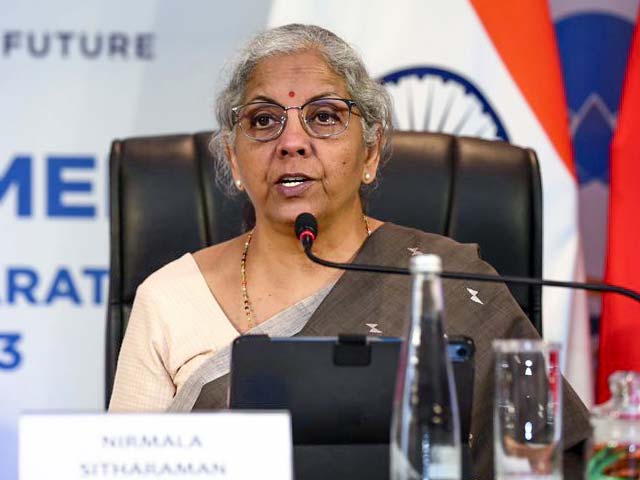
Finance Minister Nirmala Sitharaman on Saturday said the focus of the government is on four Is -- infrastructure, investment, innovation and inclusiveness -- to make India a developed nation by 2047.
She said India has the necessary wherewithal to meet the goal set by Prime Minister Narendra Modi.
Besides several investor-friendly reforms undertaken by the government, she said, India has a very vibrant young population and the emphasis on skilling them to suit the requirement of the economy would yield dividend.
With the aim to build India a developed country by 2047, she said "the emphasis has been on four different issues (Is). We are looking at infrastructure (first I) in a very big way. In the last 3 to 5 years, consistently, the public expenditure for infrastructure building has been ramped up significantly and it will reach Rs 10 lakh crore in 2023-24." With infrastructure comes investment (second I), the minister said, adding that emphasis on investment will promote greater participation of both the public and private sectors.
So, she said, infrastructure is not just going to be physical such as bridges, roads, ports or airports, but also creation of digital infrastructure is given importance.
"We are looking for both public investment and private investment and creating necessary environment, the ecosystem as we often refer to for attracting private investment. And the global discussions which are going on blended finance is also something which we're looking at," she said at an event organised by CII here.
Pointing out that innovation is the third I, she said, "the government has opened up several areas inclusive of the space, nuclear energy, looking at getting out of fossil fuels. We have enough reasons to believe the youth today are giving us solutions, which are very good for the frontier technologies that we're talking about, as much as for the legacy issues which persist in India for which we need solutions." On the fourth I, inclusiveness, she said, "as we aim to reach for the developed nation in 25 years by focussing on inclusiveness, making sure that every section of India, the common man, is benefitted by everything that we do (whether) investment or reforms are trying to take schemes to the people." Talking about India's contribution to the G20 during its presidency, the finance minister said the grouping is working on contemporary issues like dealing with post-pandemic challenges and revival plan.
First agenda is how could multilateral development banks (MDBs) become nimble and address 21st century challenges and their capacity to generate and bring in more resources including from market and private sector to address current challenges expeditiously, she said.
The other issues under India's presidency are debt and debt-related distress that many countries are facing, she said, adding countries are waiting for debt resolution even 3-4 years after submitting application.
In this regard, a speedier and comprehensive approach is required whether it comes under common framework or outside, she said.
Citing example of Sri Lanka's distress, she said it required a quick redressal although outside of framework because it's a middle income country.
The third is looking at cryptocurrencies or crypto assets which are outside the central bank domain, she said, adding a collective solution or some kind of mechanism through which they can be regulated is required.
"At the moment countries tried some ways. India did not rush into coming up with regulation but we are looking at it because it's so technology driven. We think it is possible only when all countries can take a common approach. Each one can legislate upon them the way they want later within their country. There has to be a common approach in it getting some regulatory framework in place," the minister said.
The fourth agenda is Digital Public Infrastructure, and India in this regard has proven scale and also continuously bringing in newer building blocks.
So, she said, India stack is not just growing vertically but also now spreading into health, education, climate management and so on.
These are the four agenda points for G20 and there are lot of receptivity among the G7 on these issues.
Another continuing agenda is Cities for Tomorrow, Sitharaman said, adding, Japan in 2019 presidency talked about resilient infrastructure for future cities and expect constructive cooperation from G 7 Japan presidency.
She said G20 is now awaiting Volume 2 of Expert Group on strengthening MDBs, which is going to give the roadmap without doing away with the emphasis on poverty alleviation and shared prosperity.
The first volume, which was submitted at the third Finance Ministers and Central Bank Governors meeting last month, focuses on the broadening of vision, financial capacity and modalities of funding of the MDBs.
(Except for the headline, this story has not been edited by NDTV staff and is published from a syndicated feed.)

-
High US Salaries, No Green Card Certainty: The Financial Calculation Facing Indian H-1B Families

The suspension of PERM processing at eight technology employers does not cancel existing H-1B visas. What it does is force a question many Indian families have been avoiding: is the US salary worth tying your career and family plans to one employer?
-
Swiggy vs Eternal: Food Delivery's Two Rivals Are No Longer In The Same Race
Eternal is building a private AI assistant, dark.ai. Swiggy is still working out how to make Instamart pay, with an operating loss of Rs 895 crore in the July-September quarter while Blinkit stayed profitable.
-
Where You Live Shapes How You Get To Work | The Reason Why
Two-wheelers are the most popular way to get to work in India, accounting for nearly 43% of workplace commutes.
-
Unhedged Position: Can India See An Indonesia-Style Time Correction?
The Nifty is trading below levels it first clocked in 2024. Is there, then, as I have suggested in the headline, potential that the current time correction drags on painfully for the next three-five, even ten years?
-
Navigating Friction And Energy Realities: An Analysis Of Marco Rubio's October Visit To India
Occurring at a critical juncture marked by stalled trade negotiations and escalating geopolitical pressures over global energy supplies, the visit offers a profound window into modern US-India relations.
-
India Exports Capital. Why Not Export Trusteeship?
The big question, then, is whether India can build an institution that global borrowers, investors, banks, and lawyers can trust, even without an Indian connection.
-
France's Economy & Politics Are In Crisis | The Reason Why
Let's look at how the French economy and politics evolved under Nicolas Sarkozy, Franois Hollande and Emmanuel Macron.
-
You May Inherit The Business. You Must Earn Its Credibility.
Succession tests the founder's ability to share authority as much as it tests the next generation's readiness to assume it.
-
Signing Deals Is One Thing; Making Them Work Is Another | The Week In Whys
Sometimes, things don't turn out as planned. Indian companies have lost some bids to rivals, some projects won't produce until 2030.
-
FOMC Wall, PERM Suspension, Hospital Stocks | Talking Points This Week
A PERM suspension would directly affect green-card sponsorship rather than H-1B visas, so the near-term earnings impact could remain relatively limited. The key question is whether this marks a new phase in US scrutiny of Indian IT.









