Nifty IT Set For Worst Year Since 2008 Financial Crisis; What’s Next?

A gauge of Indian IT stocks is on course for its worst performance since the Global Financial Crisis of 2008-09, as demand for software services comes off pandemic highs amid macro headwinds.
That's a minor blip in the larger scheme of things, analysts say.
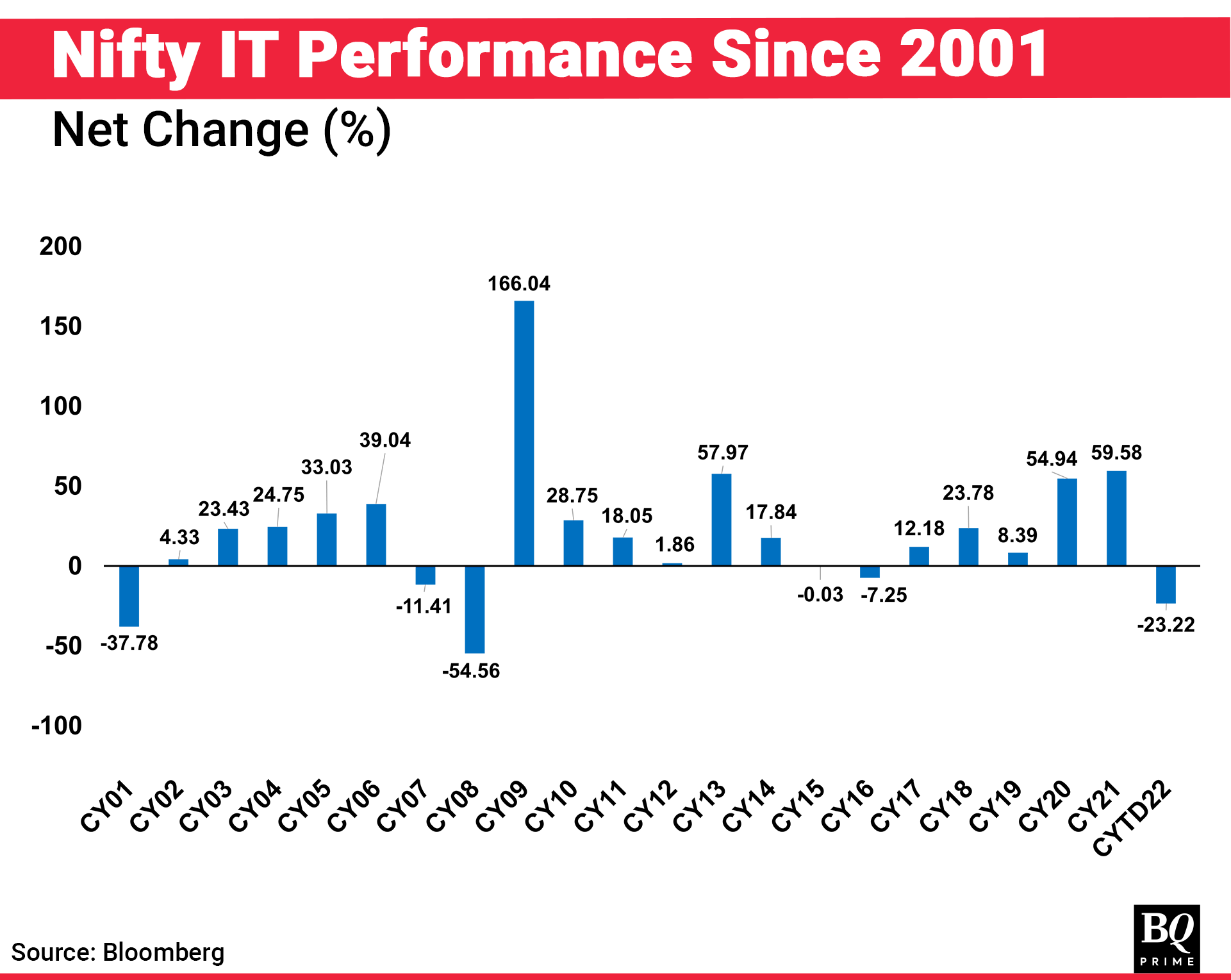
The Nifty IT index has declined as much as 25% so far in 2022—the steepest decline in a calendar year since at least 2008, when the barometer fell 54.56%, according to Bloomberg data. The gauge more than doubled in the pandemic years of 2020 and 2021, underscoring the rush of digital transformation deals amid stay-at-home restrictions.
Then the Russia-Ukraine war started.
The sanctions imposed on Moscow have had a ripple effect in the U.S. and Europe—two of the biggest markets for Indian IT firms—curtailing spending power across the Atlantic. The pandemic momentum was lost in a hurry amid record attrition rates at home. A weaker rupee hasn't been of much help either.
So, what does 2023 look like? It's pretty normal, actually, and that's not a bad thing.
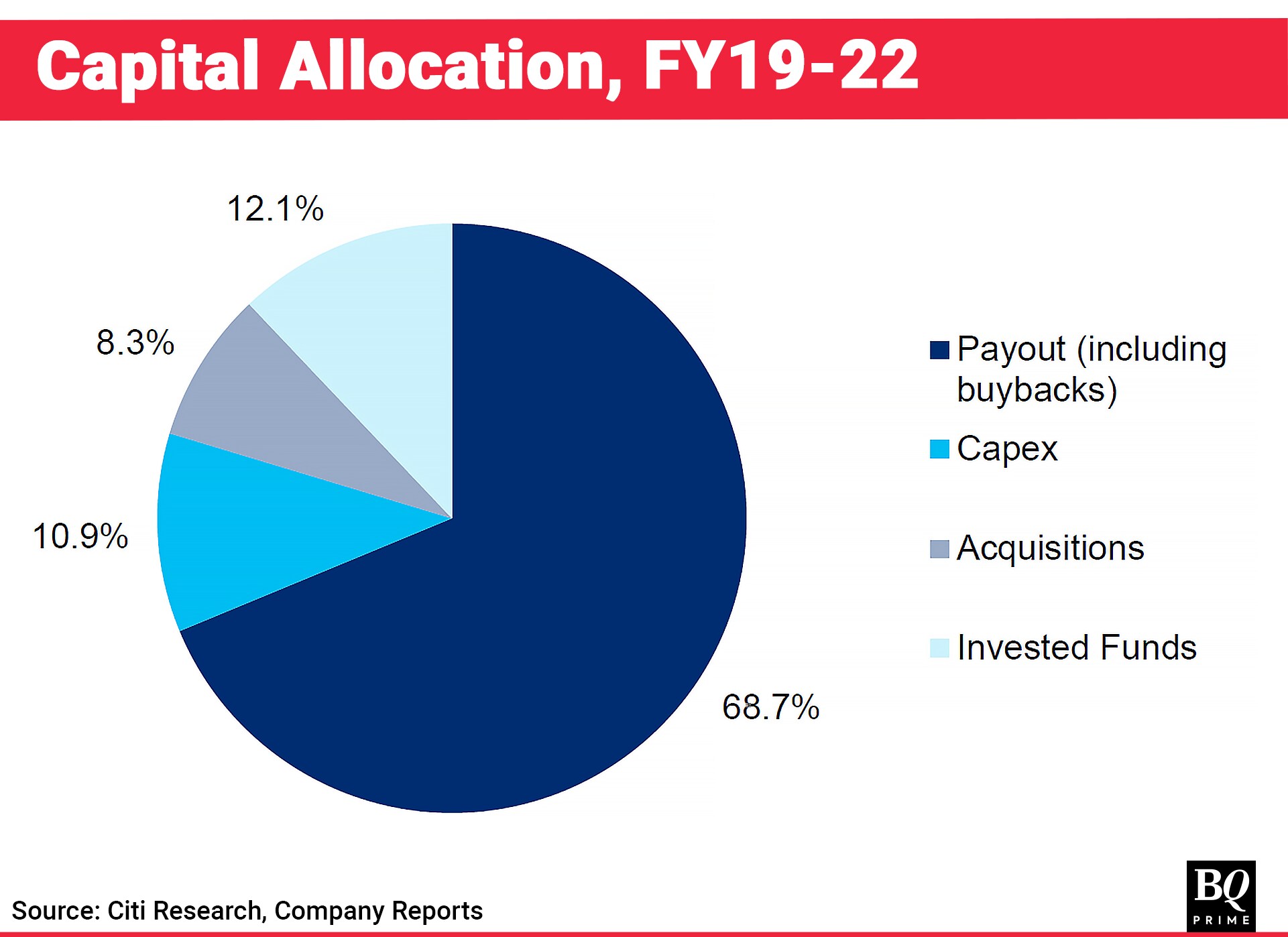
“As revenue growth slows, investor focus will shift back to variables like capital allocation,” Citi Research said in its 'deep dive' on the Indian IT industry. “We expect the pace and magnitude of mergers and acquisitions and sustained payouts—dividends and buybacks—to continue” amid healthy balance sheets and cash generation, the brokerage said.
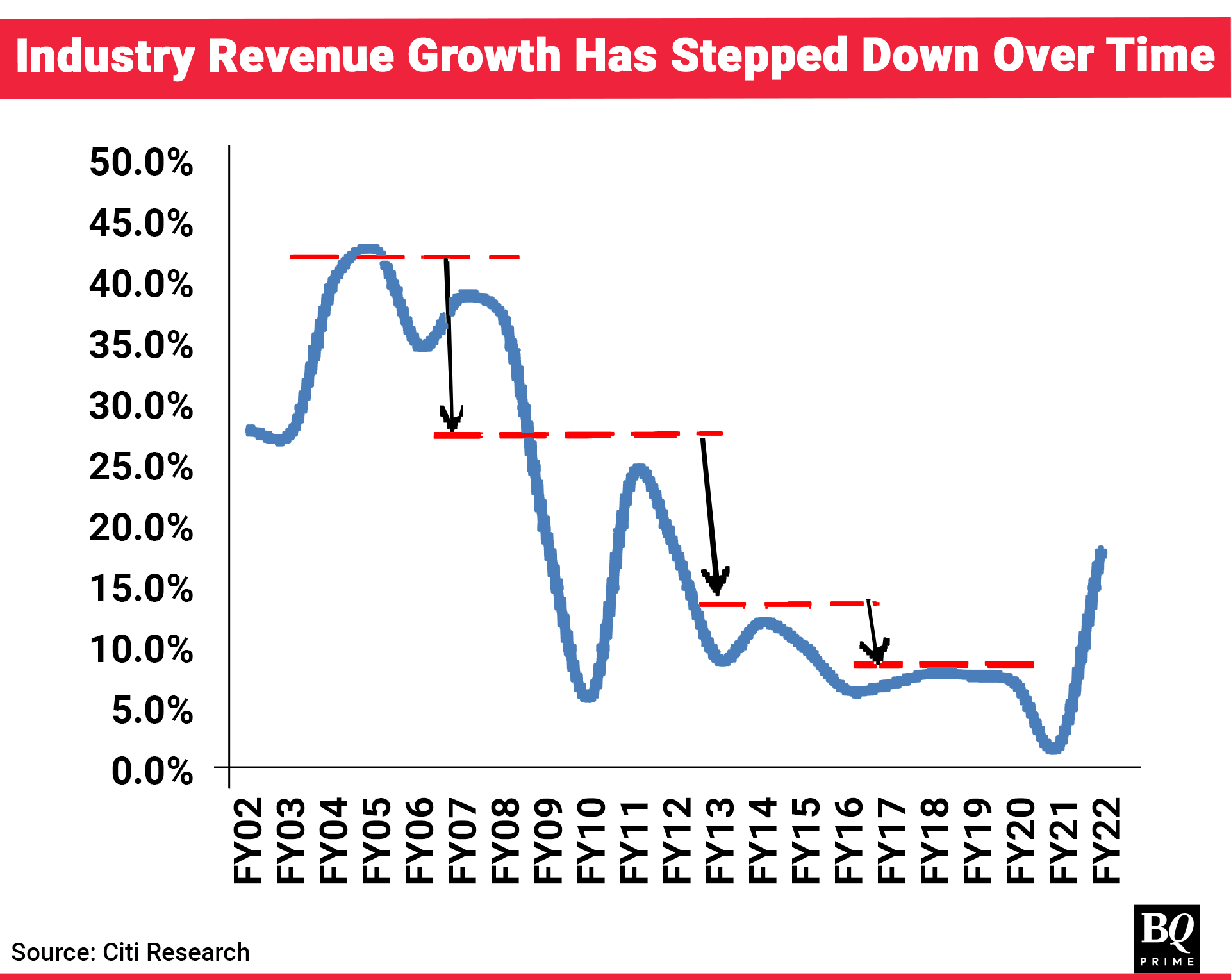
The revenue growth seen during the pandemic was an aberration; the metric has stepped down over time, only to spike in the last couple of years as the pace of digital deals picked up. Going forward, growth beyond the financial year ending March 2023 will likely normalise, Citi said in the report. If a macro slowdown hits, tech spending will be affected, but not in the manner seen in the past.
“Indian IT companies…look reasonably well-placed,” Citi said in the report. “Net-net growth will moderate, but tech spends will not freeze, which is generally the case in uncertain times.”
Cash In Hand
Indian IT companies have seen muted cash flow growth over the years, partly due to slower revenue growth and higher spending on digital and localisation, but cash-flow generation has remained consistent: operational cash flow of the Big 4—Tata Consultancy Services Ltd., Infosys Ltd., Wipro Ltd., and HCL Technologies Ltd.—stood at 80% of Ebitda in FY19 and 78% in FY22. The mid-tier was able to convert 73% of its operating profit into cash in FY19 and 69% in FY22.
“Cash generation across the sector has remained impressive and is likely to continue,” Citi said. This has resulted in healthy balance sheets to fund both acquisitions and payouts.
M&A Deals
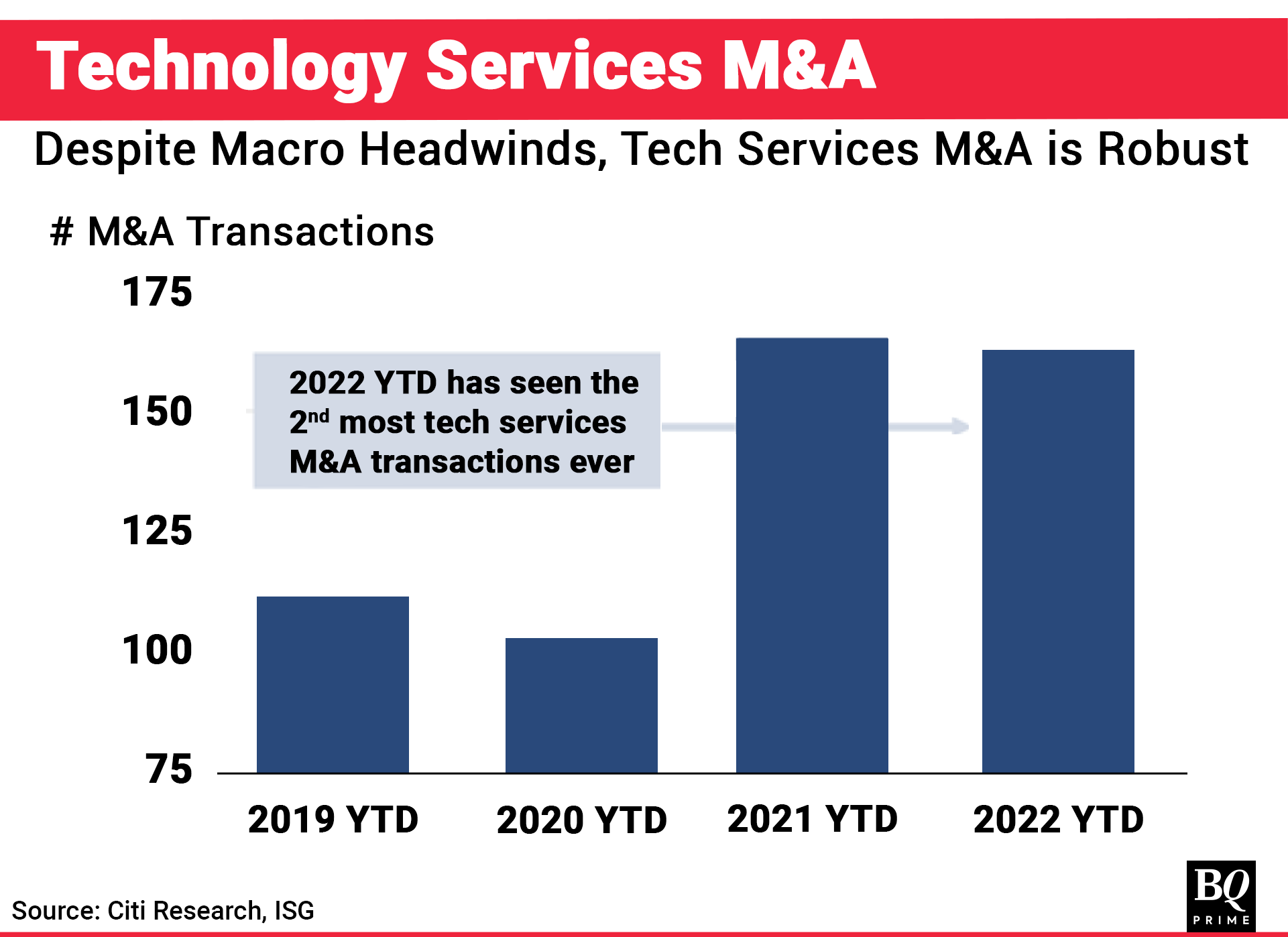
Dealmaking in the technology services sector spiked in 2021 as demand for cloud, data analytics, and cybersecurity solutions surged amid more work from home. While the momentum sustained in 2022 in volume terms, the value of M&A deals nearly halved as companies focused on smaller, tuck-in acquisitions.
“While Indian IT companies have stepped up the pace of mergers and acquisitions, it's still slower than that of global peers,” Citi said in its report. Most of the acquisitions are aimed at filling portfolio gaps—capabilities or geographies—rather than “buying revenue."
Since 2019, Indian IT firms have made only five notable cloud-focused acquisitions—none of them by the 'Big Four'—while Cognizant Technology Solutions Corp. and Accenture Plc have struck 14 such deals. The Indian IT sector acquired seven firms to augment capability over the same time period, compared to nine by Cognizant and Accenture.
Indian IT firms have also deployed little cash toward M&A deals despite healthy reserves.
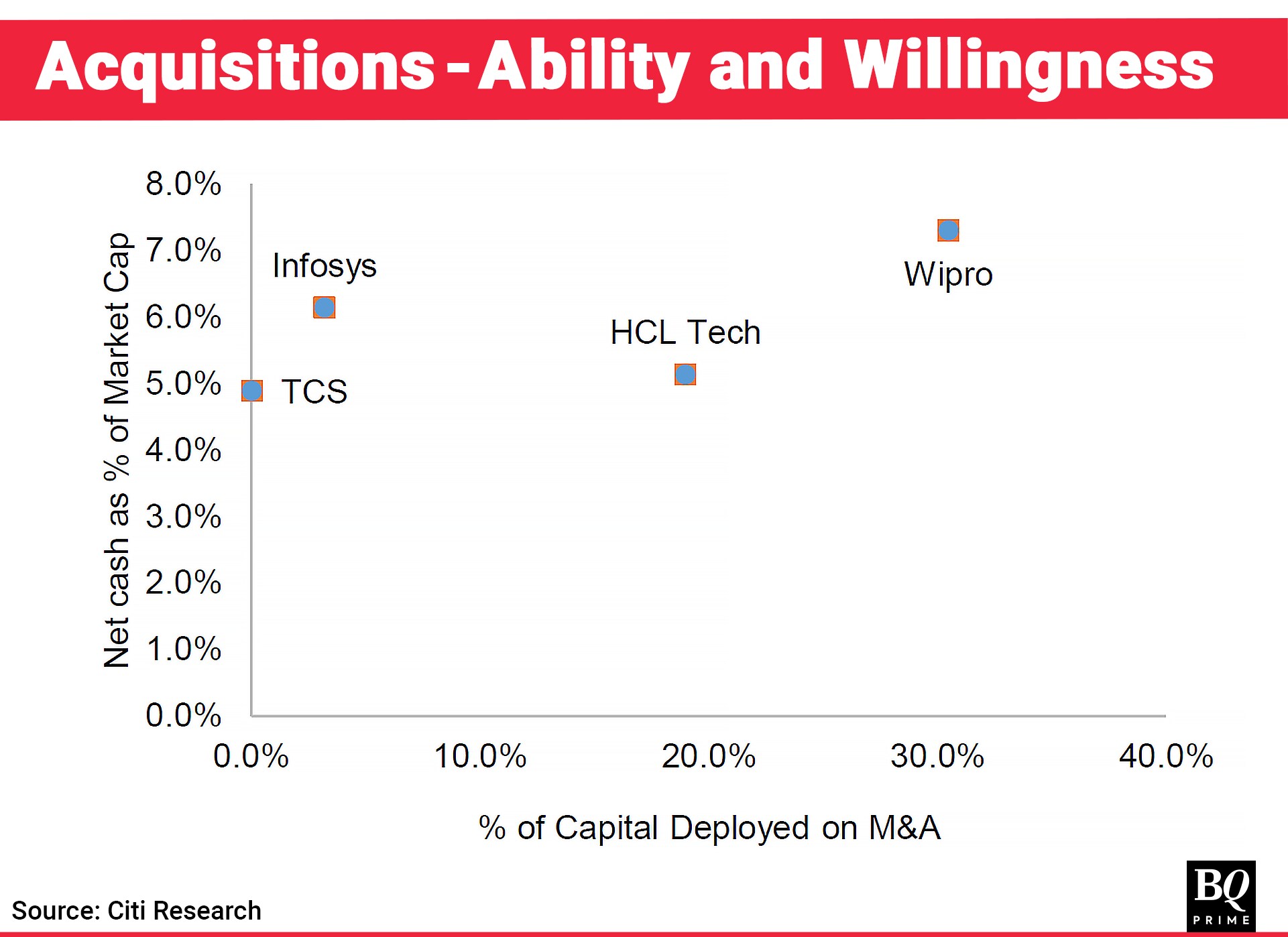
“Going forward, large Indian IT companies are likely to be consolidators,” Citi said in the report. “The ability to acquire is definitely there but different companies have different strategies as far as focus areas are concerned.”
If Blackstone Group's acquisition of Mphasis Ltd. and Baring PE's purchase of Coforge Ltd. and Hexaware Technologies are anything to go by, India's mid-tier IT firms will continue to see private equity interest as they are well-placed on key financial metrics—growth, margins, and cash flows—and are competitive with larger peers in striking cloud deals.
“Going forward, some of these mid-tier companies can see a correction in valuation—that could act as a deterrent for exit,” the Citi report stated. “In that context, we expect PE investors to keep evaluating their options.”
Buybacks & Dividends
While M&A deals are sporadic, dividends and buybacks are more predictable.
Indian IT firms have given sustained returns to their shareholders over the past few years, and that's likely to continue going forward. Infosys recently commenced a Rs 9,300-crore buyback, its fourth in five years, which will continue well into 2023. HCL Technologies has announced a new payout policy wherein it'll return to shareholders at least 75% of net income over five years. Wipro has pegged its payout ratio at 45-50%.
“A few mid-tier companies have the potential to improve their distribution, but it's unlikely to happen soon,” Citi said in the report. “We expect these mid-tier Indian IT companies to maintain their level of payout as their focus will be more on mergers and acquisitions.”
The Valuation Question
While the Nifty IT index has corrected 25% this year, not all of the macro challenges are priced in. The gauge continues to trade at a 15% premium to the benchmark Nifty 50.
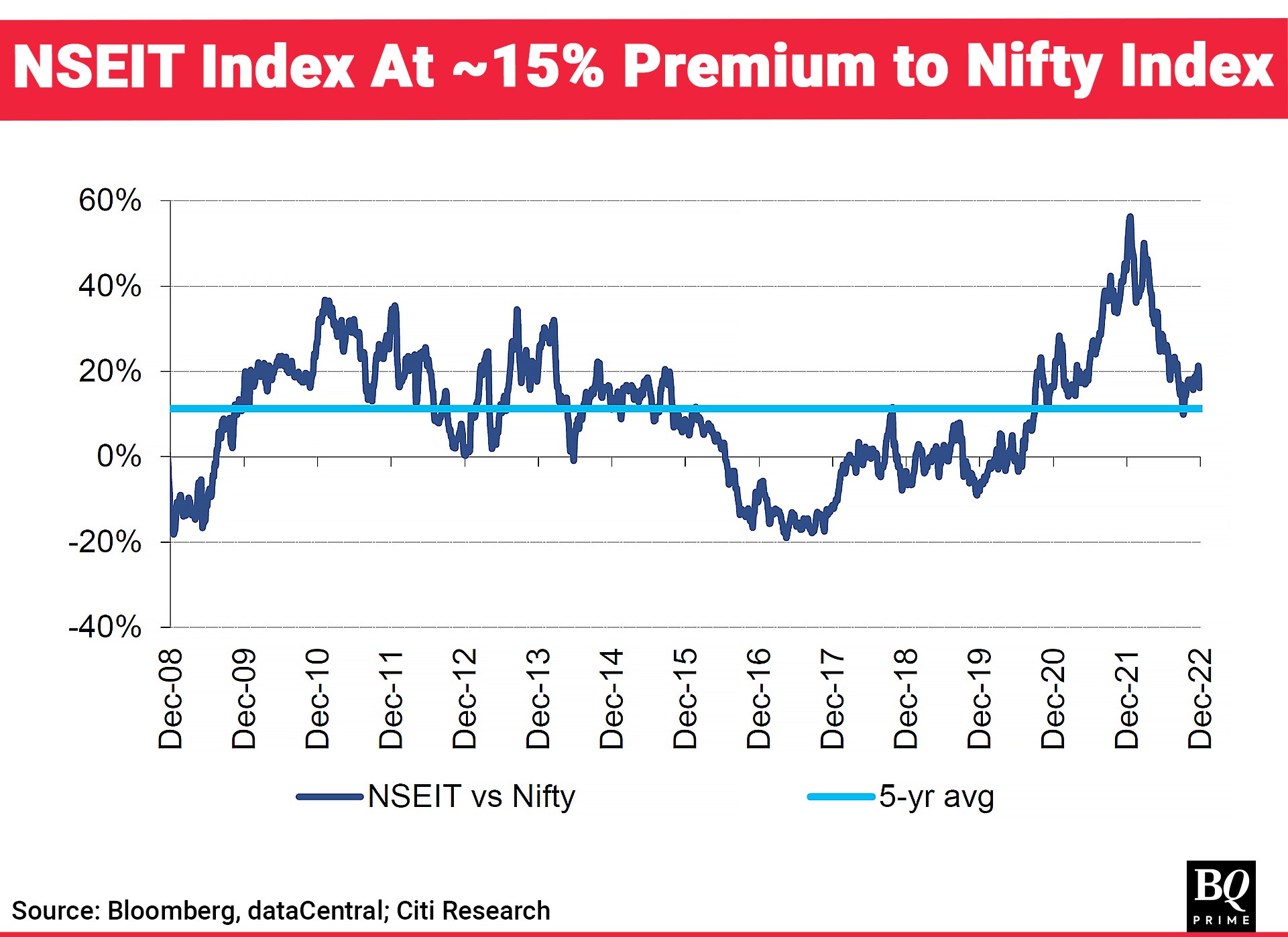
The current valuations in India's IT space are “unsustainable in a worsening US macro scenario,” Credit Suisse said in a note. The market capitalisation of the big four is likely to correct by 10-27%, the brokerage said, narrowing the gap with the next five.
The valuation gap between top-tier and mid-tier IT firms has narrowed to 10% now from 50% at the start of the year, thus partly pricing in the risks, according to Citi Research.
Still, Citi prefers the 'Big Four' over the 'Next Five' in the face of macro headwinds posing a risk to growth. In that cohort, Infosys Ltd. stands out. In fact, the company, which celebrated its 40th anniversary on Wednesday, remains the brokerage's only ‘buy' in the sector.
“Infosys continues to be one of our preferred large cap ideas as we expect the valuation gap with TCS—currently at 8% discount—to narrow on superior revenue growth going ahead.”

-
High US Salaries, No Green Card Certainty: The Financial Calculation Facing Indian H-1B Families

The suspension of PERM processing at eight technology employers does not cancel existing H-1B visas. What it does is force a question many Indian families have been avoiding: is the US salary worth tying your career and family plans to one employer?
-
Swiggy vs Eternal: Food Delivery's Two Rivals Are No Longer In The Same Race
Eternal is building a private AI assistant, dark.ai. Swiggy is still working out how to make Instamart pay, with an operating loss of Rs 895 crore in the July-September quarter while Blinkit stayed profitable.
-
Where You Live Shapes How You Get To Work | The Reason Why
Two-wheelers are the most popular way to get to work in India, accounting for nearly 43% of workplace commutes.
-
Unhedged Position: Can India See An Indonesia-Style Time Correction?
The Nifty is trading below levels it first clocked in 2024. Is there, then, as I have suggested in the headline, potential that the current time correction drags on painfully for the next three-five, even ten years?
-
Navigating Friction And Energy Realities: An Analysis Of Marco Rubio's October Visit To India
Occurring at a critical juncture marked by stalled trade negotiations and escalating geopolitical pressures over global energy supplies, the visit offers a profound window into modern US-India relations.
-
India Exports Capital. Why Not Export Trusteeship?
The big question, then, is whether India can build an institution that global borrowers, investors, banks, and lawyers can trust, even without an Indian connection.
-
France's Economy & Politics Are In Crisis | The Reason Why
Let's look at how the French economy and politics evolved under Nicolas Sarkozy, Franois Hollande and Emmanuel Macron.
-
You May Inherit The Business. You Must Earn Its Credibility.
Succession tests the founder's ability to share authority as much as it tests the next generation's readiness to assume it.
-
Signing Deals Is One Thing; Making Them Work Is Another | The Week In Whys
Sometimes, things don't turn out as planned. Indian companies have lost some bids to rivals, some projects won't produce until 2030.
-
FOMC Wall, PERM Suspension, Hospital Stocks | Talking Points This Week
A PERM suspension would directly affect green-card sponsorship rather than H-1B visas, so the near-term earnings impact could remain relatively limited. The key question is whether this marks a new phase in US scrutiny of Indian IT.









