New Smartphone From InFocus To Support Aadhaar Authentication
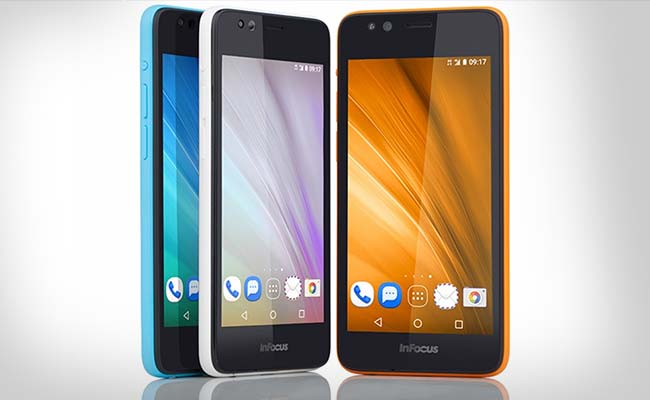
New Delhi: US-based handset maker InFocus will soon launch a new smartphone in India that will support Aadhaar authentication using the iris scanner on the device.
Priced at under Rs 12,000, the device will be made available early next year. InFocus has been awarded STQC (Standardization Testing and Quality Certification) from the Indian government and the company plans to launch more device supporting Aadhaar authentication in the future.
STQC certification authenticates the use of Iris-recognition devices, used for biometric authentication linked under the Aadhaar project.
"InFocus smartphone features IriTech's superior iris image quality assessment and on-board K7 generation algorithm to provide good quality images and avoid false positives while maximising true positive identification rates," InFocus India Country Head Sachin Thapar told PTI.
Apart from UIDAI, IriTech also works with government agencies in the US, Kenya and Columbia.
The smartphone with embedded algorithm can complete an image capture and K7 image generation in less than 2 seconds.
It can capture the iris image under various environments, including under direct sunlight.
"Moreover, the biometric data from the InFocus device gets encrypted by a UIDAI key at the chip level in device, making it impossible for anyone but the Aadhaar server to see the information. Such encryption prevents information leakage of all kinds," he said.
Thapar said there is a great potential in the integration of iris recognition technology in a ubiquitous device like smartphone.
"While the M425 will be made available in the next 2-3 months, we will bring more devices with this technology as we have received the certification," he added.
Currently, Samsung is the only phone maker to have already embedded Delta ID's ActiveIRIS technology in its Galaxy Tab Iris.
Unique Identification Authority of India (UIDAI) has held discussions with handset makers and operating system providers to embed the identification technology onto their devices. The availability of smart devices that are Aadhaar-enabled will help people authenticate their Aadhaar biometrics on the phone itself to avail of various government schemes, subsidies and services.
"The InFocus Aadhaar-enabled iris smartphone is a great example of the innovation possible on the Aadhaar platform. The phone is timely as it can be used for applications like opening instant bank accounts with eKYC and as a cashless microATM for merchant payments. This will accelerate JAM (Jan Dhan-Aadhaar-Mobile) implementation," said Nandan Nilekani, former Chairman of UIDAI.
The M425 is a 4G-VoLTE enabled smartphone, powered by 1.5 GHz quad-core processor. The dual SIM phone features 4.5-inch display, 1GB RAM, 8GB internal memory (expandable up to 64GB) and 2,300mAh battery.
Stating that the device can be used as a secure and reliable biometric solution in various arenas like banking, E-PDS (Electronic Public Distribution System), MNREGA (Mahatma Gandhi National Rural employment Guarantee Act) payments, E-governance services such as passport, taxation, healthcare and education, Thapar said this also represents a huge leap towards facilitating biometric identification.
"It also eliminates use of any separate devices for biometric identification," he added.
(Except for the headline, this story has not been edited by NDTV staff and is published from a syndicated feed.)

-
Where You Live Shapes How You Get To Work | The Reason Why

Two-wheelers are the most popular way to get to work in India, accounting for nearly 43% of workplace commutes.
-
High US Salaries, No Green Card Certainty: The Financial Calculation Facing Indian H-1B Families
The suspension of PERM processing at eight technology employers does not cancel existing H-1B visas. What it does is force a question many Indian families have been avoiding: is the US salary worth tying your career and family plans to one employer?
-
Unhedged Position: Can India See An Indonesia-Style Time Correction?
The Nifty is trading below levels it first clocked in 2024. Is there, then, as I have suggested in the headline, potential that the current time correction drags on painfully for the next three-five, even ten years?
-
Navigating Friction And Energy Realities: An Analysis Of Marco Rubio's October Visit To India
Occurring at a critical juncture marked by stalled trade negotiations and escalating geopolitical pressures over global energy supplies, the visit offers a profound window into modern US-India relations.
-
India Exports Capital. Why Not Export Trusteeship?
The big question, then, is whether India can build an institution that global borrowers, investors, banks, and lawyers can trust, even without an Indian connection.
-
France's Economy & Politics Are In Crisis | The Reason Why
Let's look at how the French economy and politics evolved under Nicolas Sarkozy, Franois Hollande and Emmanuel Macron.
-
You May Inherit The Business. You Must Earn Its Credibility.
Succession tests the founder's ability to share authority as much as it tests the next generation's readiness to assume it.
-
Signing Deals Is One Thing; Making Them Work Is Another | The Week In Whys
Sometimes, things don't turn out as planned. Indian companies have lost some bids to rivals, some projects won't produce until 2030.
-
FOMC Wall, PERM Suspension, Hospital Stocks | Talking Points This Week
A PERM suspension would directly affect green-card sponsorship rather than H-1B visas, so the near-term earnings impact could remain relatively limited. The key question is whether this marks a new phase in US scrutiny of Indian IT.
-
Everything, Everywhere, All At Once: Dalal Street's Week To Forget | Joining The Dots
Visa curbs, a Starlink spat and cancer drug caps: what connects this week's shocks for Indian markets









