New Monetary Policy Committee Members - Factbox
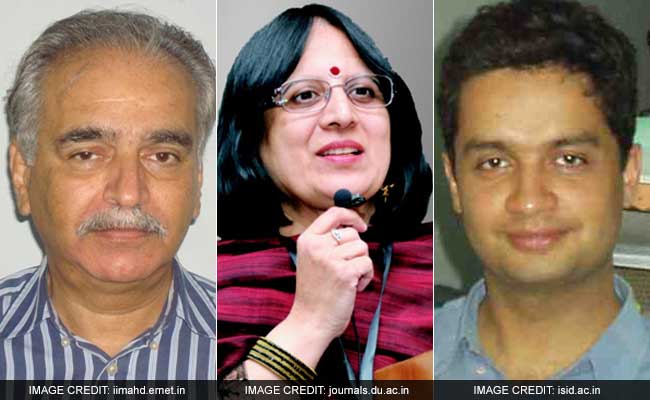
Mumbai: The government on Thursday picked three economists from the academic world for a new monetary policy committee to set interest rates, as the Reserve Bank of India (RBI) gets ready for a landmark switch in the way it decides policy.
The three are Chetan Ghate, a professor at the Indian Statistical Institute, Pami Dua, a director at the Delhi School of Economics, and Ravindra Dholakia, a professor at the Indian Institute of Management in Ahmedabad.
They will join RBI Governor Urjit Patel and two senior officials from the bank's monetary policy department.
Chetan Ghate
Mr Ghate is an associate professor in the planning unit at the Indian Statistical Institute in New Delhi and has taught most of his career, including at Colorado College. He has a PhD from the Claremont Graduate University in California.
He is probably the most familiar to the RBI, as he sits on a five-member technical advisory committee that has provided non-binding advice on interest rates to the RBI governor. But the RBI does not disclose a breakdown of the individual recommendations, making it hard to know his stance.
Mr Ghate was also a member of the panel headed by Patel that in 2014 recommended policy changes, including targeting inflation and establishing a panel to decide rates.
He is well versed on monetary policy, having written research papers on the supply-side impact of inflation. His areas of interest include macroeconomic theory and policy, growth and development, political economy, open economy and macroeconomics.
Mr Ghate won the 2014 Mahalanobis Memorial Gold Medal, given to the best economics researcher in India under the age of 45.
Pami Dua
Ms Dua has been a director at the Delhi School Of Economics since 2013, and was the head of the department of economics of the institute between 2010 and 2014. She is a career-long professor who has taught at the University of Connecticut and Yale and has a PhD from the London School of Economics.
She specialises in macroeconomics and has written several papers on topics including inflation, exchange rates and foreign capital inflows. Her areas of research include time series econometrics, forecasting, macroeconometrics and business cycle analysis.
Ms Dua was on the RBI's committee on data and information management in 2014 and was also previously a member of the technical advisory group on leading indicators at the RBI from 2006 to 2008.
Ravindra Dholakia
Mr Dholakia has been a faculty member at the Indian Institute Of Management, Ahmedabad, since 1985. He has a PhD from the University of Baroda.
He has nearly four decades of experience teaching economics, has been on various government committees and was on assignments at international organisations, including the World Heath Organisation and UNICEF.
Mr Dholakia has been on various government committees including one on restructuring of state-run units appointed by the Gujarat government in 1999-2000 when Prime Minister Narendra Modi was the chief minister.
His areas of interest include policy analysis, international trade, fiscal policy and public debt, economic development and planning on issues such as health, education and labour.
In one of his research papers on unemployment trade-offs in developing countries, Mr Dholakia argued that containing demand side pressures with monetary policy tools was likely to lower the rate of recovery.

-
High US Salaries, No Green Card Certainty: The Financial Calculation Facing Indian H-1B Families

The suspension of PERM processing at eight technology employers does not cancel existing H-1B visas. What it does is force a question many Indian families have been avoiding: is the US salary worth tying your career and family plans to one employer?
-
Swiggy vs Eternal: Food Delivery's Two Rivals Are No Longer In The Same Race
Eternal is building a private AI assistant, dark.ai. Swiggy is still working out how to make Instamart pay, with an operating loss of Rs 895 crore in the July-September quarter while Blinkit stayed profitable.
-
Where You Live Shapes How You Get To Work | The Reason Why
Two-wheelers are the most popular way to get to work in India, accounting for nearly 43% of workplace commutes.
-
Unhedged Position: Can India See An Indonesia-Style Time Correction?
The Nifty is trading below levels it first clocked in 2024. Is there, then, as I have suggested in the headline, potential that the current time correction drags on painfully for the next three-five, even ten years?
-
Navigating Friction And Energy Realities: An Analysis Of Marco Rubio's October Visit To India
Occurring at a critical juncture marked by stalled trade negotiations and escalating geopolitical pressures over global energy supplies, the visit offers a profound window into modern US-India relations.
-
India Exports Capital. Why Not Export Trusteeship?
The big question, then, is whether India can build an institution that global borrowers, investors, banks, and lawyers can trust, even without an Indian connection.
-
France's Economy & Politics Are In Crisis | The Reason Why
Let's look at how the French economy and politics evolved under Nicolas Sarkozy, Franois Hollande and Emmanuel Macron.
-
You May Inherit The Business. You Must Earn Its Credibility.
Succession tests the founder's ability to share authority as much as it tests the next generation's readiness to assume it.
-
Signing Deals Is One Thing; Making Them Work Is Another | The Week In Whys
Sometimes, things don't turn out as planned. Indian companies have lost some bids to rivals, some projects won't produce until 2030.
-
FOMC Wall, PERM Suspension, Hospital Stocks | Talking Points This Week
A PERM suspension would directly affect green-card sponsorship rather than H-1B visas, so the near-term earnings impact could remain relatively limited. The key question is whether this marks a new phase in US scrutiny of Indian IT.









