Nestle's Shocker: Excess Sugar In Baby Food Products In India, Other Asian Countries, Finds Study
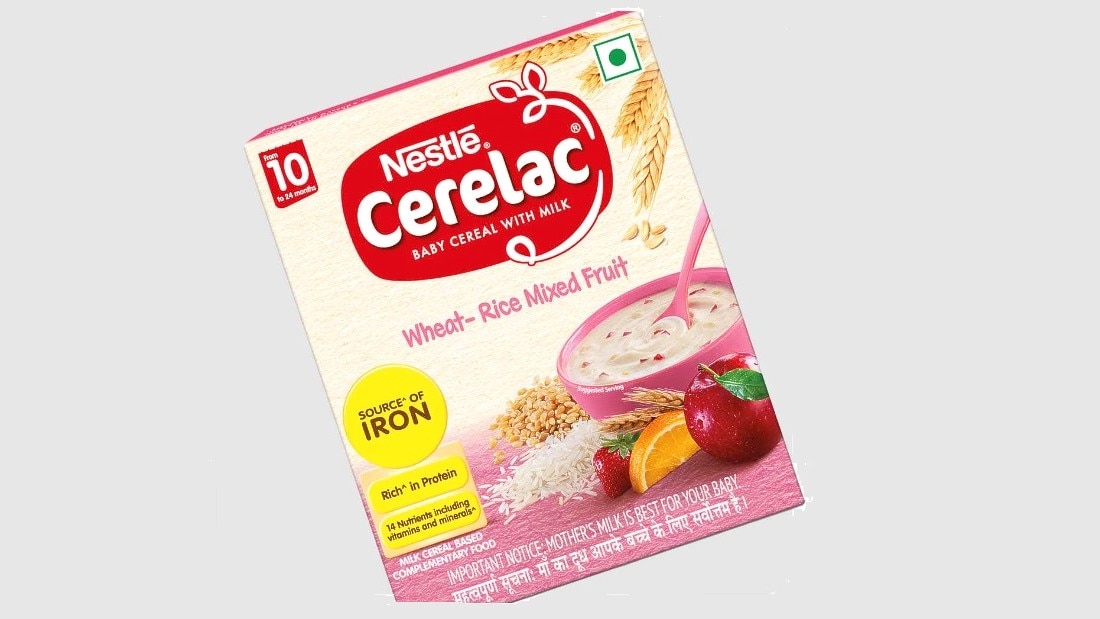
Recent revelations have uncovered that Nestle's Cerelac, a milk cereal-based complementary food for infants, contains excessive sugar, especially in developing countries such as India. This finding is contrary to the guidelines of the World Health Organization, which prohibit added sugar in baby food. The high sugar content in Cerelac raises concerns about compliance with established health standards.
A report by Swiss investigative organisation Public Eye shows that the consumer goods giant has different sugar content for Asian countries when compared to developed markets like US and Europe.
In India, for instance, Cerelac has been found to contain an average of nearly 3 grammes of added sugar per serving.
However, a Nestle India Ltd. spokesperson told NDTV Profit that the company has reduced the total amount of added sugars in its infant cereals portfolio by 30% over the past five years and it continues to "review" and "reformulate" products to reduce them further. "We believe in the nutritional quality of our products for early childhood and prioritise using high-quality ingredients," it said in an emailed statement.
After examining 150 products sold by the multinational in Asia, Africa and Latin America, Public Eye found that almost all the Cerelac infant cereals targeted at babies from six months of age contain added sugar of nearly 4 grammes per serving on average, equal to roughly a sugar cube.

As high as 7.3 grammes of added sugar per serving was detected in a product sold in the Philippines. Another powdered-milk brand, Nido, for young children from one–three years old examined also contains added sugar — almost 2 grammes per serving on average. A product sold in Panama was found to have 5.3 grammes of added sugar for every serving.
However, these products are sold without added sugar in Nestle's main European markets, including the UK, Germany and France.
Biscuit-flavoured cereals for babies aged six months and older contained 6 grammes of added sugar for every serving in Senegal and South Africa, the report found. The same product sold in Switzerland has none, it said.
In Brazil, where Cerelac is known as Mucilon, three-quarters of Cerelac baby cereals contain added sugar, on average 3 grammes per serving.
In its report, written in collaboration with the International Baby Food Action Network, Public Eye alleged that Nestle takes advantage of the weakness in existing regulations to continue selling such products. "There is a double standard here that can't be justified," Nigel Rollins, scientist at the WHO, was quoted as saying by Public Eye in its report.
Globally, Cerelac is the number one baby cereal brand, with sales exceeding $1 billion in 2022, according to Euromonitor International. The highest figures, according to the report, are in low- and middle-income countries, with 40% of sales just in Brazil and India.
Public Eye is petitioning Nestle to discontinue sugar usage in products designed for babies and toddlers under the age of three in every part of the world.

-
High US Salaries, No Green Card Certainty: The Financial Calculation Facing Indian H-1B Families

The suspension of PERM processing at eight technology employers does not cancel existing H-1B visas. What it does is force a question many Indian families have been avoiding: is the US salary worth tying your career and family plans to one employer?
-
Unhedged Position: Can India See An Indonesia-Style Time Correction?
The Nifty is trading below levels it first clocked in 2024. Is there, then, as I have suggested in the headline, potential that the current time correction drags on painfully for the next three-five, even ten years?
-
Navigating Friction And Energy Realities: An Analysis Of Marco Rubio's October Visit To India
Occurring at a critical juncture marked by stalled trade negotiations and escalating geopolitical pressures over global energy supplies, the visit offers a profound window into modern US-India relations.
-
India Exports Capital. Why Not Export Trusteeship?
The big question, then, is whether India can build an institution that global borrowers, investors, banks, and lawyers can trust, even without an Indian connection.
-
France's Economy & Politics Are In Crisis | The Reason Why
Let's look at how the French economy and politics evolved under Nicolas Sarkozy, Franois Hollande and Emmanuel Macron.
-
You May Inherit The Business. You Must Earn Its Credibility.
Succession tests the founder's ability to share authority as much as it tests the next generation's readiness to assume it.
-
Signing Deals Is One Thing; Making Them Work Is Another | The Week In Whys
Sometimes, things don't turn out as planned. Indian companies have lost some bids to rivals, some projects won't produce until 2030.
-
FOMC Wall, PERM Suspension, Hospital Stocks | Talking Points This Week
A PERM suspension would directly affect green-card sponsorship rather than H-1B visas, so the near-term earnings impact could remain relatively limited. The key question is whether this marks a new phase in US scrutiny of Indian IT.
-
Everything, Everywhere, All At Once: Dalal Street's Week To Forget | Joining The Dots
Visa curbs, a Starlink spat and cancer drug caps: what connects this week's shocks for Indian markets
-
India Is Going Abroad For Critical Minerals. But It May Take Years To Pay Off | The Reason Why
Although India's steps are in the right direction, they remain modest compared with India's growing dependence.









