Need To Lower Logistics Costs To Compete Globally: Gadkari
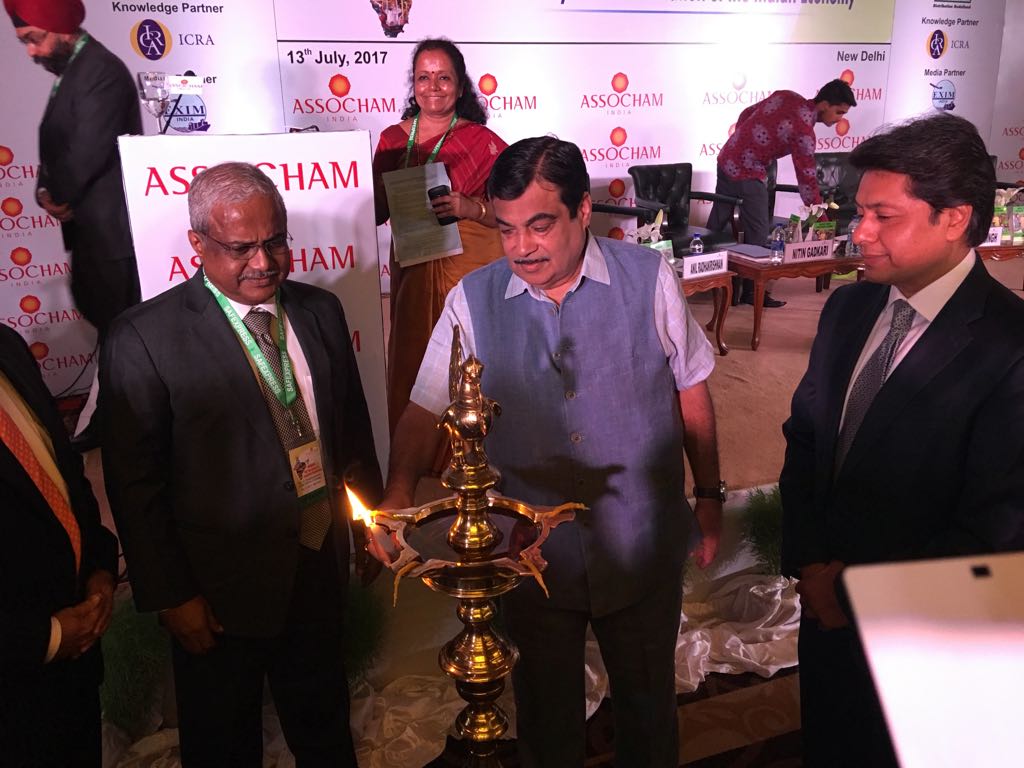
Transport Minister Nitin Gadkari on Thursday stressed the need to reduce infrastructure logistics cost of ports, railways freight and roadways by 4-6 percent to compete in the international market.
“Logistic costs goes from 14-18 percent (of the GDP). Till this cost reduces from 4-6 percent, we cannot compete in international market,” he told reporters on the sidelines of an event organised by industry body ASSOCHAM in New Delhi.
He said all the stakeholders should give priority to waterways, second priority to railways and third to road for transporting goods and passengers, adding that new innovative methods for logistics to reduce the cost should be encouraged.
The minister called upon the industry for optimum utilisation of land of 12 major ports and 200 minor and private ports for logistics under the government's scheme Sagarmala, which is aimed at developing ports.
We are expecting Rs 15 lakh crore capital investment in Sagarmala project. Funds of Rs 1.5 lakh crore have been awarded for port mechanisation and modernisation in the last three years. In 2014-15, the profit from port development was Rs 3,000 crore. In 2015-16, it was Rs 4,000 crore. In this fiscal year (FY17), we saw a profit of Rs 5,000 crore. Now, we are eyeing a profit of Rs 7,000-8,000 crore for FY18.Nitin Gadkari, Transport Minister
The minister also told the industry to give proposals for setting up more dry ports as the government is planning to build a dry port in Maharashtra's Wardha and Charla region. The Ministry of Shipping had also given a proposal to Coal Ministry for transportation of 300 million tonnes coal in Talcher through waterways.
Meanwhile, Adani Logistics Ltd. plans to keep its focus for FY 18 more on end-to-end logistics, i.e., from the port to the consumer's warehouse or factory, Anil Radhakrishnan, chairman and chief executive officer of the company told BloombergQuint on the sidelines of the event.
“We have 10 ports across two zones in the country... Our endeavour is to link our ports and make supply chain more seamless. We bring our cargo to the port and move it to trains to North India and there you can have bonded warehousing. If you look at the entire supply chain, that is where our focus is going to be. This is the segment where we want to play in the coming years,”he said.
On the impact of Good and Services Tax (GST), he said it's too early to gauge it “but the signs we are seeing in the market is really positive because the flow of goods on the transportation side is easing a lot. Impact on warehousing will take some time as that is what we expect with the GST coming in, we need to understand the supply chain well to make warehousing efficient."
Also Read: Railways To Launch First Train With Solar Power-Backed Coaches On July 14

-
Love, Sex Aur Dhokha: The Audacious Plot To Spy On Jensen Huang

A Taipei dinner, a Singapore chip buyer and a suspected Chinese asset: inside the alleged spy operation that got close to NVIDIA's Jensen Huang.
-
Talking Points This Week: Tech Nerves, FII Buying, And A Faraway Banking Shock
The global markets are not shining this Diwali. The exception in the large markets is, India.
-
Midterm Rally Lasted A Day. The Hard Reality Of A Divided US May Last Two Years | Opinion
Between a contested AI boom, a debt ceiling that arrives in 2027 and a president with every incentive to act alone, the next two years may prove more volatile than the first day's rally suggests.
-
Blue Wave Will Derail the AI Trade but Won't Dismantle the AI Era | Unhedged Position
The Democrats' sweep of the US Congress will see politics collide with economic forces both over the long and short term.
-
It's Time To Take The GST Council's Bet On Trust Global
Payment records can prove India's services exports, and clear, proportionate rules can bring foreign digital sellers into the tax net.
-
Opinion | India at 38: From Innovation Overperformer to Innovation Powerhouse
India now has 453 VC-backed deep science startups, 18 of them late-stage, after 117 percent growth since 2020. Laurus Labs, at USD 9.3 billion, is the most valuable deep science company in any middle-income economy outside China.
-
Navigating Energy Crossroads: S Jaishankar's Call For Diversified Supply Chains At G20 Ministerial Meeting
As geopolitical fault lines continue to test maritime trade routes and commodity flows, Jaishankar's message remains pertinent: true economic resilience requires open markets, protected transit lines, and a genuine commitment to multilateral cooperation rather than coercion.
-
Indians Are Travelling, But Not Every Journey Is A Holiday | The Week In Whys
Pilgrims, patients and working women are the real travellers, and the system hasn't quite caught up with them.
-
Getting To Work Costs Women More | The Reason Why
It is not just about women paying more than men. It is about women paying much more in cities than in villages.









