Need To Bring Down Basic Smartphone Price To $30: Google's Sundar Pichai
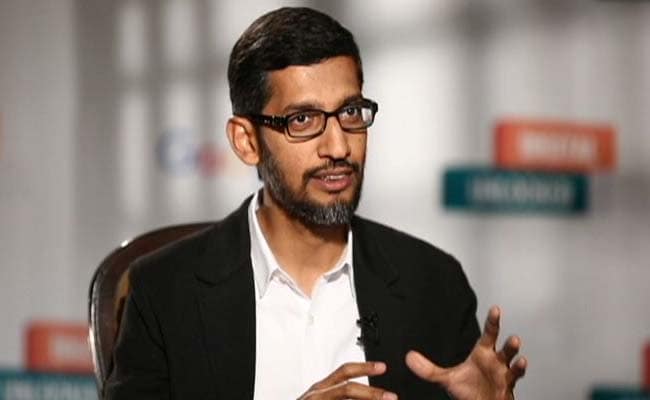
Kharagpur: Google's India-born chief Sundar Pichai on Thursday said the prices of entry-level smartphones in India need to come down further to around $30 to improve access to the Internet and digital services for people.
Mr Pichai, who was speaking at his alma mater IIT-Kharagpur, said the focus is also on areas like local language support and improving connectivity in India as the country becomes a global player in the 'digital economy'.
"I would love to see cheaper smartphones, entry-level smartphones. I think to really we need to bring the prices down even more, maybe at $30 level (about Rs 2,000) for India for entry level smartphones," he said addressing an audience of 3,500 students and teachers.
Read Also: Surprised To Find Young IITians Having IIM In Minds, says Sundar Pichai
In 2014, Google had launched its 'Android One' programme, partnering with handset makers, to launch high-quality, yet affordable Android devices for consumers in emerging markets like India. A few handsets were launched with partners like Micromax, Karbonn and Spice.
The devices launched that time were priced at Rs 6,399 onwards, but since then many more affordable smartphones with better specifications have hit the market.
Currently, there are smartphones available even for sub-Rs 1,000 but most of the aspirational devices are priced above Rs 3,000.
Mr Pichai said the company has also been able to roll out many programmes for Digital India through "effective public-private partnerships".
He cited examples like partnership with RailTel for offering wi-fi services at railway stations and with NPCI for digitising payments.
When asked about by when India would be able to catch up with China on the digital front, Mr Pichai said he is confident that India will be a global player in the digital economy.
"I think I am absolutely, with full certainty, convinced that India will be a global player in the digital economy and it will be competitive with any country in the world in the digital economy. We have all the foundation," he said.
He added that the startups in India, that is building products for India and the world, will ensure that happens.
Stating that connectivity is "extraordinarily important", Mr Pichai said Google is also working on a number of projects like Internet Saathi to educate people on Internet, especially in rural areas, as well as to get them online.
Besides, Google is also working on making its services available in as many local Indian languages as possible.
"English is spoken only by a small segment of the overall population. So just getting Google to work in other languages is a big focus".
"We have made progress today in Android, with search, we support many languages but we want to do all that better so that it works even in rural situations with the right dialects and so on," he said.
(Except for the headline, this story has not been edited by NDTV staff and is published from a syndicated feed.)

-
High US Salaries, No Green Card Certainty: The Financial Calculation Facing Indian H-1B Families

The suspension of PERM processing at eight technology employers does not cancel existing H-1B visas. What it does is force a question many Indian families have been avoiding: is the US salary worth tying your career and family plans to one employer?
-
Swiggy vs Eternal: Food Delivery's Two Rivals Are No Longer In The Same Race
Eternal is building a private AI assistant, dark.ai. Swiggy is still working out how to make Instamart pay, with an operating loss of Rs 895 crore in the July-September quarter while Blinkit stayed profitable.
-
Where You Live Shapes How You Get To Work | The Reason Why
Two-wheelers are the most popular way to get to work in India, accounting for nearly 43% of workplace commutes.
-
Unhedged Position: Can India See An Indonesia-Style Time Correction?
The Nifty is trading below levels it first clocked in 2024. Is there, then, as I have suggested in the headline, potential that the current time correction drags on painfully for the next three-five, even ten years?
-
Navigating Friction And Energy Realities: An Analysis Of Marco Rubio's October Visit To India
Occurring at a critical juncture marked by stalled trade negotiations and escalating geopolitical pressures over global energy supplies, the visit offers a profound window into modern US-India relations.
-
India Exports Capital. Why Not Export Trusteeship?
The big question, then, is whether India can build an institution that global borrowers, investors, banks, and lawyers can trust, even without an Indian connection.
-
France's Economy & Politics Are In Crisis | The Reason Why
Let's look at how the French economy and politics evolved under Nicolas Sarkozy, Franois Hollande and Emmanuel Macron.
-
You May Inherit The Business. You Must Earn Its Credibility.
Succession tests the founder's ability to share authority as much as it tests the next generation's readiness to assume it.
-
Signing Deals Is One Thing; Making Them Work Is Another | The Week In Whys
Sometimes, things don't turn out as planned. Indian companies have lost some bids to rivals, some projects won't produce until 2030.
-
FOMC Wall, PERM Suspension, Hospital Stocks | Talking Points This Week
A PERM suspension would directly affect green-card sponsorship rather than H-1B visas, so the near-term earnings impact could remain relatively limited. The key question is whether this marks a new phase in US scrutiny of Indian IT.









