GST Council-Like Federal Body Needed In Healthcare, Farm Sectors, Says Jaitley
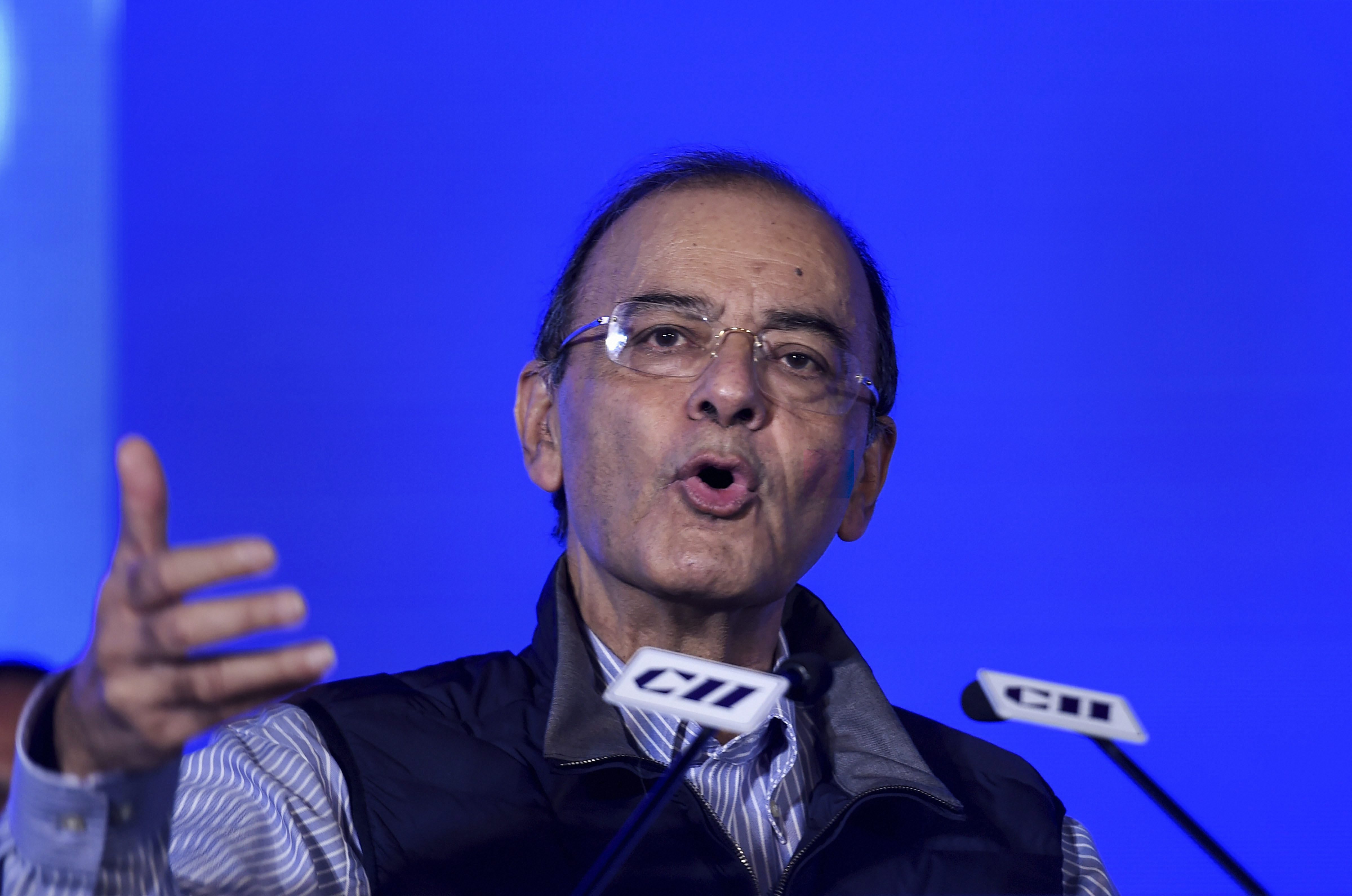
Finance Minister Arun Jaitley on Thursday made a case for developing a federal institution like the Goods and Service Tax Council in the healthcare and farm sectors.
He hoped that such a federal body in healthcare sector should face least resistance from states, since the welfare schemes would be implemented through the states, with Centre only coordinating it.
"The federal institution experiment of the GST having succeeded..There are two other sectors which eminently require federal institutions of this kind.”
"The GST was constitutionally provided for,” Jaitley said while addressing the CII Health Summit. “Those areas are not constitutionally provided for, but political maturity can impose on governments to try that experiment. One is healthcare and one is agriculture."
Listing out the necessity for setting up such a federal body, he said the states and Centre both spend on healthcare and have their respective schemes. The minister, however, did not elaborate on the details of benefits which may accrue to the farm sector.
Jaitley said the states have their hospitals and the Centre is also establishing institutes of eminence across the country. The Centre has implemented Ayushman Bharat and states also have similar schemes, he said.
"All these need to be merged so that the benefit of these merged resources benefit patient population of the country. Obviously it will be implemented through the states, with Centre coordinating it.”
"And if you have a federal institution, ultimately this is not a turf issue if my scheme is better than your scheme. It is essentially a welfare issue, whether the patients in my state are better than the patients in other states. Whether they have more facilities. Every state would stand to benefit if this coordination with such a federal institution actually came up between the Centre and states," Jaitley added.
"We have had 31 meeting and taken several decisions, all unanimously. So common tax system came up, merging central and state tax by virtue of a federal body which was coordinating it. That's India's first experiment by creating a federal institution.
"Healthcare is an area where there would be least resistance (for a federal institution), because it's a welfare-targeted programmes where we can move significantly a long way in making sure India remains healthier," he said.
Recalling the roll out of healthcare scheme Ayushman Bharat, Jaitley said when the scheme was being conceptualised, there were discussions on whether it will succeed, how will private sector hospital treat patients, how will the queues and footfalls at hospitals be handled.
Prime Minister Narendra Modi in September launched the Ayushman Bharat—Pradhan Mantri Jan Aarogya Yojana which aims to provide a coverage of Rs 5 lakh per family annually, benefiting more than 10.74 crore poor families for secondary and tertiary care hospitalisation through a network of empanelled health care providers.
"I foresee in next three-four years, this figure exponentially increasing as the campaign would be picking up so that the awareness that such a facility is available and this would lead to a far greater realisation and patients going to these institutions and institutions also improving in terms of expertise," Jaitley said.

-
High US Salaries, No Green Card Certainty: The Financial Calculation Facing Indian H-1B Families

The suspension of PERM processing at eight technology employers does not cancel existing H-1B visas. What it does is force a question many Indian families have been avoiding: is the US salary worth tying your career and family plans to one employer?
-
Unhedged Position: Can India See An Indonesia-Style Time Correction?
The Nifty is trading below levels it first clocked in 2024. Is there, then, as I have suggested in the headline, potential that the current time correction drags on painfully for the next three-five, even ten years?
-
Navigating Friction And Energy Realities: An Analysis Of Marco Rubio's October Visit To India
Occurring at a critical juncture marked by stalled trade negotiations and escalating geopolitical pressures over global energy supplies, the visit offers a profound window into modern US-India relations.
-
India Exports Capital. Why Not Export Trusteeship?
The big question, then, is whether India can build an institution that global borrowers, investors, banks, and lawyers can trust, even without an Indian connection.
-
France's Economy & Politics Are In Crisis | The Reason Why
Let's look at how the French economy and politics evolved under Nicolas Sarkozy, Franois Hollande and Emmanuel Macron.
-
You May Inherit The Business. You Must Earn Its Credibility.
Succession tests the founder's ability to share authority as much as it tests the next generation's readiness to assume it.
-
Signing Deals Is One Thing; Making Them Work Is Another | The Week In Whys
Sometimes, things don't turn out as planned. Indian companies have lost some bids to rivals, some projects won't produce until 2030.
-
FOMC Wall, PERM Suspension, Hospital Stocks | Talking Points This Week
A PERM suspension would directly affect green-card sponsorship rather than H-1B visas, so the near-term earnings impact could remain relatively limited. The key question is whether this marks a new phase in US scrutiny of Indian IT.
-
Everything, Everywhere, All At Once: Dalal Street's Week To Forget | Joining The Dots
Visa curbs, a Starlink spat and cancer drug caps: what connects this week's shocks for Indian markets
-
India Is Going Abroad For Critical Minerals. But It May Take Years To Pay Off | The Reason Why
Although India's steps are in the right direction, they remain modest compared with India's growing dependence.









