Narendra Modi on Course for Election Victory, Exit Polls Show
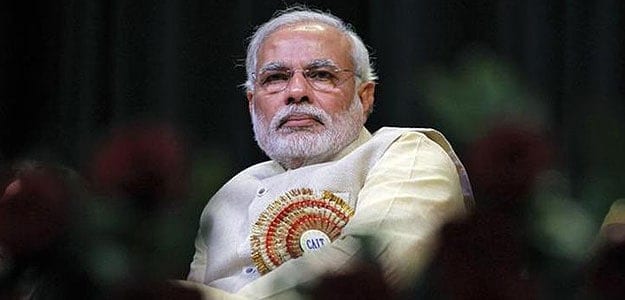
The BJP's Narendra Modi is set to become India's next Prime Minister, exit polls showed on Monday, with his Opposition party and its allies forecast to sweep to a parliamentary majority.
Indian elections are notoriously hard to call, however. Pre-election opinion polls and post-voting exit polls both have a patchy record.
Research group C-Voter predicted 289 seats for the National Democratic Alliance headed by the BJP, with just 101 seats for the alliance led by the Congress party - which would be the ruling party's worst ever result.
C-Voter said its poll was based on a sample of 166,901 randomly selected respondents in all 543 seats up for election. The pollster said its margin of error is +\-3 percent at a national level.
Another poll, by Cicero for the India Today group, showed the NDA hitting between 261 and 283 seats. A majority of 272 is needed to form a government, although that is often achieved with outside support from regional parties.
Several national exit polls over-estimated the BJP's seat share in the last two general elections in 2004 and 2009. The ruling Congress party went on to form coalition governments on both occasions.
"We will only know if this 'Modi wave' has really happened after the election results," said Praveen Rai, a political analyst at the Delhi-based Centre for the Study of Developing Societies (CSDS), who published a report on exit polls last month. "It still might be more of a media wave, a manufactured wave."
Uttar Pradesh, India's most populous state and a crucial political battleground, is particularly tricky for pollsters to forecast because it is a caste-sensitive state where some voters are afraid to speak frankly about who they chose, Mr Rai said.
Should Mr Modi fall short of a majority when the results come in on May 16, he will need to strike a coalition deal with regional parties.
Mr Modi, has electrified the lengthy contest with a media-savvy campaign that has hinged on vows to kickstart the economy and create jobs.
Yet much depends on the BJP winning enough seats to form a stable government that will allow him to push through his promised reforms.
Copyright @ Thomson Reuters 2014

-
High US Salaries, No Green Card Certainty: The Financial Calculation Facing Indian H-1B Families

The suspension of PERM processing at eight technology employers does not cancel existing H-1B visas. What it does is force a question many Indian families have been avoiding: is the US salary worth tying your career and family plans to one employer?
-
Unhedged Position: Can India See An Indonesia-Style Time Correction?
The Nifty is trading below levels it first clocked in 2024. Is there, then, as I have suggested in the headline, potential that the current time correction drags on painfully for the next three-five, even ten years?
-
Navigating Friction And Energy Realities: An Analysis Of Marco Rubio's October Visit To India
Occurring at a critical juncture marked by stalled trade negotiations and escalating geopolitical pressures over global energy supplies, the visit offers a profound window into modern US-India relations.
-
India Exports Capital. Why Not Export Trusteeship?
The big question, then, is whether India can build an institution that global borrowers, investors, banks, and lawyers can trust, even without an Indian connection.
-
France's Economy & Politics Are In Crisis | The Reason Why
Let's look at how the French economy and politics evolved under Nicolas Sarkozy, Franois Hollande and Emmanuel Macron.
-
You May Inherit The Business. You Must Earn Its Credibility.
Succession tests the founder's ability to share authority as much as it tests the next generation's readiness to assume it.
-
Signing Deals Is One Thing; Making Them Work Is Another | The Week In Whys
Sometimes, things don't turn out as planned. Indian companies have lost some bids to rivals, some projects won't produce until 2030.
-
FOMC Wall, PERM Suspension, Hospital Stocks | Talking Points This Week
A PERM suspension would directly affect green-card sponsorship rather than H-1B visas, so the near-term earnings impact could remain relatively limited. The key question is whether this marks a new phase in US scrutiny of Indian IT.
-
Everything, Everywhere, All At Once: Dalal Street's Week To Forget | Joining The Dots
Visa curbs, a Starlink spat and cancer drug caps: what connects this week's shocks for Indian markets
-
India Is Going Abroad For Critical Minerals. But It May Take Years To Pay Off | The Reason Why
Although India's steps are in the right direction, they remain modest compared with India's growing dependence.









