NAFTA 2.0 Negotiations: Nasty And False Trumpeting Again
When international trade negotiations drag on past one deadline after another, trade negotiators are fond of saying “substance should drive timing.” They mean that talks should continue until a mutually agreeable outcome is reached. This adage presumes that style—the way in which one negotiating country treats another—facilitates the outcome.
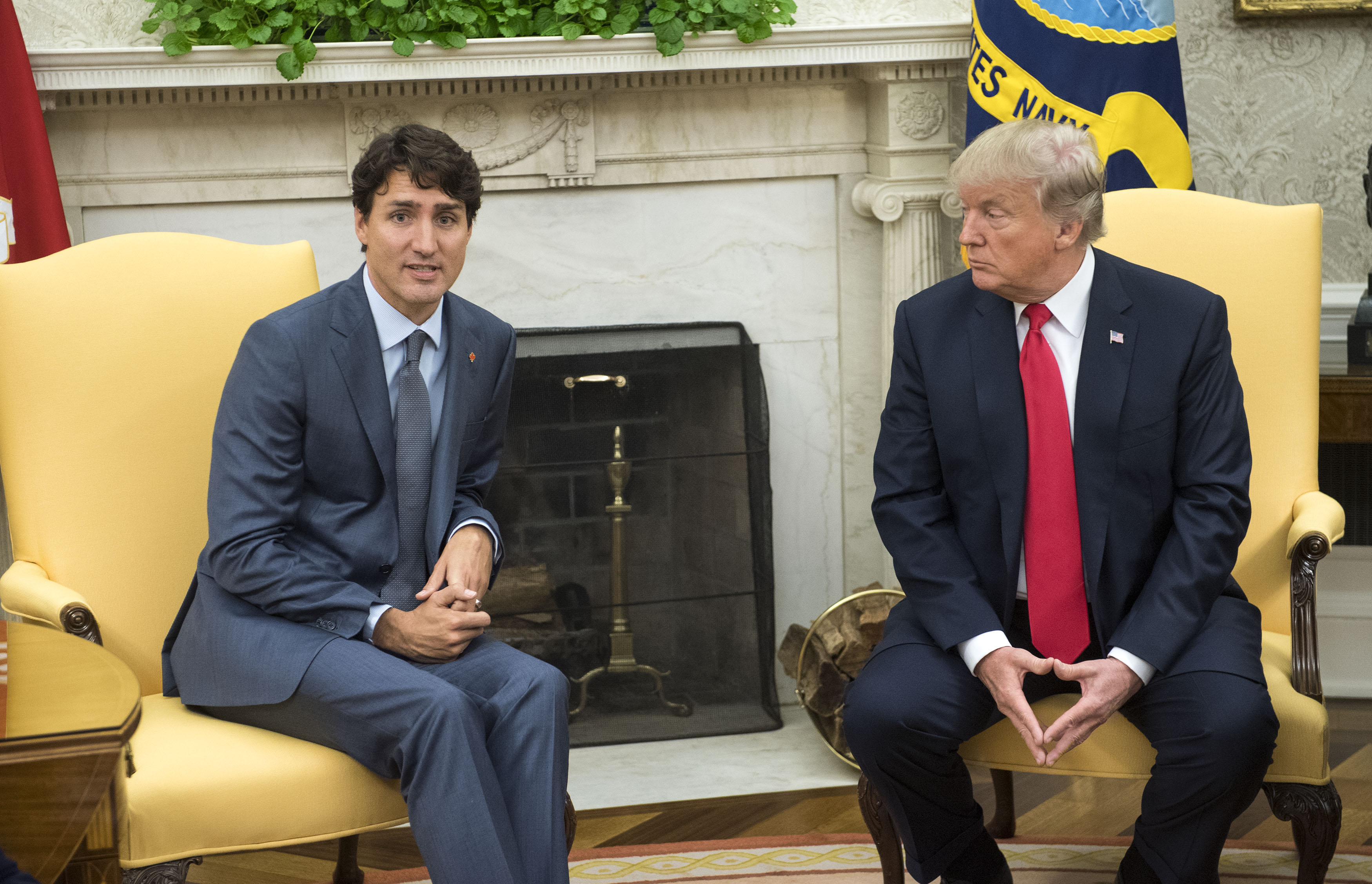
Thanks to America's Nasty And False Trumpeting Again style, that presumption is wrong with respect to negotiations on a new North American Free Trade Agreement, NAFTA 2.0. America and Mexico reached an agreement in principle on Aug. 27. Canada has not signed on. Negotiations between America and Canada continue, with neither side budging.

Four Reasons To Care
The NAFTA 2.0 saga is not just a two-country story. Four reasons suggest the negotiations should matter far beyond the U.S. and Canada.
1. Imperial Decline
Politically, if America cannot hold together its home region in a free trade agreement that has been in operation since Jan. 1, 1994, then perhaps the theorists of American imperial decline are correct.
NAFTA accounts for 21 percent of world GDP, so it's bigger than the European Union's 19 percent and is close to the nowhere-near-completed Regional Comprehensive Economic Partnership.
Now, the U.S. struggles to capture the imagination of Canada and Mexico, thanks to its January 2017 withdrawal from the Trans-Pacific Partnership, which was converted to an 11-member Comprehensive and Progressive Agreement for Trans-Pacific Partnership without America. Canada and Mexico also inked free trade agreements with the EU, whereas the U.S. let atrophy its Trans-Atlantic Trade and Investment Partnership talks.

2. Supply Chain Configurations
With Canada and Mexico as rising global economic powers in North America, businesses are reconsidering their current and anticipated future supply chains on that continent. While they hope for a NAFTA 2.0 grand bargain, they sense that expansion might be more prudent in Canada and Mexico, to take advantage of CPTPP and the EU FTAs.
Why sink billions of dollars in a U.S. plant expecting duty-free, quota-free access of its output into Mexico when the proposed U.S.-Mexico bilateral FTA calls for a sunset clause that could cut the payback time on long-term investments by nearly a decade?

3. Self-Defeating Style!
The interplay of style and substance is the third reason to care about trilateralising the U.S.-Mexico bilateral agreement. Nastiness and falsehoods undermine the objective of sensibly overhauling NAFTA 1.0. They take NAFTA from being a pact between The Three Amigos, to one with America as Iago.
If this self-defeating style persists, then India should steer clear of FTA talks with America and follow Canada and Mexico into arrangements with CPTPP and the EU.
The President said any deal with Canada would be “totally on our terms,” accused Canada of “decades of abuse,” and threatened Canada with “ruination” by imposing auto tariffs.
Hmm. Canada is not a vassal state, nor is it an aggressive one.
The United States Trade Representative boasted the bilateral deal with Mexico was better than TPP.
 @ChileMFA/Twitter) ">
4. Toward A Doable Deal
The fourth reason to care about the NAFTA 2.0 saga follows from the third one. If the Trump Administration modifies its style, then a substantive outcome is eminently and quickly achievable.
Succinctly put, here is what that outcome could be: maintenance of dispute settlement panels and cultural industry protections, on the one hand, in exchange for dairy, steel, and aluminium empathy, on the other.
Consider the straightforward trade-offs.
On the one hand…
In NAFTA 1.0, the U.S. championed the inclusion of panels to resolve anti-dumping and countervailing duty disputes, bringing in a provision from the 1989 FTA with Canada to offer an alternative to Mexican courts.
Fast forward a quarter century: the U.S. wants to eliminate the panel system, because since 1994, it lost a few controversial cases to Canada.

NAFTA 1.0 also had cultural industry protections to ensure a space for its Francophone and indigenous peoples' cultural expressions against encroachments from American media corporations. With its other policies for cultural preservation flattened, Canada's desire to keep that exemption in NAFTA 2.0 is logical.
On the other hand…
The President blusters that what Canada has “done to our dairy farm workers is a disgrace,” and “dairy farmers in Wisconsin and upstate New York… are getting killed by NAFTA.”
What he is not saying is that every trading nation has sensitive sectors, including America. Canada's Supply Management System covers five sensitivities. During TPP negotiations, Canada agreed to liberalise the SMS by granting managed-trade access to the other parties for dairy products, table and broiler hatching eggs, chicken, and turkey. Canada's concession came after relentless pressure not only from the U.S. but also the world's third biggest dairy exporter, New Zealand.

When, in January 2017, Trump pulled America out of TPP, roughly 60 percent of the GDP of the original TPP market was lost. Canadian farm sectors asked why Canada should continue to grant the same concessions in CPTPP to fewer parties when there was less in return?
The answer was that if each CPTPP party withdrew one or more previous concessions, the entire FTA covering 14 percent of world GDP would unravel.
So they kept the concessions in place. Moreover, Canada appreciated that among the TPP 11, Japan, Vietnam, and Malaysia are large markets, not only for Canadian farm products but industrial goods and services, too.
That answer does not satisfy the Trump Administration in NAFTA 2.0 negotiations. It demands SMS concessions from Canada that were at least as good as those Canada preserved from TPP into CPTPP for the remaining parties. And, the Trump Administration also seeks the same concessions from Canada on cheese as Canada had granted to the EU in the Comprehensive Economic Trade Agreement.
Ending The Tamasha
With a friendlier, truer style, the Trump Administration can end the NAFTA 2.0 tamasha (disturbance, spectacle), and position itself alongside Canada to agree to obvious substantive trade-offs.
The U.S. can appreciate Canada cannot reasonably be expected to concede TPP Plus or CETA Plus treatment in its SMS sectors. The other 10 CPTPP parties and EU would line up quickly in Ottawa to restore parity with the U.S. The U.S. also can see that killing an AD-CVD panel system after losing a few cases is the stuff of dictatorial, rule-of-man regimes, not democratic, rule-of-law champions.
Conversely, Canada can drop its preferential classification system for ultra-filtered milk that impedes access for American exports in this fast-growing specialty market. And, it can concede a quota cap on steel and aluminium exports, as Argentina, Australia, Brazil, and South Korea did this spring, following America's Section 232 action, typically calculated as a percentage of average annual shipments to the U.S. in 2015-17. Canada also can embrace a mechanism to review and/or improve the dispute settlement panel system.
Canada can do all this from a position of strength, because it, not the U.S., holds the trump card.
Congress will not pass NAFTA 2.0 as a bilateral FTA with Mexico. No Canada, no NAFTA 2.0.
Roosevelt And Campobello
No Canada was unthinkable when Franklin Roosevelt was in office from 1933 to 1945. He and his family summered regularly in Canada, at Campobello Island, on which they owned a home. FDR enjoyed excellent relations with Canadian Prime Minister Mackenzie King, and the two concluded a trade agreement in 1936. Connected to the American mainland by the Roosevelt Bridge, visitors can enjoy the gorgeous, well-preserved estate nestled in the Roosevelt Campobello International Park, the world's only park maintained jointly by two governments, and read FDR's words:

And, visitors can contemplate whether the domineering nastiness and falsehoods from one side in NAFTA 2.0 negotiations will put an end to “forever.”
Raj Bhala is the inaugural Brenneisen Distinguished Professor, The University of Kansas, School of Law, and Senior Advisor to Dentons U.S. LLP. The views expressed here are his and do not necessarily represent the views of the State of Kansas or University, or Dentons or any of its clients, and do not constitute legal advice.
The views expressed here are those of the author's and do not necessarily represent the views of BloombergQuint or its editorial team.

-
Talking Points This Week: Tech Nerves, FII Buying, And A Faraway Banking Shock

The global markets are not shining this Diwali. The exception in the large markets is, India.
-
Midterm Rally Lasted A Day. The Hard Reality Of A Divided US May Last Two Years | Opinion
Between a contested AI boom, a debt ceiling that arrives in 2027 and a president with every incentive to act alone, the next two years may prove more volatile than the first day's rally suggests.
-
Blue Wave Will Derail the AI Trade but Won't Dismantle the AI Era | Unhedged Position
The Democrats' sweep of the US Congress will see politics collide with economic forces both over the long and short term.
-
It's Time To Take The GST Council's Bet On Trust Global
Payment records can prove India's services exports, and clear, proportionate rules can bring foreign digital sellers into the tax net.
-
Opinion | India at 38: From Innovation Overperformer to Innovation Powerhouse
India now has 453 VC-backed deep science startups, 18 of them late-stage, after 117 percent growth since 2020. Laurus Labs, at USD 9.3 billion, is the most valuable deep science company in any middle-income economy outside China.
-
Navigating Energy Crossroads: S Jaishankar's Call For Diversified Supply Chains At G20 Ministerial Meeting
As geopolitical fault lines continue to test maritime trade routes and commodity flows, Jaishankar's message remains pertinent: true economic resilience requires open markets, protected transit lines, and a genuine commitment to multilateral cooperation rather than coercion.
-
Indians Are Travelling, But Not Every Journey Is A Holiday | The Week In Whys
Pilgrims, patients and working women are the real travellers, and the system hasn't quite caught up with them.
-
Getting To Work Costs Women More | The Reason Why
It is not just about women paying more than men. It is about women paying much more in cities than in villages.
-
AI Bias In Investing Cannot Be Eliminated, But It Can Be Governed
Framing is a particularly important example as identical financial information presented in terms of gains rather than losses can lead an LLM to reach a different assessment.









