Mystery Whales Baffle Gold Market After Central Bank Purchases
(Bloomberg) -- A normally dry research report jolted the gold market this week, when it pointed to massive but so far unidentified sovereign buyers.
Central banks bought 399 tons of bullion in the third quarter, almost double the previous record, according to the World Gold Council. Just under a quarter went to publicly identified institutions, stoking speculation about mystery buyers.
While most central banks inform the International Monetary Fund when they buy gold to supplement their foreign exchange coffers, others are more secretive. Few have the capacity to undertake the third-quarter buying spree, enough to soften the blow from investors selling bullion as the Federal Reserve hiked interest rates.
“With that weight of selling, I was a bit surprised gold wasn't weaker,” said Ross Norman, chief executive officer of Metals Daily, an information portal focusing on precious metals. “But I suppose now we have our answer.”
The WGC, a lobby group for the mining industry, uses data from consultancy Metals Focus Ltd. to produce its estimates. It in turn relies on a combination of public data, trade statistics and field research to provide figures for demand from different sectors of the gold market.
While it's difficult to identify the gold market whales, only some central banks have the capacity for such purchases:
China
The world's No. 2 economy rarely discloses how much gold its central bank is buying. In 2015, the People's Bank of China revealed a nearly 600-ton jump in its bullion reserves, shocking market watchers after six years of silence.
The country hasn't reported any change in its gold hoard since 2019, fueling speculation it may have been buying under the radar.

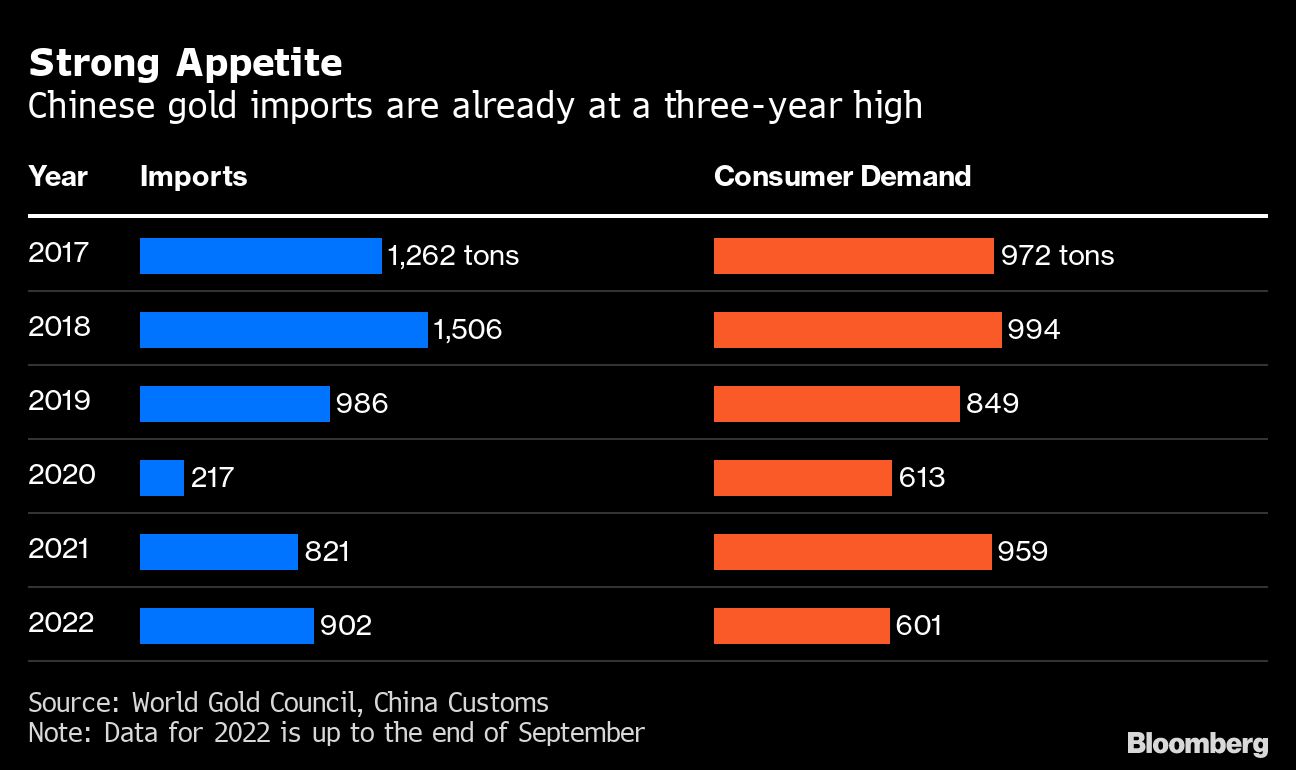
Trade data show the country has been taking in vast amounts of bullion. China has imported 902 tons of gold so far this year, already surpassing last year's total. That's on top of the more than 300 tons the country's mines typically produce each year.
And while domestic demand has been strong, with citizens buying some 601 tons through the third quarter, it's on track to fall short of 2021 levels. Earlier in the year, Covid-19 lockdowns hampered purchases of jewelry and bullion in one of the world's top consumers.
For China, the need to find an alternative to dollars, which dominate its reserves, has rarely been stronger. Tensions with the US are high following measures taken against its semiconductor firms, while Russia's invasion of Ukraine has demonstrated Washington's willingness to sanction central bank reserves.
Russia
Russia is the world's second-biggest gold mining nation, typically producing more than 300 tons a year. Before February 2022, it exported metal to trade centers like London and New York, but also to nations in Asia.

Since the invasion of Ukraine, Russia's gold has no longer been welcome in the West, while China and India have been reluctant to import huge quantities. That raises the possibility the central bank could step in to buy those supplies, but Russia's overall foreign exchange reserves, including gold, have declined this year.
Russia's reserves of dollars and euros were frozen by sanctions, making it less attractive for the central bank to add to them. Moreover, it doesn't break out its holdings of gold separately.
The nation has been a massive buyer of gold in the past, spending six years accumulating bullion before stopping at the onset of the pandemic. Russia said in February, after the invasion of Ukraine, that it was ready to buy gold at a certain price, but Deputy Governor Alexei Zabotkin said last month that purchases were no longer practical as they would push up money supply and inflation.
Oil Exporters
Few nations have done better out of this year's energy crisis than Gulf oil exporters. Saudi Arabia, the United Arab Emirates and Kuwait have all reaped a windfall, and some have been plowing cash into foreign assets through sovereign wealth funds.

They may have looked to gold to diversify. Saudi Arabia has the biggest gold hoard in the Arab world, but hasn't reported a change in its holdings since 2010. Back then a “difference in accounting” led to its reserves doubling to 323 tons.
India
India's central bank has made large gold purchases before, buying 200 tons from the International Monetary Fund in 2009. Since then it's tended to buy more gradually, while providing timely updates to the market.

It may have shied away from splashing out on gold this year, given the pressure on its currency. That's been exacerbated by strong imports of precious metals for its consumer sector in recent months.
More stories like this are available on bloomberg.com
©2022 Bloomberg L.P.

-
It's Time To Take The GST Council's Bet On Trust Global

Payment records can prove India's services exports, and clear, proportionate rules can bring foreign digital sellers into the tax net.
-
Opinion | India at 38: From Innovation Overperformer to Innovation Powerhouse
India now has 453 VC-backed deep science startups, 18 of them late-stage, after 117 percent growth since 2020. Laurus Labs, at USD 9.3 billion, is the most valuable deep science company in any middle-income economy outside China.
-
Navigating Energy Crossroads: S Jaishankar's Call For Diversified Supply Chains At G20 Ministerial Meeting
As geopolitical fault lines continue to test maritime trade routes and commodity flows, Jaishankar's message remains pertinent: true economic resilience requires open markets, protected transit lines, and a genuine commitment to multilateral cooperation rather than coercion.
-
Indians Are Travelling, But Not Every Journey Is A Holiday | The Week In Whys
Pilgrims, patients and working women are the real travellers, and the system hasn't quite caught up with them.
-
Getting To Work Costs Women More | The Reason Why
It is not just about women paying more than men. It is about women paying much more in cities than in villages.
-
AI Bias In Investing Cannot Be Eliminated, But It Can Be Governed
Framing is a particularly important example as identical financial information presented in terms of gains rather than losses can lead an LLM to reach a different assessment.
-
Joining The Dots | Dark Skies, Steady Diya: Why Hope Holds This Diwali
With war, a weak rupee and foreign outflows weighing on sentiment, policymakers at the NDTV World Summit and market veterans at NDTV Profit Ignite: Diwali Edition offered the same advice: stay invested and filter out the noise.
-
The Curious Case of Equitas Small Finance Bank And A CEO Who Quit For Stock
PN Vasudevan believes persistent investor concerns over a perceived conflict of interest had become a governance overhang on Equitas Small Finance Bank's stock, even as the lender improved profitability and asset quality.
-
Talking Points This Week: AI Cash Burn, A Tiger Comeback And An India That Still Finds Its Own Path
India is not immune to higher oil or tighter global liquidity, yet its earnings base is broader, its domestic policy levers are still available.










