Bullet Train Project: Agreement Signed With Japanese Firm For Design Of Rail Track
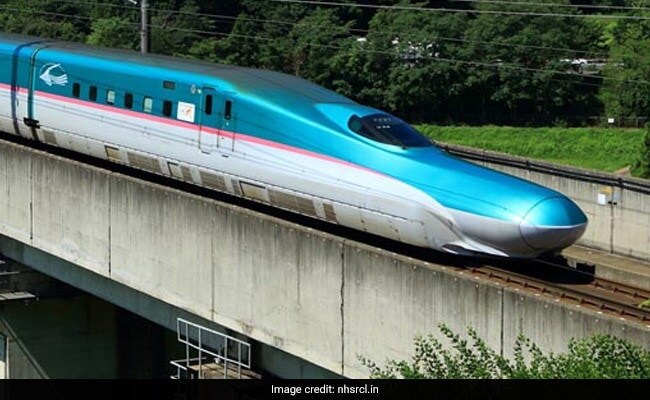
The National High-Speed Rail Corporation Limited (NHSRCL), executing the country's first bullet train project, signed a memorandum of understanding (MoU) on Friday, March 12, with Japan Railway Track Consultant Co. Limited (JRTC) for the design of high-speed rail track work. According to a statement shared by NHSRCL, the rail track work is for the bullet train corridor's package between Vadodara to Vapi in Gujarat - spanning across a length of 237 km. (Also Read: Bullet Train Project: ₹ 1,390 Crore Contract Signed With L&T For Procuring Steel Bridges )
As per the agreement, the Japanese consultant firm JRTC will provide the detailed design and drawing of the major high-speed rail track components such as track slab arrangement, RC track bed, as well as continuous welded rail (CWR) forces etc.
“This signing of MoU marks a very important milestone for the MAHSR project. This also symbolizes a strong team work and association which I am sure will not be limited to MAHSR project but may also continue for other future projects in other countries,'' said Achal Khare, Managing Director, NHSRCL.
This MoU will strengthen the ties between India and Japan partnership and will also give a boost to ‘Make in India' initiative. This will also ensure the Transfer of Technology from Japanese High-speed rail system to India,'' said Shinzo Miyamoto, Minister, Embassy of Japan to India.
Meanwhile, the National High-Speed Rail Corporation Limited recently conducted the aerial light detection and ranging survey (LiDAR) survey for capturing the data related to the vertical profile of the Mumbai-Ahmedabad high-speed rail corridor. The aerial survey will help in setting up the vertical ground profile along the alignment. It will form the basis for the subsequent design (including the pier design) along the Mumbai-Ahmedabad high-speed rail corridor.
Once operational, the 508 km long Mumbai-Ahmedabad high-speed rail will reduce the distance between the two states to two-three hours, running at 320 km per hour. The bullet train project is funded by Japan International Cooperation Agency. The rolling stock is being developed on the lines of the Japanese E5 Shinkansen technology.

-
Ten Things I Learnt This Samvat

Patience can be a trap. Cheap stocks can stay cheap. Leverage can wipe you out. What did Samvat 2082 teach us? Niraj Shah writes on 10 lessons from the year gone by.
-
Talking Points This Week: Tech Nerves, FII Buying, And A Faraway Banking Shock
The global markets are not shining this Diwali. The exception in the large markets is, India.
-
Midterm Rally Lasted A Day. The Hard Reality Of A Divided US May Last Two Years | Opinion
Between a contested AI boom, a debt ceiling that arrives in 2027 and a president with every incentive to act alone, the next two years may prove more volatile than the first day's rally suggests.
-
Blue Wave Will Derail the AI Trade but Won't Dismantle the AI Era | Unhedged Position
The Democrats' sweep of the US Congress will see politics collide with economic forces both over the long and short term.
-
It's Time To Take The GST Council's Bet On Trust Global
Payment records can prove India's services exports, and clear, proportionate rules can bring foreign digital sellers into the tax net.
-
Opinion | India at 38: From Innovation Overperformer to Innovation Powerhouse
India now has 453 VC-backed deep science startups, 18 of them late-stage, after 117 percent growth since 2020. Laurus Labs, at USD 9.3 billion, is the most valuable deep science company in any middle-income economy outside China.
-
Navigating Energy Crossroads: S Jaishankar's Call For Diversified Supply Chains At G20 Ministerial Meeting
As geopolitical fault lines continue to test maritime trade routes and commodity flows, Jaishankar's message remains pertinent: true economic resilience requires open markets, protected transit lines, and a genuine commitment to multilateral cooperation rather than coercion.
-
Indians Are Travelling, But Not Every Journey Is A Holiday | The Week In Whys
Pilgrims, patients and working women are the real travellers, and the system hasn't quite caught up with them.
-
Getting To Work Costs Women More | The Reason Why
It is not just about women paying more than men. It is about women paying much more in cities than in villages.









