Ambani Sets Succession Plan in Motion by Promoting His Children
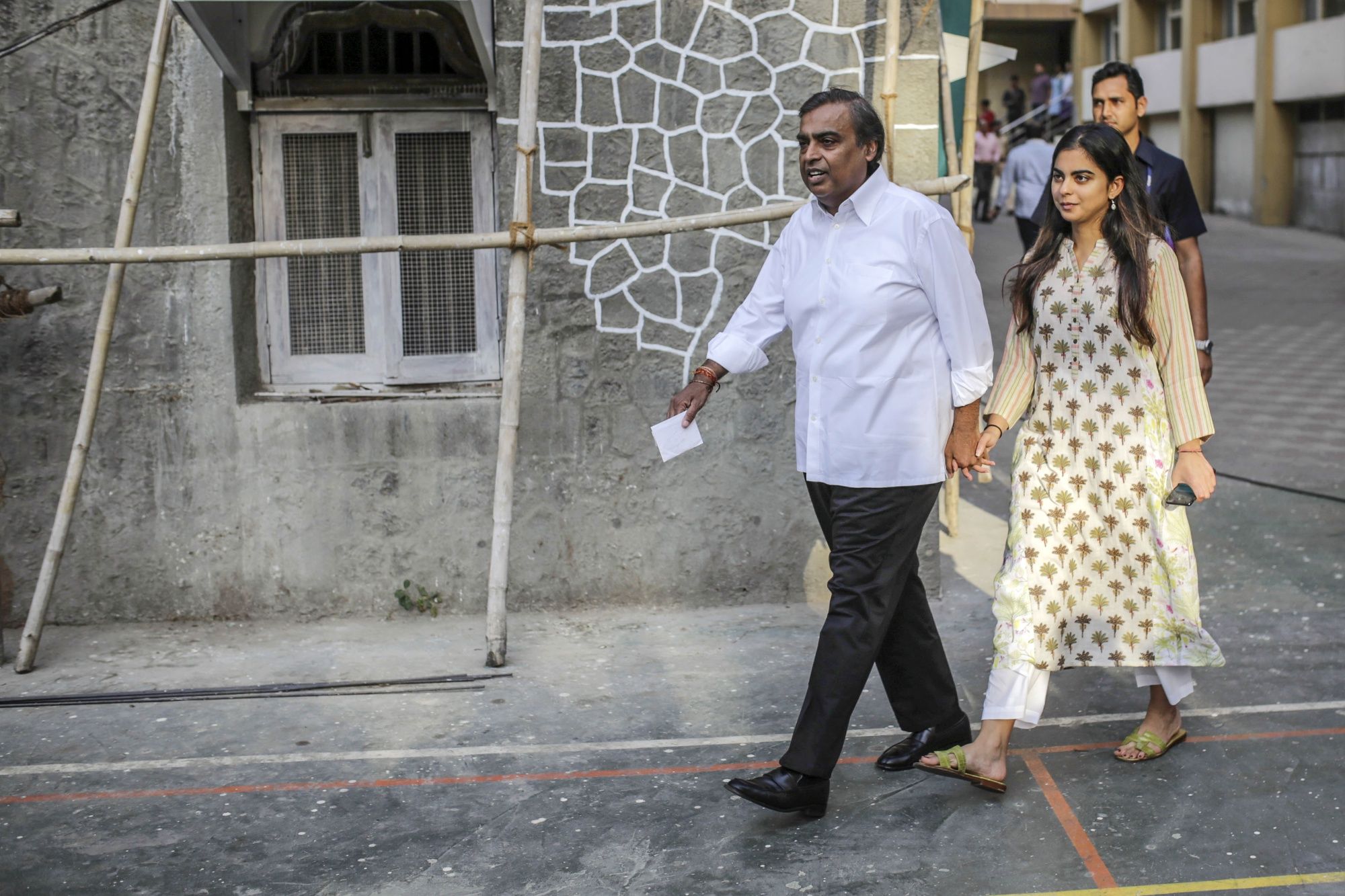
(Bloomberg) -- Indian billionaire Mukesh Ambani just got busy with the early stages of succession planning at his energy-to-technology conglomerate Reliance Industries Ltd., naming two of his offspring as chiefs of key units in his $217 billion empire.
On Tuesday, the 65-year-old tycoon made way for his first-born Akash Ambani to become the chairman of India's No. 1 wireless carrier Reliance Jio Infocomm Ltd. Akash's twin sister Isha, 30, is set to be appointed chair of Reliance's retail arm, and an announcement is expected as early as Wednesday, people familiar with the matter said. The company declined to comment.
While Mumbai-based Reliance has telegraphed such a leadership transition, the move underscores the senior Ambani's efforts to avert family feuds that have torn many wealthy clans apart, including his own. Bloomberg News reported last year that the mogul's favored succession plan shares elements with that of Walmart Inc.'s Walton family, a framework that would allow the biggest transfer of wealth in recent times.

The changes at the top come at a crucial time for Reliance. In a pivot from its legacy oil refining and petrochemicals business, the conglomerate is diversifying into e-commerce, green energy and expanding its retail footprint across the country. In 2020, technology venture Jio Platforms Ltd. lured more than $25 billion from marquee Silicon Valley investors including Meta Platforms Inc. and Google. It has also unveiled ambitious plans to take on Amazon.com Inc. in the country, including streaming.
“It shows a well-planned succession plan,” said Sankaran Manikutty, a former professor who taught at the Indian Institute of Management in Ahmedabad and has extensively worked on family businesses, telecommunications and strategy in emerging economies. “Ambani just ensured the continuity of the business. For now, nothing will change for the conglomerate, but Mukesh Ambani will be around to guide the next generation.”
Before their elevation, both Isha and Akash played prominent roles as directors in those units. They were part of teams that negotiated with Meta when the Menlo Park, California-based company decided to invest almost $6 billion in Jio Platforms. At annual shareholders meetings in recent years, the twins have introduced new products and demonstrated various technology applications such as virtual reality. Their father has credited his children with helping nudge him into the internet business.
Isha, a Yale University graduate and a former McKinsey & Co. consultant, kicked off Reliance's e-commerce foray into fashion retail in 2016 by starting online shopping portal Ajio. Like Jio Platforms, Reliance Retail Ventures also brought on board many investors like General Atlantic and KKR & Co. in 2020, valuing the retailer at as much as $62 billion then.
Reliance Retail runs supermarkets, India's largest consumer electronics chain store, a cash and carry wholesaler, fast-fashion outlets and an online grocery store called JioMart. It reported $2.6 billion in revenue for the year through March 2022. The unit operates more than 12,000 stores across the country.
Brown University Alumnus
Akash, who has studied economics and is an alumnus of Brown University, will oversee a telecommunications operator that debuted in 2016. With its free calls and cheap data, Reliance Jio shook up an industry mired in debt and sent some competitors into bankruptcy. The group is betting on this unit's pipes to deliver a range of services from e-commerce to entertainment in a market with almost 600 million smartphones. Reliance Jio is now gearing up for India's auction of 5G airwaves by the end of July.
The twins have a younger brother, Anant, 27, who is a member of the board of Jio Platforms. It's still unclear what broader plans his father has for his youngest child.
Mukesh Ambani, the chairman and managing director of the group's flagship Reliance Industries, has for years studied the ways in which billionaire families, from the Waltons to the Kochs, passed on what they'd built to the next generation, Bloomberg News reported last year. With the latest moves, Mukesh Ambani may still be looking at the Walton family model.
Trust-Like Structure
In a nod to that structure, Ambani was considering moving his family's holdings into a trust-like structure that would control the Mumbai-listed flagship Reliance Industries, people familiar with the matter said last year.
As part of that plan, Ambani, his wife Nita, and three children would have stakes in the new entity overseeing Reliance and be on its board, along with a few of Ambani's long-term confidantes as advisers. Management, though, will largely be entrusted to outsiders, professionals who will handle the day-to-day operations of India's most influential company and its businesses that span oil refining and petrochemicals to telecommunications, e-commerce and green energy.
By bringing his children into formal roles, Ambani is also seeking to avoid repeating the mistake of his own father, Dhirubhai, who died in 2002 without leaving a will. Mukesh and his younger brother Anil feuded for three years over the control of Reliance, before their mother stepped in to resolve the dispute by carving up the empire. The older sibling inherited the oil refining and petrochemicals businesses, while the younger one got the newer ventures in finance, infrastructure, power and telecom.
Mukesh is Asia's second-richest man with a net worth of about $91 billion, according to the Bloomberg Billionaires Index.
More stories like this are available on bloomberg.com
©2022 Bloomberg L.P.

-
A New Samvat Wishlist: Inclusive Prosperity And Human Development

India has strengthened its economic foundations through infrastructure, digital access and enterprise. Its next growth chapter must deepen productivity, create better livelihoods and widen participation in prosperity.
-
Love, Sex Aur Dhokha: The Audacious Plot To Spy On Jensen Huang
A Taipei dinner, a Singapore chip buyer and a suspected Chinese asset: inside the alleged spy operation that got close to NVIDIA's Jensen Huang.
-
Ten Things I Learnt This Samvat
Patience can be a trap. Cheap stocks can stay cheap. Leverage can wipe you out. What did Samvat 2082 teach us? Niraj Shah writes on 10 lessons from the year gone by.
-
Talking Points This Week: Tech Nerves, FII Buying, And A Faraway Banking Shock
The global markets are not shining this Diwali. The exception in the large markets is, India.
-
Midterm Rally Lasted A Day. The Hard Reality Of A Divided US May Last Two Years | Opinion
Between a contested AI boom, a debt ceiling that arrives in 2027 and a president with every incentive to act alone, the next two years may prove more volatile than the first day's rally suggests.
-
Blue Wave Will Derail the AI Trade but Won't Dismantle the AI Era | Unhedged Position
The Democrats' sweep of the US Congress will see politics collide with economic forces both over the long and short term.
-
It's Time To Take The GST Council's Bet On Trust Global
Payment records can prove India's services exports, and clear, proportionate rules can bring foreign digital sellers into the tax net.
-
Opinion | India at 38: From Innovation Overperformer to Innovation Powerhouse
India now has 453 VC-backed deep science startups, 18 of them late-stage, after 117 percent growth since 2020. Laurus Labs, at USD 9.3 billion, is the most valuable deep science company in any middle-income economy outside China.
-
Navigating Energy Crossroads: S Jaishankar's Call For Diversified Supply Chains At G20 Ministerial Meeting
As geopolitical fault lines continue to test maritime trade routes and commodity flows, Jaishankar's message remains pertinent: true economic resilience requires open markets, protected transit lines, and a genuine commitment to multilateral cooperation rather than coercion.









