Morgan Stanley Sees Rates Risk to Stocks. Bank of America Says Not So Much

(Bloomberg) -- A pair of Wall Street's most prominent US equity strategists are at odds about whether stocks can extend this year's rally against the reality that interest rates will remain higher for longer.
Morgan Stanley's Michael Wilson, an unwavering equity bear, says the correlation between real rates and equity returns has fallen deeper into negative territory — a sign that interest rates have once again become a determinant of stock performance. At Bank of America Corp., however, Savita Subramanian thinks equity markets can still thrive if rates remain elevated.
“Since mid-July, stocks have experienced a distinct change in personality,” Wilson wrote in a note to clients dated Oct. 1. He added that the leg lower in US equities following the latest Federal Reserve meeting last month suggests investors are “beginning to question the ‘higher for longer' narrative.”
Wilson, who correctly called 2022's stock market rout but failed to predict this year's rally, has been vindicated by weakness across US stocks since the summer. The S&P 500 Index logged back-to-back drops in August and September, paring some of its double-digit gain this year.
In contrast, BofA's Subramanian sees reasons to be bullish even if borrowing costs stay high. For starters, 50% more large-capitalization companies have dwindled into small caps than vice versa, a reversal from prior decades — and a sign that higher costs of capital have “purged weaklings,” with the attrition leaving the S&P 500 in “good shape.”
Moreover, she points out that the S&P 500 returned an annualized 15% per year between 1985 and 2005, while real rates were 3.5%.
Subramanian was among the first in a parade of sell-side strategists to turn positive on US stocks this year after missing a rally in the first half of 2023, raising her year-end S&P 500 forecast twice since May. She correctly predicted last year's stock plunge.
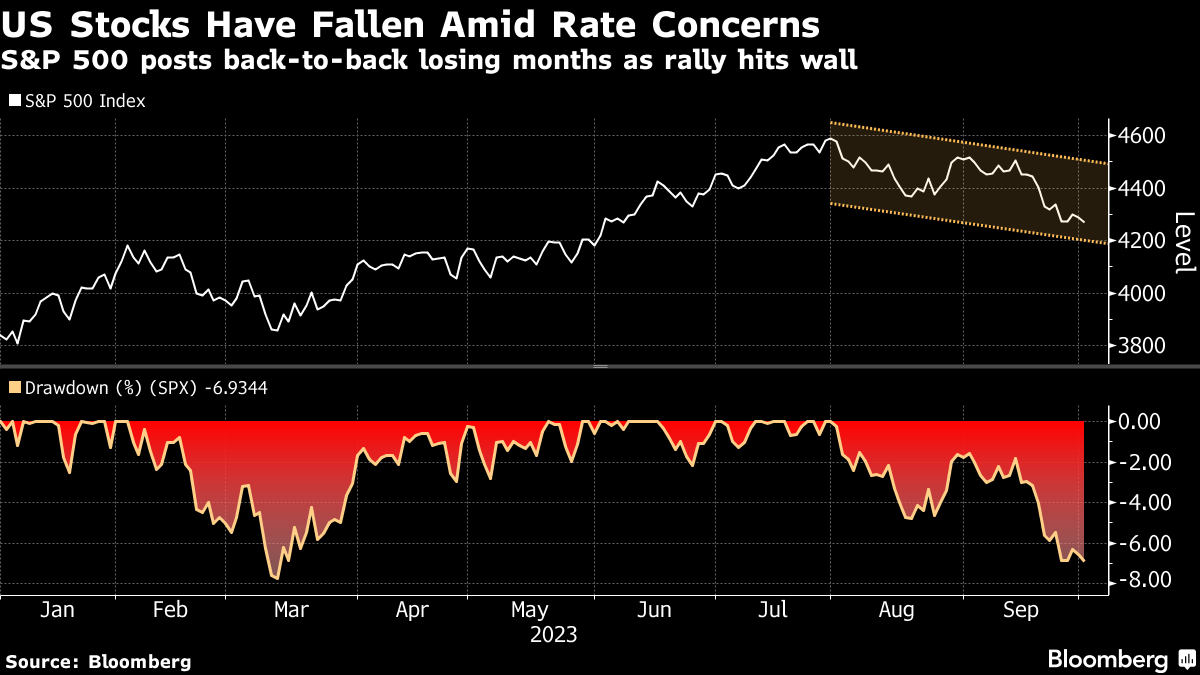
US equities extended their slide on Monday as bond yields pushed higher, further sapping the appetite for risk assets. The declines come after US stocks closed out their worst month of the year on Friday amid a weeks-long bout of selling over concerns about the toll of restrictive monetary policy on growth.
Although the turbulence has acquitted some equity bears after their gloomy calls failed to play out in the first half of the year, optimists have dismissed recent losses as a normal seasonal slump — pointing to discounted stocks and the upcoming earnings season as reason to buy, setting up for a potential year-end rally.
Goldman Sachs Group Inc. said Monday that the selloff has led to historically cheap valuations for technology stocks at a time when earnings estimates are still rising, a sign that shares can resume the blowout bullish run they staged earlier this year.
The glum mood as of late is another reason to buy stocks, according to BofA. Its sell-side indicator, a contrarian sentiment guage that tracks sell-side strategists' recommended equity allocations, stayed at a level in September that has historically preceded gains 95% of the time.
“Wall Street is bearish, conviction-less and stuck,” the bank said Monday. “Buy stocks, sell bonds.”
More stories like this are available on bloomberg.com
©2023 Bloomberg L.P.

-
Ten Things I Learnt This Samvat

Patience can be a trap. Cheap stocks can stay cheap. Leverage can wipe you out. What did Samvat 2082 teach us? Niraj Shah writes on 10 lessons from the year gone by.
-
Talking Points This Week: Tech Nerves, FII Buying, And A Faraway Banking Shock
The global markets are not shining this Diwali. The exception in the large markets is, India.
-
Midterm Rally Lasted A Day. The Hard Reality Of A Divided US May Last Two Years | Opinion
Between a contested AI boom, a debt ceiling that arrives in 2027 and a president with every incentive to act alone, the next two years may prove more volatile than the first day's rally suggests.
-
Blue Wave Will Derail the AI Trade but Won't Dismantle the AI Era | Unhedged Position
The Democrats' sweep of the US Congress will see politics collide with economic forces both over the long and short term.
-
It's Time To Take The GST Council's Bet On Trust Global
Payment records can prove India's services exports, and clear, proportionate rules can bring foreign digital sellers into the tax net.
-
Opinion | India at 38: From Innovation Overperformer to Innovation Powerhouse
India now has 453 VC-backed deep science startups, 18 of them late-stage, after 117 percent growth since 2020. Laurus Labs, at USD 9.3 billion, is the most valuable deep science company in any middle-income economy outside China.
-
Navigating Energy Crossroads: S Jaishankar's Call For Diversified Supply Chains At G20 Ministerial Meeting
As geopolitical fault lines continue to test maritime trade routes and commodity flows, Jaishankar's message remains pertinent: true economic resilience requires open markets, protected transit lines, and a genuine commitment to multilateral cooperation rather than coercion.
-
Indians Are Travelling, But Not Every Journey Is A Holiday | The Week In Whys
Pilgrims, patients and working women are the real travellers, and the system hasn't quite caught up with them.
-
Getting To Work Costs Women More | The Reason Why
It is not just about women paying more than men. It is about women paying much more in cities than in villages.









