Morgan Stanley-Led Banks Face $500 Million Loss On Twitter Debt
(Bloomberg) -- When banks led by Morgan Stanley agreed in April to help finance Elon Musk's purchase of Twitter Inc., they were eager to aid an important client, the richest person in the world. Now neither Musk nor the banks have an obvious way to wriggle out of it.
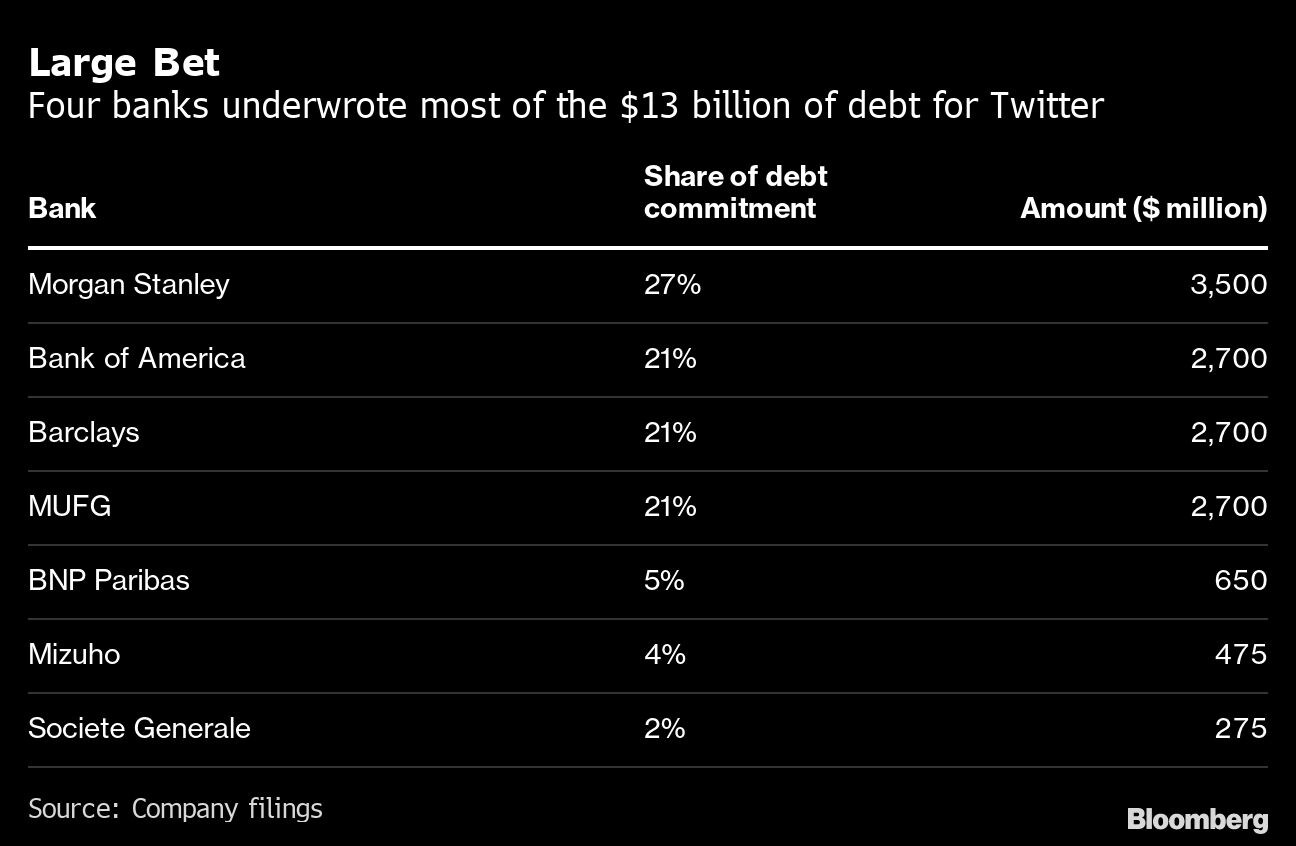
Lenders that also include Bank of America Corp., Barclays Plc and Mitsubishi UFJ Financial Group Inc. committed to provide $13 billion of debt financing for the deal. Their losses would amount to $500 million or more if the debt were to be sold now, according to Bloomberg calculations. They agreed to fund the purchase whether or not they were able to offload the debt to outside investors, according to public documents and lawyers who have looked at them.
“I think that those banks would like to get out of it, I think the deal makes less sense for them now, and that the debt will be harder to syndicate to investors,” said Howard Fischer, partner at law firm Moses Singer. But Fischer, a former senior trial counsel at the Securities and Exchange Commission who isn't involved in Twitter, said there's no legal basis for them to back out.
Junk bond and leveraged loan yields have surged since April, meaning that banks will lose money from having agreed to provide financing at lower yields than the market will accept now. Any pain the banks bear from this deal comes as lenders have already sustained billions of dollars of writedowns and losses this year after central banks worldwide have started hiking rates to tame inflation.
Even if the banks could find buyers for Twitter debt in the market now, which is far from certain, selling bonds and loans tied to the deal probably wouldn't be possible before the buyout closes.
Banks have a pipeline of around $50 billion of debt financings they've committed to provide in the coming months, according to Deutsche Bank AG estimates. While usually banks would sell bonds and loans to fund those deals, investors are less eager to buy now than they were toward the beginning of the year, and offloading this debt will be hard.
That's forcing banks to provide the financing themselves on a number of deals, a strain on their earnings and capital requirements. For example, lenders including Bank of America and Barclays expect to have to fund $8.35 billion of debt for the leveraged buyout of Nielsen Holdings next week, Bloomberg reported on Tuesday.
Representatives for Morgan Stanley, Bank of America, Barclays, MUFG and Twitter declined to comment. A representative for Musk did not immediately respond to a request for comment.
Way Out?
Banks may not be able to back out of the Twitter deal, but Musk has been trying to. Twitter said on Thursday that it's dubious of the billionaire's promises to close on the transaction. The company said that a banker involved in the debt financing testified earlier Thursday that Musk had yet to send them a borrowing notice, and had otherwise not communicated to them that he intended to close the deal.
The lack of a borrowing notice on its own isn't necessarily a problem. Usually that document comes toward the end of the process of closing on a purchase, said David Wicklund, a partner at Vinson & Elkins who focuses on complex acquisition and leveraged financings. It's often submitted to banks two or three days before closing, making it one of the last items to be finished.
But leading up to the closing of a big acquisition typically involves a blizzard of paperwork that has to be negotiated between both parties. There may be 50 to 80 documents that get discussed, Wicklund said.
A Delaware judge said on Thursday that if the transaction isn't done by October 28, she will set new dates in November for the lawsuit between Twitter and Musk. That date comes from a filing from Musk's team that said the banks needed until then to provide the debt funding.
On Monday, Musk sent Twitter a letter saying he would go through with his acquisition “pending receipt of the proceeds of the debt financing.” That made it seem like there was some doubt as to whether the banks would provide their promised financing, which became a sticking point in negotiations between the company and the billionaire.
But in a court document on Thursday, Musk's team said that counsel for the banks “has advised that each of their clients is prepared to honor its obligations.”
Bonds, Loans
The banking group originally planned to sell $6.5 billion of leveraged loans to investors, along with $6 billion of junk bonds split evenly between secured and unsecured notes. They are also providing $500 million of a type of loan called a revolving credit facility that they would typically plan to hold themselves.
Of the more than $500 million of losses that the banks are estimated to have on the Twitter debt, up to about $400 million stems from the riskiest portion, the unsecured bonds, which have a maximum interest rate for the company of about 11.75%, Bloomberg reported earlier this year. The losses exclude fees the banks would usually earn on the transaction.
The rest of the losses are estimated based on where the maximum interest rates would have been determined for the loan and secured bond when compared to the unsecured portion. The expected loss could ultimately be higher or lower.
The banking group is expected to give the cash to Twitter and become a lender to the soon-to-be highly indebted social media giant.
Morgan Stanley would hold onto the most at about $3.5 billion of debt, based on the debt commitment letter:

The banks will have to mark down the debt based on where it would trade in the secondary market, which would likely be at steep discounts to face value, especially for the riskiest portions. BNP Paribas, Mizuho and Societe Generale SA declined to comment. The banks can then wait until better market conditions and try to sell the debt to investors at a later date, likely at a discount to face value.
More stories like this are available on bloomberg.com
©2022 Bloomberg L.P.

-
Love, Sex Aur Dhokha: The Audacious Plot To Spy On Jensen Huang

A Taipei dinner, a Singapore chip buyer and a suspected Chinese asset: inside the alleged spy operation that got close to NVIDIA's Jensen Huang.
-
Ten Things I Learnt This Samvat
Patience can be a trap. Cheap stocks can stay cheap. Leverage can wipe you out. What did Samvat 2082 teach us? Niraj Shah writes on 10 lessons from the year gone by.
-
Talking Points This Week: Tech Nerves, FII Buying, And A Faraway Banking Shock
The global markets are not shining this Diwali. The exception in the large markets is, India.
-
Midterm Rally Lasted A Day. The Hard Reality Of A Divided US May Last Two Years | Opinion
Between a contested AI boom, a debt ceiling that arrives in 2027 and a president with every incentive to act alone, the next two years may prove more volatile than the first day's rally suggests.
-
Blue Wave Will Derail the AI Trade but Won't Dismantle the AI Era | Unhedged Position
The Democrats' sweep of the US Congress will see politics collide with economic forces both over the long and short term.
-
It's Time To Take The GST Council's Bet On Trust Global
Payment records can prove India's services exports, and clear, proportionate rules can bring foreign digital sellers into the tax net.
-
Opinion | India at 38: From Innovation Overperformer to Innovation Powerhouse
India now has 453 VC-backed deep science startups, 18 of them late-stage, after 117 percent growth since 2020. Laurus Labs, at USD 9.3 billion, is the most valuable deep science company in any middle-income economy outside China.
-
Navigating Energy Crossroads: S Jaishankar's Call For Diversified Supply Chains At G20 Ministerial Meeting
As geopolitical fault lines continue to test maritime trade routes and commodity flows, Jaishankar's message remains pertinent: true economic resilience requires open markets, protected transit lines, and a genuine commitment to multilateral cooperation rather than coercion.
-
Indians Are Travelling, But Not Every Journey Is A Holiday | The Week In Whys
Pilgrims, patients and working women are the real travellers, and the system hasn't quite caught up with them.