More Companies Spending On CSR But Aren’t Being Generous Enough

Listed companies are gradually opening up their wallets to fund corporate social responsibility activities, but a lot remains when it comes to loosening their purse strings.
Companies spent a mere 2 percent of their profit in financial year 2018, or Rs 10,000 crore, on CSR activities, according to a report by rating agency Crisil.
Of all the companies mandated by the Companies Act, only 1,246 contributed to CSR in the year ended March 2018, according to the report by Crisil Foundation, the report said. An additional Rs 2,380 crore could have been pledged for the cause had all the listed companies spent the stipulated 2 percent of their profit.
As per the act, companies need to part with 2 percent of its average net profit of the preceding three years on CSR activities.
Dipping Further
A 2017 amendment to the Companies Act will now consider the financials of the immediate preceding quarter instead. This, according to Crisil, will lead to reduced contributons and slimmer CSR spends. The stipulation to limit all expenditure to 5 percent of the CSR amount is seen as an impediment by companies for enhancing their in-house CSR capacities.
Large companies which drew sales of over Rs 1,500 crore accounted for 79 percent of the total spend estimated by Crisil for the fiscal. Nearly half of the companies which spend on CSR are small firms but account for only 16 percent of the total spend by the companies.
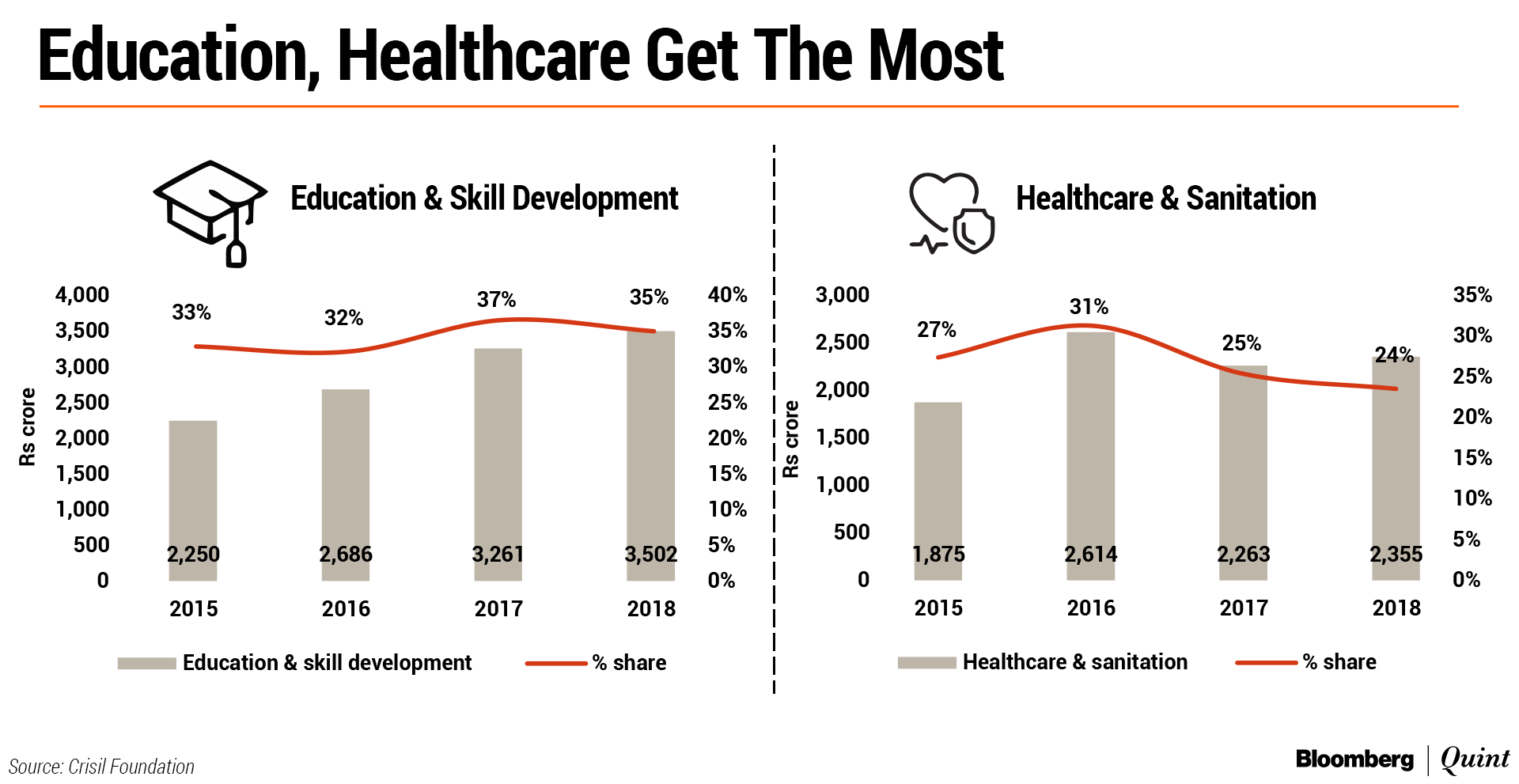
Companies are drawing more cheques toward education and skill development. This, along with health and sanitation activities accounts for more than 50 percent of the spend. However, contribution to relief funds in 2018 are a third of what they were in 2015.
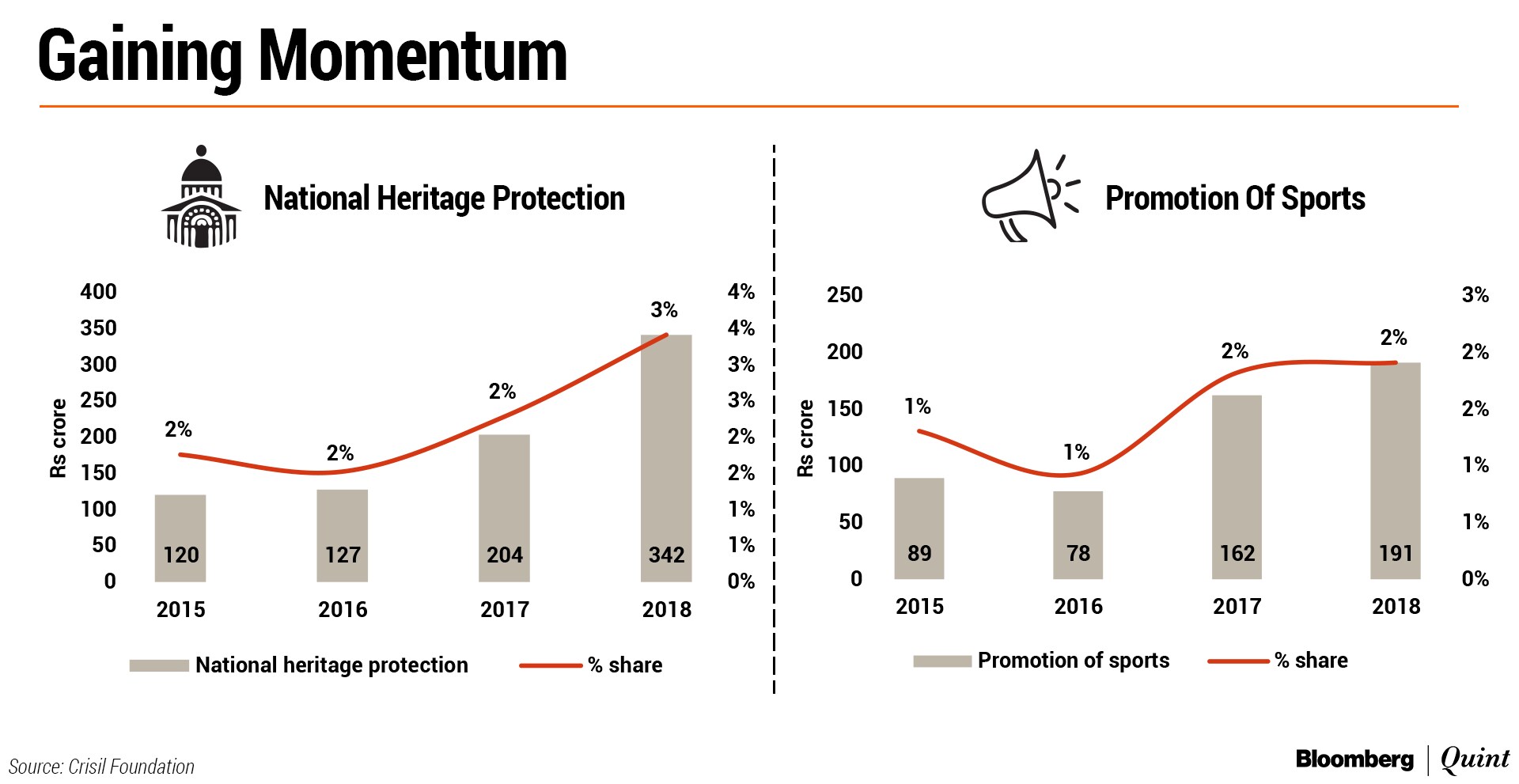
However, there is growing momentum for national heritage protection and promotion of sports. Since fiscal 2015, spending on national heritage protection almost tripled, while money earmarked for promotion of sports almost doubled. With Tokyo Olympics a year away, this seems to be great news for sports enthusiasts.
While private companies have stepped up participation in CSR spends, public-sector undertakings represent only 4 percent of the total companies, with larger state-run companies accounting for 91 percent of the total spend from the segment.
Energy companies spent nearly Rs 2,253 crore toward CSR, the maximum. However, share of these two segments was down nearly 300 basis points from the fiscal 2017 level, which could indicate diversification of spends to different avenues. Healthcare companies parted the most with their profit to fund CSR.
Most of the companies that spent on CSR were based in Maharashtra, followed by Delhi-NCR and Gujarat. While more than half of the companies in all states spent over 2 percent or more of their profit on CSR, 74 percent of the companies prefer non-governmental organisations and voluntary organisations to further their cause of choice.
Companies spent Rs 50,000 crore in four years for CSR, the report said. “The cumulative spend is more than the fiscal 2018 Union Budget allocation for health and family welfare and two-thirds of the allocation for education—the two key CSR spending heads,” said Maya Vengurlekar, chief operating officer of Crisil Foundation.
The rating agency also said there's a need to improve the quality and impact of all spends on the ground, along with the need to introduce measure its impact in a better manner.

-
Talking Points This Week: Tech Nerves, FII Buying, And A Faraway Banking Shock

The global markets are not shining this Diwali. The exception in the large markets is, India.
-
Midterm Rally Lasted A Day. The Hard Reality Of A Divided US May Last Two Years | Opinion
Between a contested AI boom, a debt ceiling that arrives in 2027 and a president with every incentive to act alone, the next two years may prove more volatile than the first day's rally suggests.
-
Blue Wave Will Derail the AI Trade but Won't Dismantle the AI Era | Unhedged Position
The Democrats' sweep of the US Congress will see politics collide with economic forces both over the long and short term.
-
It's Time To Take The GST Council's Bet On Trust Global
Payment records can prove India's services exports, and clear, proportionate rules can bring foreign digital sellers into the tax net.
-
Opinion | India at 38: From Innovation Overperformer to Innovation Powerhouse
India now has 453 VC-backed deep science startups, 18 of them late-stage, after 117 percent growth since 2020. Laurus Labs, at USD 9.3 billion, is the most valuable deep science company in any middle-income economy outside China.
-
Navigating Energy Crossroads: S Jaishankar's Call For Diversified Supply Chains At G20 Ministerial Meeting
As geopolitical fault lines continue to test maritime trade routes and commodity flows, Jaishankar's message remains pertinent: true economic resilience requires open markets, protected transit lines, and a genuine commitment to multilateral cooperation rather than coercion.
-
Indians Are Travelling, But Not Every Journey Is A Holiday | The Week In Whys
Pilgrims, patients and working women are the real travellers, and the system hasn't quite caught up with them.
-
Getting To Work Costs Women More | The Reason Why
It is not just about women paying more than men. It is about women paying much more in cities than in villages.
-
AI Bias In Investing Cannot Be Eliminated, But It Can Be Governed
Framing is a particularly important example as identical financial information presented in terms of gains rather than losses can lead an LLM to reach a different assessment.









