Microsoft Joins Apple In Exclusive $2 Trillion Club
Microsoft Corporation took its place in the history books as just the second U.S. public company to reach a $2 trillion market value, buoyed by bets its dominance in cloud computing and enterprise software will expand further in a post-coronavirus world.
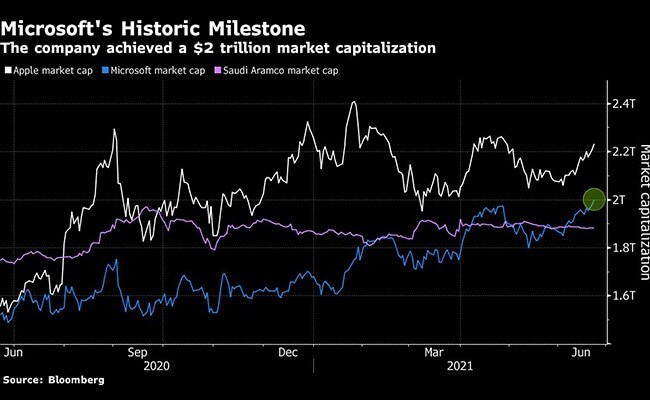
Its shares rose as much as 1.2 per cent in New York on Tuesday, enough for the software company to briefly join Apple Inc. as one of only two companies trading at such a lofty value before closing pennies short of the mark at $265.51. Saudi Aramco eclipsed that threshold briefly in December 2019, but currently has a market value of about $1.9 trillion.
Since taking the reins in 2014, Chief Executive Officer Satya Nadella has reshaped the Redmond, Washington-based company into the largest seller of cloud-computing software, counting both its infrastructure and Office application cloud units. Microsoft is also the only one of the biggest U.S. technology companies that has so far evaded the recent wave of scrutiny from increasingly active American antitrust regulators, giving it a freer hand in both acquisitions and product expansion.

Add image caption here
Microsoft has gained 19 per cent so far this year, outperforming Apple and Amazon.com Inc., as investors piled into the stock on expectations of long-term growth for both earnings and revenue, and expansion in areas like machine learning and cloud computing. The company's third-quarter results, released in late April, topped expectations and demonstrated strong growth across its business segments.
The tech-heavy Nasdaq 100 Index outperformed the S&P 500 Index on Tuesday after Federal Reserve Chair Jerome Powell reiterated his view that inflation will be short lived. Both benchmarks extended gains after Powell's comments with the Nasdaq 100 closing up 0.9 per cent and the S&P 500 up 0.5 per cent.
Microsoft "has its hands in a lot and it is doing it all well: gaming, cloud, automation, analytics, AI," said Hilary Frisch, senior research analyst at Clearbridge Investments. "It is an attractively valued name within tech, and it should benefit from both the economy reopening as well as from a more pronounced shift toward the cloud."
Co-founded in 1975 by Bill Gates and Paul Allen, Microsoft created the personal-computer software industry and dominated the market for PC operating systems and Office software for years. As internet browsers like Netscape grew in importance in the 1990s, Microsoft raced to introduce its own product that it bundled with Windows software. That led to a bruising antitrust lawsuit, filed in 1998 by the U.S. government, with a federal judge finding the company guilty in 2000.

Though Microsoft avoided a breakup of its business, the penalty the government originally sought in the antitrust case, the next decade saw the software maker largely miss the advent of mobile software, social media and internet search, falling behind newer rivals such as Google and nimbler ones like Apple. With a series of strategic shifts, in the past seven years Nadella has restored Microsoft to the vanguard of technology with a focus on cloud, mobile computing and artificial intelligence.
While it took Microsoft 33 years from its IPO to reach its first $1 trillion in value in 2019, the next trillion only took about two years amid a surge in popularity in tech stocks before the Covid-19 pandemic and during the health crisis. Apple made Wall Street history when it reached $2 trillion last year.
Among U.S. names, the pair are trailed by Amazon, which has a market cap of nearly $1.8 trillion, and Alphabet Inc., which is valued around $1.6 trillion.
"Microsoft checks all the boxes: it is in the markets that investors favor, it offers strong and sustainable growth, and it remains very well positioned to capitalize on the long-term secular trends we see in technology," said Logan Purk, an analyst at Edward Jones. A $2 trillion valuation "is warranted, given how it has pivoted toward the cloud, and it remains attractively valued even given the strong performance."
According to data compiled by Bloomberg, more than 90 per cent of analysts recommend buying Microsoft, while none has the equivalent of a sell rating on the stock. The average price target points to upside of about 11 per cent from current levels.
Growth Drivers
Microsoft's cloud-computing business has been a central force behind the advance. According to data compiled by Bloomberg, the Intelligent Cloud business accounted for 33.8 per cent of Microsoft's 2020 revenue, making it the largest of the three major segments for the first time, and up from 31 per cent in 2019. The division showed revenue growth of 24 per cent last year, compared with the 13 per cent growth in Productivity and Business Processes, and the 6 per cent growth of Microsoft's More Personal Computing unit.
Nadella's strategic moves had put Microsoft in a position to benefit from business trends that arose during the global pandemic. Lockdowns and remote work accelerated a shift to the company's meeting software and pushed clients to speed up modernizations of software networks and applications around the cloud. The software maker's Xbox gaming subscriptions also lured users looking for diversion during months stuck at home.
As workers return to the office, Microsoft has tried to push new ideas for managing meetings where some attendees are in person and some remote, and has been hawking features to boost wellness and productivity for workers that the company says are burned out by the tribulations of the past year.
"At a high level, the two core pillars of Microsoft's bull narrative - Microsoft 365 and Azure - are well understood by the investment community," William Blair analyst Jason Ader wrote in May. "What is perhaps less appreciated is how over the last 15 years Microsoft has expanded its IT wallet share through expanding into new product areas" and taking market share. The wallet share doubled from 2006 to 2020, and "we believe it can double again over the next decade," it wrote.
Wall Street is also positive on the company's M&A strategy. It recently announced that it is buying speech-recognition pioneer Nuance Communications Inc. The company also tried to acquire Discord Inc. for $12 billion, but the video-game chat company rejected Microsoft's offer.
(Except for the headline, this story has not been edited by NDTV staff and is published from a syndicated feed.)

-
Navigating Energy Crossroads: S Jaishankar's Call For Diversified Supply Chains At G20 Ministerial Meeting

As geopolitical fault lines continue to test maritime trade routes and commodity flows, Jaishankar's message remains pertinent: true economic resilience requires open markets, protected transit lines, and a genuine commitment to multilateral cooperation rather than coercion.
-
Indians Are Travelling, But Not Every Journey Is A Holiday | The Week In Whys
Pilgrims, patients and working women are the real travellers, and the system hasn't quite caught up with them.
-
Getting To Work Costs Women More | The Reason Why
It is not just about women paying more than men. It is about women paying much more in cities than in villages.
-
AI Bias In Investing Cannot Be Eliminated, But It Can Be Governed
Framing is a particularly important example as identical financial information presented in terms of gains rather than losses can lead an LLM to reach a different assessment.
-
Joining The Dots | Dark Skies, Steady Diya: Why Hope Holds This Diwali
With war, a weak rupee and foreign outflows weighing on sentiment, policymakers at the NDTV World Summit and market veterans at NDTV Profit Ignite: Diwali Edition offered the same advice: stay invested and filter out the noise.
-
The Curious Case of Equitas Small Finance Bank And A CEO Who Quit For Stock
PN Vasudevan believes persistent investor concerns over a perceived conflict of interest had become a governance overhang on Equitas Small Finance Bank's stock, even as the lender improved profitability and asset quality.
-
Talking Points This Week: AI Cash Burn, A Tiger Comeback And An India That Still Finds Its Own Path
India is not immune to higher oil or tighter global liquidity, yet its earnings base is broader, its domestic policy levers are still available.
-
Foreign Investors Own Half Of HDFC Bank and ICICI Bank. An LTCG Cut Could Matter Most Here
Foreign portfolio investors have US$115 billion parked in HDFC Bank, ICICI Bank. If the government cuts long-term capital gains tax, Jefferies says returning foreign money could land here first.
-
'Never Seen This Level Of Negativity': Sandeep Tandon Says The Next Rally May Be Closer Than You Think
Veteran investor Sandeep Tandon says foreign selling is easing, large-caps are due a comeback and mid-caps are crowded, while he turns positive on gold, power and pharma this Diwali.
-
Indians Stay With Family, Not In Hotels | The Reason Why
India still lacks enough clean, reliable and affordable hotels for budget-conscious travellers.










