May Take 3 Months For Rs 200 Note To Reach ATMs: Report
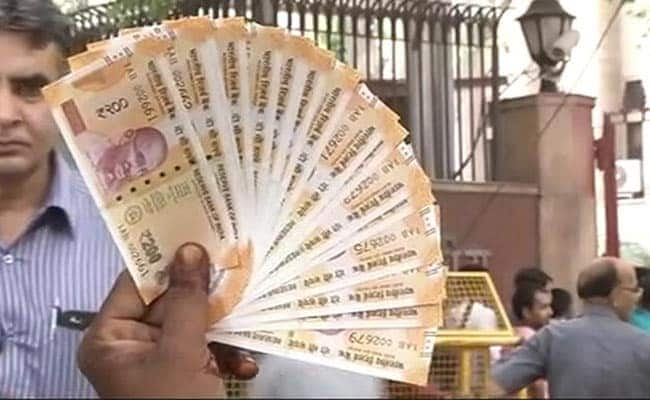
New Delhi: While the RBI launched the 200-rupee note a week ago, it may take up to three months for ATMs to start dispensing the new denomination currency as it will involve a huge exercise of recalibration.
Some banks have even asked the ATM companies to begin testing the new note for recalibration of the machines, though they have not got supplies of the new currency. Only last year, the banks were involved in recalibration of ATM machines after the demonetisation of high-value currency notes in November.
Reserve Bank of India (RBI) did issue a statement saying that the supply of the new Rs 200 notes would soon be ramped up, but has not given any time-frame by which it will be available in adequate numbers.
ATM manufacturing companies said that they have not received any directive from the RBI regarding the recalibration of ATMs for the new Rs 200 note. They disclosed that some banks have at an informal level have asked them to start testing of the new note, since it is of a different size.
It is yet to be seen whether all the 2.25 lakh ATM machines across India would be recalibrated for dispensing the new note.
Ravi B Goyal, Chairman and Managing Director, AGS Transact Technologies Limited, which claims to have an installed base of 60,000 ATMs, told IANS, "The process of recalibration will begin once we receive the directive from the RBI. The size of the new notes is different from the existing ones and so, once we receive the new notes, we will have to understand its dimensions and accordingly reconfigure the ATM cassettes. Next, we will have to check if the supply of notes is good enough to run the cassettes at full capacity."
"The entire process of recalibration can be completed within 90 days without affecting the regular functionality of ATMs to a large extent. In fact, the ATMs will continue to be fully operational during recalibration and will continue to supply Rs 100, Rs 500 and Rs 2,000 denominations," he said.
Among the other companies operating in the sector are NCR Corporation, which has over 1,08,000 machines, and BTI Payments, which has 4,500 cash dispensers.
NCR Corporation said that while some banks have reached out to them to start testing of the new note, they were yet to receive the supply to begin the process.
"Banks have started getting in touch with us for testing the same. They will let us know which machines they wish to configure for Rs 200, which will require physical visits to ATMs. However, the new notes are still to be provided to us by the respective banks so that the testing can begin," Anand Garollu, General Manager (Services), NCR Corporation said.
K. Srinivas, Managing Director and CEO of BTI Payments, an RBI-licensed firm that operates cash dispensers not owned and managed by banks, said, "Recalibration will begin as and when we receive adequate quantity of Rs 200 notes. We are looking to roll this out as quickly as possible."
He said that the industry was expecting Rs 200 notes to be available over a period of time across various geographies.
"The recalibration can be done progressively as and when the new denomination note starts to become available. Unlike the last time around (during demonetisation), when we had to recalibrate all machines in one go," Srinivas added.
The ATM companies said that they were expecting to receive official communication on recalibration of ATMs soon. However, e-mails to RBI in this regard did not elicit any reply, they said.
"The production of these (Rs 200) notes is being ramped up by the currency printing presses and over time, as more notes are printed, it will be distributed across the country through the banking channels and will be available for public in adequate quantity," the RBI had said in a statement.
Currently, Rs 200 notes are available only through select RBI offices and some banks.
While State Bank of India and Punjab National Bank are reported to have received the new Rs 200 notes, Eknath Baliga, Manger, KYC-Antimoney Laundering Cell, Corporation Bank, Mangalore, told IANS that none of its branches across the country had received the Rs 200 notes so far.
The Rs 200 note is currently being printed only by RBI presses. Security Printing and Minting Corporation of India (SPMCIL) sources told IANS that the company has not received any indent so far for the printing of Rs 200 notes. India's two currency presses are owned by RBI and two by SPMCIL, which is a government-owned company.
How the ATM recalibration happens:
Usually, an ATM holds four cassettes -- three of which can continue to be used for Rs 100, Rs 500, Rs 2,000, and the fourth cassette can be used for the new Rs 200 notes. On an average, each cassette has a capacity to hold 2,000-2,500 notes depending upon the quality of cash issued by banks. However, there are many ATMs that only have either two or three cassettes.
The number of slots in the ATM can be configured as per the bank's preference. The banks decide which denomination needs to be configured in a machine on the basis of the customer profile in the area where the ATM is located and the number of transactions on that machine.
The banks need to make requisite changes at their ATM switch before the roll-out of the physical recalibration at the ATMs in the field.
The recalibration of a new denomination takes 30-45 minutes per ATM. The process of recalibration is not very difficult but is time-consuming given an engineer has to visit every ATM and configure it to dispense the requisite denomination.
The introduction of the Rs 200 note has been welcomed as it would ease the currency circulation in the market as people prefer lower denomination cash withdrawals from ATMs. Rs 200 would also be more convenient for rural consumers.
(This story has not been edited by NDTV staff and is auto-generated from a syndicated feed.)

-
Navigating Energy Crossroads: S Jaishankar's Call For Diversified Supply Chains At G20 Ministerial Meeting

As geopolitical fault lines continue to test maritime trade routes and commodity flows, Jaishankar's message remains pertinent: true economic resilience requires open markets, protected transit lines, and a genuine commitment to multilateral cooperation rather than coercion.
-
Indians Are Travelling, But Not Every Journey Is A Holiday | The Week In Whys
Pilgrims, patients and working women are the real travellers, and the system hasn't quite caught up with them.
-
Getting To Work Costs Women More | The Reason Why
It is not just about women paying more than men. It is about women paying much more in cities than in villages.
-
AI Bias In Investing Cannot Be Eliminated, But It Can Be Governed
Framing is a particularly important example as identical financial information presented in terms of gains rather than losses can lead an LLM to reach a different assessment.
-
Joining The Dots | Dark Skies, Steady Diya: Why Hope Holds This Diwali
With war, a weak rupee and foreign outflows weighing on sentiment, policymakers at the NDTV World Summit and market veterans at NDTV Profit Ignite: Diwali Edition offered the same advice: stay invested and filter out the noise.
-
The Curious Case of Equitas Small Finance Bank And A CEO Who Quit For Stock
PN Vasudevan believes persistent investor concerns over a perceived conflict of interest had become a governance overhang on Equitas Small Finance Bank's stock, even as the lender improved profitability and asset quality.
-
Talking Points This Week: AI Cash Burn, A Tiger Comeback And An India That Still Finds Its Own Path
India is not immune to higher oil or tighter global liquidity, yet its earnings base is broader, its domestic policy levers are still available.
-
Foreign Investors Own Half Of HDFC Bank and ICICI Bank. An LTCG Cut Could Matter Most Here
Foreign portfolio investors have US$115 billion parked in HDFC Bank, ICICI Bank. If the government cuts long-term capital gains tax, Jefferies says returning foreign money could land here first.
-
'Never Seen This Level Of Negativity': Sandeep Tandon Says The Next Rally May Be Closer Than You Think
Veteran investor Sandeep Tandon says foreign selling is easing, large-caps are due a comeback and mid-caps are crowded, while he turns positive on gold, power and pharma this Diwali.
-
Indians Stay With Family, Not In Hotels | The Reason Why
India still lacks enough clean, reliable and affordable hotels for budget-conscious travellers.










