Market Outlook: Q4 Results, Macro-Data To Dictate Equity Indices Trend
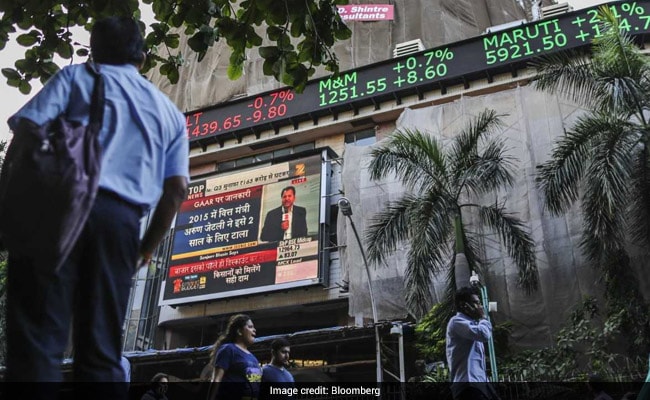
Mumbai: Macro-economic data points, coupled with fourth quarter (Q4) earning results, are expected to influence the Indian equity markets during the upcoming truncated week. According to market observers, the US Fed's open market committee meet along with the trajectory of global crude oil prices and the rupee's movement against the US dollar can trigger volatility during the week's trade sessions.
"The earnings momentum would again be critical since HDFC, Kotak Bank and Dabur will be releasing their numbers. For PSU and other banks, the key question is whether the peak in NPA (non-performing assets) reporting cycle is near," Devendra Nevgi, Founder and Principal Partner, Delta Global Partners, told IANS.
Companies like HDFC, Kotak Mahindra Bank, HCL Technologies, Hero MotoCorp, Interglobe Aviation, Marico, Welspun Corp and Adani Ports and Special Economic Zone are expected to announce their Q4 earning results next week.
"Earnings and (the Karnataka) election will be the main triggers for the market while investors will have to keep an eye on domestic headwinds like rise in oil price and rupee movement," said Vinod Nair, Head of Research at Geojit Financial Services.
"On the other hand, the earnings season has started on a positive note led by private sector banks and IT companies. Global market sentiment will be based on the outcome of two-day FOMC meet which is scheduled to start from May 1."
Apart from Q4 results, investors will look out for upcoming macro-economic data points such as the eight core industries' (ECI) output, the country's fiscal deficit numbers and PMI manufacturing and services' figures which will be released during the week starting April 30.
"Next week, the fiscal deficit for the full financial year would be available and the data would be scrutinised in detail for any slippages, especially in the month of March," Nevgi said.
"The PMI would be tracked, too, for the economic progress. Crude prices would be tracked closely for any spurt."
Nevgi added that DIIs (domestic institutional investors) have supported the market as they remained net buyers, whereas FPIs (foreign portfolio investors) have been net sellers since April 13.
The provisional figures from the stock exchanges showed that during last week, foreign institutional investors (FIIs) sold scrips worth Rs 3,060.41 crore, while the domestic institutional investors purchased stocks worth Rs 2,649.61 crore.
In terms of currency, the rupee weakened by 54 paise to close at 66.67 against the dollar on last Friday.
On technical charts, the underlying trend for the National Stock Exchange's (NSE) Nifty remains bullish.
"Technically, the near-term trend of Nifty is positive and one may expect further upside in the early part of next week. Nifty could face resistance at the 10,750-10,800 band for the next week," said Deepak Jasani, Head of Retail Research for HDFC Securities.
Last week, healthy Q4 earnings lifted the benchmark equity indices as they settled at their highest closing levels in over three months.
On a weekly basis, the barometer 30-scrip Sensitive Index (Sensex) of the Bombay Stock Exchange (BSE) rose by 554.12 points or 1.61 per cent to close at 34,969.70 points.
Similarly, the wider Nifty50 made gains during the week ended April 27. It closed trade at 10,692.30 points -- up 128.25 points or 1.21 per cent from its previous week's close.
The Indian equity indices will remain closed on Tuesday to observe Maharashtra Day.
(Except for the headline, this story has not been edited by NDTV staff and is published from a syndicated feed.)

-
Unhedged Position: Can India See An Indonesia-Style Time Correction?

The Nifty is trading below levels it first clocked in 2024. Is there, then, as I have suggested in the headline, potential that the current time correction drags on painfully for the next three-five, even ten years?
-
Navigating Friction And Energy Realities: An Analysis Of Marco Rubio's October Visit To India
Occurring at a critical juncture marked by stalled trade negotiations and escalating geopolitical pressures over global energy supplies, the visit offers a profound window into modern US-India relations.
-
India Exports Capital. Why Not Export Trusteeship?
The big question, then, is whether India can build an institution that global borrowers, investors, banks, and lawyers can trust, even without an Indian connection.
-
France's Economy & Politics Are In Crisis | The Reason Why
Let's look at how the French economy and politics evolved under Nicolas Sarkozy, Franois Hollande and Emmanuel Macron.
-
You May Inherit The Business. You Must Earn Its Credibility.
Succession tests the founder's ability to share authority as much as it tests the next generation's readiness to assume it.
-
Signing Deals Is One Thing; Making Them Work Is Another | The Week In Whys
Sometimes, things don't turn out as planned. Indian companies have lost some bids to rivals, some projects won't produce until 2030.
-
FOMC Wall, PERM Suspension, Hospital Stocks | Talking Points This Week
A PERM suspension would directly affect green-card sponsorship rather than H-1B visas, so the near-term earnings impact could remain relatively limited. The key question is whether this marks a new phase in US scrutiny of Indian IT.
-
Everything, Everywhere, All At Once: Dalal Street's Week To Forget | Joining The Dots
Visa curbs, a Starlink spat and cancer drug caps: what connects this week's shocks for Indian markets
-
India Is Going Abroad For Critical Minerals. But It May Take Years To Pay Off | The Reason Why
Although India's steps are in the right direction, they remain modest compared with India's growing dependence.
-
When Everyone Has AI, What Gives You An Edge?
India's young workforce is entering an uncertain world of work where powerful AI tools are becoming widely accessible. The advantage will belong to those who combine deep expertise with digital fluency, and the distinctly human capabilities that technology cannot manufacture.









