Londoners Divided on Skyscraper Boom
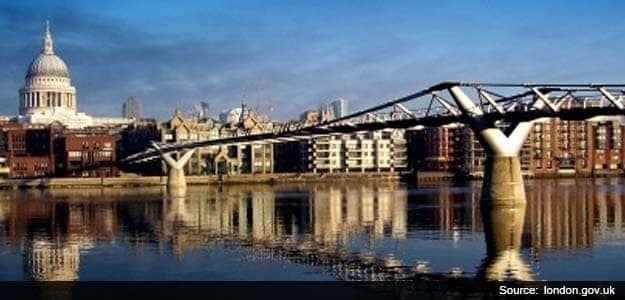
Skyscrapers are shooting up all over London, transforming a skyline once dominated by Big Ben and St Paul's Cathedral.
Some Londoners are delighted at their city's "Manhattanisation" but others warn it risks losing its soul.
"The City of London was a place of intricate streets," a "precious" urban pattern inherited from Georgian times, said Kieran Long, curator in contemporary architecture at the Victoria and Albert Museum.
"You must be very careful with what you put there," he told AFP. "Some of the high buildings have done damage to that."
A new study has revealed that no fewer than 237 skyscrapers are being built or have permission to begin construction over the coming year across London.
"It's going to change the face of London probably greater than at any time in its history, really, apart from maybe when St Paul's Cathedral was built," said Peter Murray, head of New London Architecture, a design and planning think tank.
Finished in 1710, St Paul's stands 111.3 metres (365 feet) tall - around a third of The Shard, Europe's highest skyscraper, which towers over the once-gritty Southwark neighbourhood.
Long warned places like the City of London and the West End were in danger of "losing" their character - a view not shared by passers-by at the foot of the "Walkie-Talkie", one of the signature towers changing the face of the British capital.
"I like them, I think they add character. They make London a bit more unusual," City worker Lucille Davis said.
Staring up at the skyscraper, Andy Arwood called it "amazing".
"There are so many buildings in London which are boring and dull and someone has actually sat down with that and designed it. I think it's brilliant!" he said.
'Changes the character'
London's skyscraper boom has come as a surprise to city authorities too, since there is no central urban planning office for the capital and decisions are taken borough by borough.
Mr Murray said the wave of construction was approved in response to major population growth in London with around 100,000 people coming in every year, which could bring the city's population to nearly 10 million by 2030 and around 13 million by 2050.
But while the architecture expert said some affordable housing is provided in the new buildings, he said the skyscrapers "are really designed for wealthier people".
"This is a total reversal to what we had in the 1960s and in the 1970s, where we built ugly concrete towers which were designed for poor people," he said.
In the new towers of glass, high-living apartments can go for tens of millions of pounds.
Billed as London's most luxurious apartment block, the 36-storey "Heron", for example, boasts a 6,000 square foot penthouse which went on the market this year for 18 million pounds ($30 million).
London's more original-looking skyscrapers have earned affectionate local nicknames like the "Walkie-Talkie", by Uruguay's Rafael Vinoly, or the curvaceous "Gherkin" by British architect Norman Foster.
One of the newest additions has been dubbed the "Cheesegrater" for its sloped profile, specifically designed to protect citywide views of St Paul's.
A frequent criticism of high-rises, in urban planning terms, is their thick base which Long said "completely changes the character of the streets".
By making local streets less hospitable, they can contribute to killing off independent shops, already few and far between in much of central London, in favour of sandwich joints for office workers, Long argued.
Rogers Stirk Harbour + Partners, the architects behind the "Cheesegrater", sought to respond to such concerns by cutting back the structure to create a sunlit plaza below.
But a letter to The Observer newspaper earlier this year signed by intellectuals including sculptor Antony Gormley and author Alan Bennett described many other towers as "generic" eyesores.
"The skyline of London is out of control," they warned. "Too many of these towers are of mediocre architectural quality and badly sited."

-
Talking Points This Week: Tech Nerves, FII Buying, And A Faraway Banking Shock

The global markets are not shining this Diwali. The exception in the large markets is, India.
-
Midterm Rally Lasted A Day. The Hard Reality Of A Divided US May Last Two Years | Opinion
Between a contested AI boom, a debt ceiling that arrives in 2027 and a president with every incentive to act alone, the next two years may prove more volatile than the first day's rally suggests.
-
Blue Wave Will Derail the AI Trade but Won't Dismantle the AI Era | Unhedged Position
The Democrats' sweep of the US Congress will see politics collide with economic forces both over the long and short term.
-
It's Time To Take The GST Council's Bet On Trust Global
Payment records can prove India's services exports, and clear, proportionate rules can bring foreign digital sellers into the tax net.
-
Opinion | India at 38: From Innovation Overperformer to Innovation Powerhouse
India now has 453 VC-backed deep science startups, 18 of them late-stage, after 117 percent growth since 2020. Laurus Labs, at USD 9.3 billion, is the most valuable deep science company in any middle-income economy outside China.
-
Navigating Energy Crossroads: S Jaishankar's Call For Diversified Supply Chains At G20 Ministerial Meeting
As geopolitical fault lines continue to test maritime trade routes and commodity flows, Jaishankar's message remains pertinent: true economic resilience requires open markets, protected transit lines, and a genuine commitment to multilateral cooperation rather than coercion.
-
Indians Are Travelling, But Not Every Journey Is A Holiday | The Week In Whys
Pilgrims, patients and working women are the real travellers, and the system hasn't quite caught up with them.
-
Getting To Work Costs Women More | The Reason Why
It is not just about women paying more than men. It is about women paying much more in cities than in villages.
-
AI Bias In Investing Cannot Be Eliminated, But It Can Be Governed
Framing is a particularly important example as identical financial information presented in terms of gains rather than losses can lead an LLM to reach a different assessment.









