HSBC Shares Hit 25-Year Low on China Fears, Alleged Suspicious Transfers
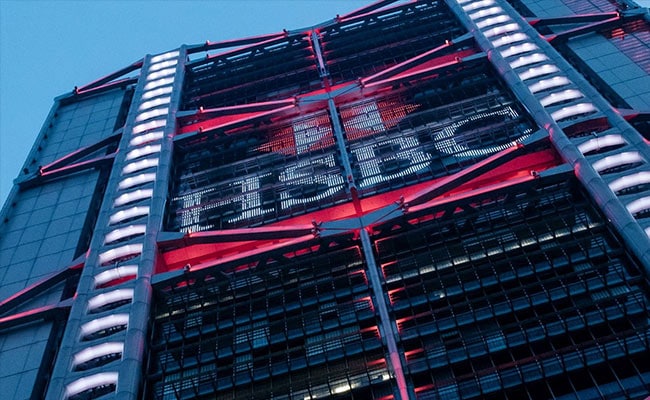
HSBC Holdings Plc slumped below its financial crisis low set more than a decade ago as pressures mount on several fronts, including a potential threat to its China expansion plans and increased scrutiny of money laundering controls.
The London-based bank's Hong Kong shares on Monday slid below their closing low for March 2009, hitting as low as HK$29.60. They have plunged 51 per cent this year, reaching the lowest since 1995. In London, HSBC fell 3.3 per cent as of 8:05 a.m. local time, compared with the 1.7 per cent decline in the benchmark FTSE 100 Index.
Europe's largest bank is a possible candidate for China's "unreliable entity list" that aims to punish firms, organizations or individuals that damage national security, the Communist Party's Global Times newspaper reported Saturday. A day later, HSBC was among global banks named in a report by the International Consortium of Investigative Journalists on lenders that "kept profiting from powerful and dangerous players" in the past two decades even after the U.S. imposed penalties on the institutions.
"If the company is listed as a unreliable company by China, which looks certain since it's a Global Times article, the bank will be facing lots of difficulties to do business in China," Banny Lam, head of research at CEB International Investment Corp., said by phone Monday. "They may have trouble expanding the mainland business, after investing so much there over the past few years."
The bank has rankled China over its participation in the American investigation of Huawei Technologies Co. Penalties include restrictions on trade, investments and visas on companies, countries, groups or persons that appear on the list.
HSBC declined to comment on the Global Times article. In a statement Monday in response to the ICIJ report it said that "starting in 2012, HSBC embarked on a multi-year journey to overhaul its ability to combat financial crime across more than 60 jurisdictions. HSBC is a much safer institution than it was in 2012."

Standard Chartered Plc, which was also mentioned in the ICIJ report, declined as much as 5.9 per cent in Hong Kong and 5.1 per cent in London. "We take our responsibility to fight financial crime extremely seriously and have invested substantially in our compliance programs," the bank said Monday in a statement.
HSBC now risks being caught in deepening turmoil after a swirl of trouble over the past year amid political unrest and an economic slump in its biggest market, Hong Kong. It also faces difficulties in navigating low interest rates and surging loan losses sparked by the global pandemic.
HSBC Chief Executive Officer Noel Quinn, who took over as the bank's permanent head in March, last month issued a stark warning about tough times ahead while reporting that first-half profit halved and predicting loan losses could swell to $13 billion this year. Mr Quinn said the bank would attempt to hasten a shakeup of its global operations, accelerating a further pivot into Asia as its European operations lose money.
Struggling to boost returns, the lender has come under fire both in the West and in China as it attempts to steer through political tension. HSBC was lambasted in the U.S. and the U.K. over its support for China's new security legislation on Hong Kong.
A jump in income from its markets business has failed to make up for broader shortcomings, unlike at some Wall Street and European competitors. HSBC stock has fallen more steeply than most big rivals this year, with Citigroup Inc. and JPMorgan Chase & Co. posting declines of 44 per cent and 29 per cent, respectively.
To make matters worse, HSBC sparked anger in Hong Kong earlier this year, alienating some of its most loyal investors, after scrapping its dividend in response to the pandemic. The bank is the worst performer on the benchmark Hang Seng index so far this year.

-
High US Salaries, No Green Card Certainty: The Financial Calculation Facing Indian H-1B Families

The suspension of PERM processing at eight technology employers does not cancel existing H-1B visas. What it does is force a question many Indian families have been avoiding: is the US salary worth tying your career and family plans to one employer?
-
Unhedged Position: Can India See An Indonesia-Style Time Correction?
The Nifty is trading below levels it first clocked in 2024. Is there, then, as I have suggested in the headline, potential that the current time correction drags on painfully for the next three-five, even ten years?
-
Navigating Friction And Energy Realities: An Analysis Of Marco Rubio's October Visit To India
Occurring at a critical juncture marked by stalled trade negotiations and escalating geopolitical pressures over global energy supplies, the visit offers a profound window into modern US-India relations.
-
India Exports Capital. Why Not Export Trusteeship?
The big question, then, is whether India can build an institution that global borrowers, investors, banks, and lawyers can trust, even without an Indian connection.
-
France's Economy & Politics Are In Crisis | The Reason Why
Let's look at how the French economy and politics evolved under Nicolas Sarkozy, Franois Hollande and Emmanuel Macron.
-
You May Inherit The Business. You Must Earn Its Credibility.
Succession tests the founder's ability to share authority as much as it tests the next generation's readiness to assume it.
-
Signing Deals Is One Thing; Making Them Work Is Another | The Week In Whys
Sometimes, things don't turn out as planned. Indian companies have lost some bids to rivals, some projects won't produce until 2030.
-
FOMC Wall, PERM Suspension, Hospital Stocks | Talking Points This Week
A PERM suspension would directly affect green-card sponsorship rather than H-1B visas, so the near-term earnings impact could remain relatively limited. The key question is whether this marks a new phase in US scrutiny of Indian IT.
-
Everything, Everywhere, All At Once: Dalal Street's Week To Forget | Joining The Dots
Visa curbs, a Starlink spat and cancer drug caps: what connects this week's shocks for Indian markets
-
India Is Going Abroad For Critical Minerals. But It May Take Years To Pay Off | The Reason Why
Although India's steps are in the right direction, they remain modest compared with India's growing dependence.









