Kotak Bank Net Income Rises Over 25% On Fall In Bad Loans, Record Margins
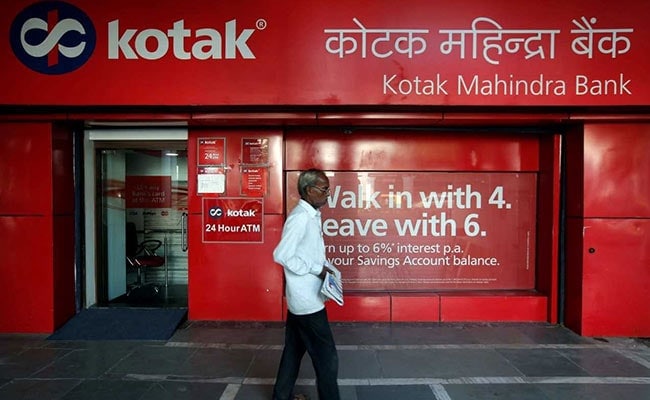
Private sector lender, Kotak Mahindra Bank on Saturday, reported a 26 per cent rise in net income at Rs 2,071.15 crore in the June quarter, buoyed by record margins and a decline in bad loans.
On a consolidated basis, the city-headquartered financial services group, which is also into life and non-life insurance, share broking, asset reconstruction, and AIF, among others, logged in 53 per cent rise in net income at Rs 2,755 crore in the June quarter over the corresponding period a year ago, the bank said.
The higher profitability is despite the bank booking a loss of over Rs 800 crore from treasury operations.
The chief financial officer Jaimin Bhatt refused to detail how much G-secs (government securities) the bank holds above the regulatory requirement of 18 per cent.
In a low credit demand or bank credit scenario, banks park their funds in government securities which are highly liquid assets and the average system level statutory liquidity ratio is over 23 per cent.
Explaining comparatively low amount of losses from the bond market, joint managing director Dipak Gupta told PTI that as much as 61 per cent of its bond holdings are in the AFS (available for sale) category and only 39 per cent in held to maturity segment, which has helped the bank to prevent a larger hit.
Total income for the quarter improved to Rs 8,582.25 crore from Rs 8,062.81 crore, boosted by an increase in interest income to Rs 7,338.49 crore, from Rs 6,479.78 crore in the year-ago period.
The key profitability gauge, the net interest income (NII), rose to Rs 4,697 crore, from Rs 3,942 crore, up 19 per cent on a near-record net interest margin (NIM) of 4.92 per cent.
NIM is the difference between what a bank earns from lending after paying for the depositors.
This high margin is even though the bank saw its low-cost CASA ratio (current and savings account ratio) declining by over 200 bps to 58.2 per cent in the quarter.
On the asset quality front, gross non-performing assets declined to 2.24 per cent from 3.56 per cent, while net NPAs fell to 0.62 per cent from 1.28 per cent.
Provisions for bad loans and contingencies slipped multi-fold to Rs 23.6 crore in the quarter, from Rs 934.8 crore in the year-ago quarter, and the provision coverage ratio stood at 72.6 per cent.
Advances rose 29 per cent to Rs 2,80,171 crore. Around 77 per cent of the incremental lending this quarter was unsecured, which are typically personal loans and credit cards and retail microfinance.
Mr Gupta said 77 per cent of loans being unsecured is neither sustainable nor healthy, but this is primarily because of the low base and will eventually come down.
Mr Gupta and Mr Bhatt guided towards a 20 per cent loan growth for the year, with a caveat that if the interest rates do not go over the roof.
They also admitted that despite a 29 per cent loan growth, their wholesale book is still not in the pink of health.
Among the many subsidiaries, Kotak Mahindra Life Insurance reported Rs 248 crore of net income up from Rs 243 crore, Kotak Securities at Rs 219 crore down from Rs 236 crore, Kotak Mahindra Prime at Rs 157 crore, up from Rs 79 crore, and Kotak Mahindra AMC logged in Rs 106 crore down from Rs 107 crore.

-
High US Salaries, No Green Card Certainty: The Financial Calculation Facing Indian H-1B Families

The suspension of PERM processing at eight technology employers does not cancel existing H-1B visas. What it does is force a question many Indian families have been avoiding: is the US salary worth tying your career and family plans to one employer?
-
Swiggy vs Eternal: Food Delivery's Two Rivals Are No Longer In The Same Race
Eternal is building a private AI assistant, dark.ai. Swiggy is still working out how to make Instamart pay, with an operating loss of Rs 895 crore in the July-September quarter while Blinkit stayed profitable.
-
Where You Live Shapes How You Get To Work | The Reason Why
Two-wheelers are the most popular way to get to work in India, accounting for nearly 43% of workplace commutes.
-
Unhedged Position: Can India See An Indonesia-Style Time Correction?
The Nifty is trading below levels it first clocked in 2024. Is there, then, as I have suggested in the headline, potential that the current time correction drags on painfully for the next three-five, even ten years?
-
Navigating Friction And Energy Realities: An Analysis Of Marco Rubio's October Visit To India
Occurring at a critical juncture marked by stalled trade negotiations and escalating geopolitical pressures over global energy supplies, the visit offers a profound window into modern US-India relations.
-
India Exports Capital. Why Not Export Trusteeship?
The big question, then, is whether India can build an institution that global borrowers, investors, banks, and lawyers can trust, even without an Indian connection.
-
France's Economy & Politics Are In Crisis | The Reason Why
Let's look at how the French economy and politics evolved under Nicolas Sarkozy, Franois Hollande and Emmanuel Macron.
-
You May Inherit The Business. You Must Earn Its Credibility.
Succession tests the founder's ability to share authority as much as it tests the next generation's readiness to assume it.
-
Signing Deals Is One Thing; Making Them Work Is Another | The Week In Whys
Sometimes, things don't turn out as planned. Indian companies have lost some bids to rivals, some projects won't produce until 2030.
-
FOMC Wall, PERM Suspension, Hospital Stocks | Talking Points This Week
A PERM suspension would directly affect green-card sponsorship rather than H-1B visas, so the near-term earnings impact could remain relatively limited. The key question is whether this marks a new phase in US scrutiny of Indian IT.









