Gucci’s Decline Shows Just How Dependent Luxury Is On China
(Bloomberg Opinion) -- Forget the K-shaped recovery. The recent surge in luxury goods shares has been decidedly C-shaped.
Big bling's valuations have been on a tear for the past two weeks since LVMH Moet Hennessy Louis Vuitton SE reported a blowout quarter for designer handbag sales, driven by Chinese consumers. But on Tuesday, Kering SA, the owner of Gucci, reminded investors that not all luxury companies would share equally in China's latest wave of revenge spending.
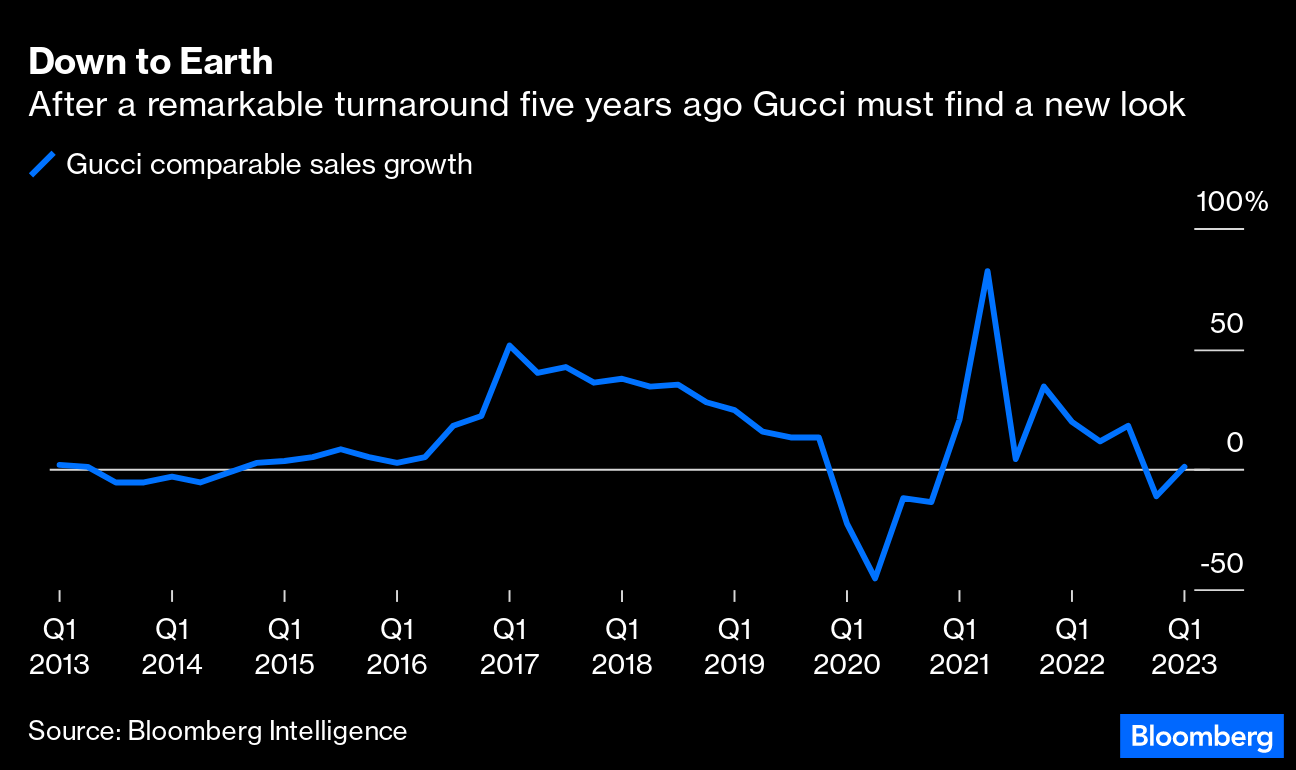
Kering's comparable sales growth, which excludes mergers and acquisitions and exchange rate fluctuations, rose 1% in the three months to March 31 — below the Bloomberg consensus of analysts' estimates of 2.9%. Gucci's sales also rose 1%, behind consensus of 2.7%. That's a far cry from the big beats of LVMH and Hermes International.
Kering will have to revitalize Gucci once more to participate in China's renewed love of luxury. But its performance is a lesson for all houses. They must work hard to stand out in the Chinese market when muscular names such as Louis Vuitton and Dior dominate.
To be sure, Kering isn't being totally left behind by China's reopening, proving that a rising tide can lift all boats to some extent. Sales to Chinese consumers rose in the double-digits year on year across all of its brands. Appetite improved from mid-March and has accelerated each month since in mainland China, as well as in Hong Kong and Macau. Compared with two years ago, group sales were up by a low double-digit percentage, with Gucci's sales in China also positive.
That's welcome, but Kering isn't benefiting as much as rivals either.
First of all, Gucci's bold maximalism under former creative director Alessandro Michele, which sparked a miraculous turnaround five to six years ago, has fallen out of fashion. Chinese consumers were among the first to adopt the logo-heavy look, but they appear to be bored with it more recently.
The company is working hard to address this shortfall. It is repositioning the house with new designer Sabato De Sarno, who joins from Valentino next month, and through taking it more upmarket. It is also improving its Chinese stores and attempting to bolster the brand by making it more visible, for example by opening an exhibition in Shanghai in a few days.
But it will take time for Gucci to regain its traction in China. That may explain why its shares are up around 23% between the start of the year and Tuesday's close — less than rivals.
Kering's performance is also a reminder that while Chinese consumers are rediscovering their love for luxury, younger, less wealthy buyers in the US, who have driven demand for sneakers and designer handbags over the past couple years, are starting to pull back.
Of course, Kering has some particular issues in what has become an even more important luxury market. Balenciaga, another previously fast-growing house, was embroiled in scandal late last year when it was accused of sexualizing children in advertising, for which it apologized. Meanwhile, amid the trend for “quiet luxury,” minimalist brand Bottega Veneta should have benefitted more.
But even with these wrinkles, Kering's performance should inject a note of caution into the luxury outlook. Its shares fell about 2% early Wednesday, dragging down the rest of the sector.
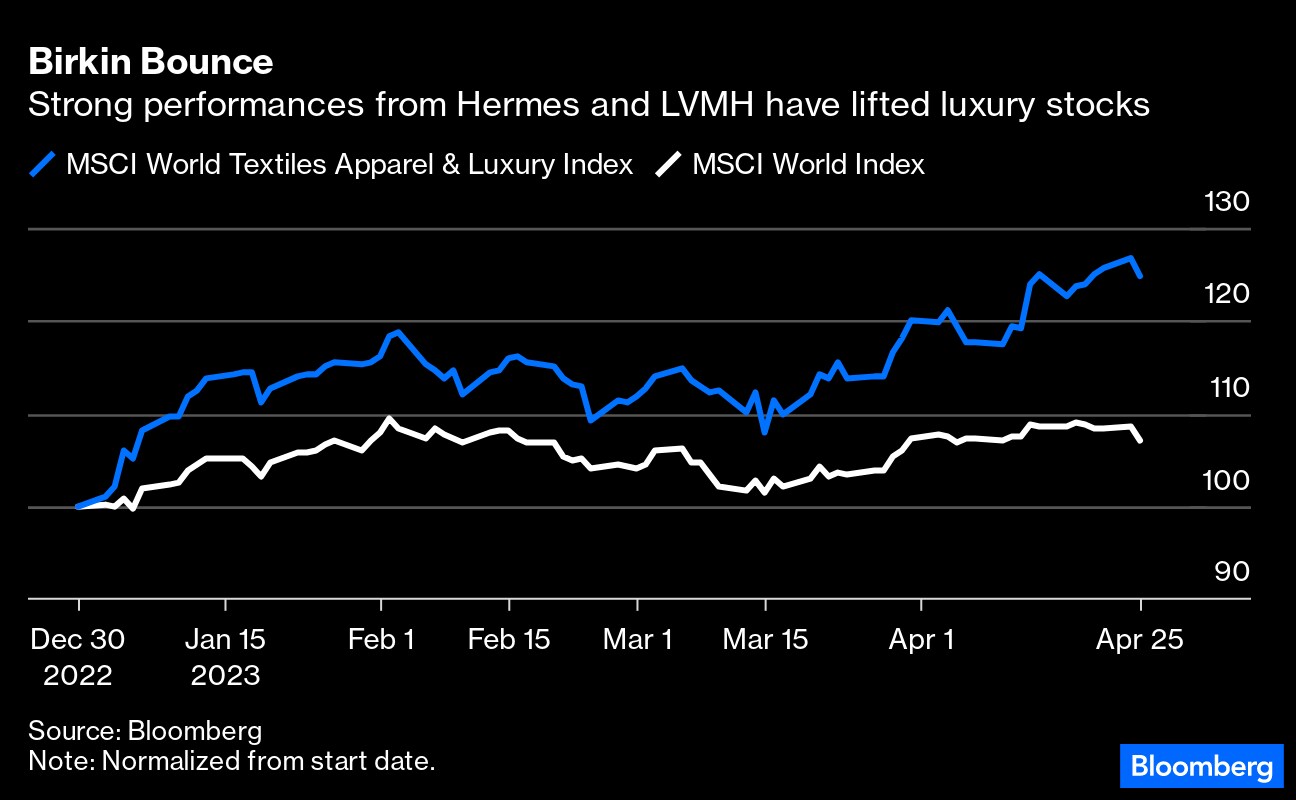
The MSCI World Textiles Apparel and Luxury Goods Index rose about 25% from the start of the year through Tuesday's close. LVMH is up 31% and became the first European company to touch a $500 billion valuation earlier this week. Hermes has achieved the biggest gain, up 38% over the same period.
But LVMH and Hermes are among the world's strongest luxury companies. Over the past three years, consumers have gravitated to the most high-profile names, such as LVMH's Louis Vuitton and Dior, Hermes and Cie Financiere Richemont SA's Cartier.
Smaller brands, such as Burberry Group Plc, will have to wrestle Chinese business away from these behemoths. Fortunately, it has star designer Daniel Lee, formerly with Bottega Veneta, to turbocharge its efforts. And it has traditionally generated a high proportion of its sales from Chinese consumers.
Right now, valuations across the sector look on par with fashion trends — although its notable that Kering's price-to-earnings ratio lags rivals.
For investors' overall optimism about luxury's prospects to be justified, they better hope to see a wave of high-flying Chinese tourists in Europe later this year and into 2024. Large-scale group tours haven't yet returned, but Kering said it was seeing individual Chinese tourists in its stores again. At the same time, there needs to be no let-up among Chinese shoppers purchasing at home.
Luxury can't afford to see this C-shaped recovery falter.
This column does not necessarily reflect the opinion of the editorial board or Bloomberg LP and its owners.
Andrea Felsted is a Bloomberg Opinion columnist covering consumer goods and the retail industry. Previously, she was a reporter for the Financial Times.
More stories like this are available on bloomberg.com/opinion
©2023 Bloomberg L.P.

-
Opinion | India at 38: From Innovation Overperformer to Innovation Powerhouse

India now has 453 VC-backed deep science startups, 18 of them late-stage, after 117 percent growth since 2020. Laurus Labs, at USD 9.3 billion, is the most valuable deep science company in any middle-income economy outside China.
-
Navigating Energy Crossroads: S Jaishankar's Call For Diversified Supply Chains At G20 Ministerial Meeting
As geopolitical fault lines continue to test maritime trade routes and commodity flows, Jaishankar's message remains pertinent: true economic resilience requires open markets, protected transit lines, and a genuine commitment to multilateral cooperation rather than coercion.
-
Indians Are Travelling, But Not Every Journey Is A Holiday | The Week In Whys
Pilgrims, patients and working women are the real travellers, and the system hasn't quite caught up with them.
-
Getting To Work Costs Women More | The Reason Why
It is not just about women paying more than men. It is about women paying much more in cities than in villages.
-
AI Bias In Investing Cannot Be Eliminated, But It Can Be Governed
Framing is a particularly important example as identical financial information presented in terms of gains rather than losses can lead an LLM to reach a different assessment.
-
Joining The Dots | Dark Skies, Steady Diya: Why Hope Holds This Diwali
With war, a weak rupee and foreign outflows weighing on sentiment, policymakers at the NDTV World Summit and market veterans at NDTV Profit Ignite: Diwali Edition offered the same advice: stay invested and filter out the noise.
-
The Curious Case of Equitas Small Finance Bank And A CEO Who Quit For Stock
PN Vasudevan believes persistent investor concerns over a perceived conflict of interest had become a governance overhang on Equitas Small Finance Bank's stock, even as the lender improved profitability and asset quality.
-
Talking Points This Week: AI Cash Burn, A Tiger Comeback And An India That Still Finds Its Own Path
India is not immune to higher oil or tighter global liquidity, yet its earnings base is broader, its domestic policy levers are still available.
-
Foreign Investors Own Half Of HDFC Bank and ICICI Bank. An LTCG Cut Could Matter Most Here
Foreign portfolio investors have US$115 billion parked in HDFC Bank, ICICI Bank. If the government cuts long-term capital gains tax, Jefferies says returning foreign money could land here first.










