K V Kamath's Journey From ICICI Bank to BRICS Bank
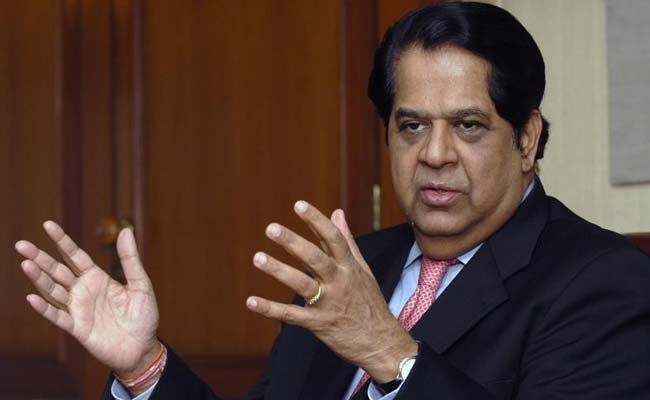
New Delhi: It's a $100-billion encore for Kundapur Vaman Kamath, who will be the first head of the five-nation BRICS Bank after transforming banking in India.
ICICI Bank, which was founded under Mr Kamath's leadership in 1994, now commands an asset base of $100 billion, while the New Development Bank of BRICS nations will have initial authorised capital of $100 billion.
Mr Kamath will largely operate from China in his new role at Shanghai-based BRICS Bank - taking him back to one of his favourite countries where he spent a good amount of time during his tenure at Asian Development Bank, between 1988 and 1996, when he returned to ICICI Bank as its CEO.
The 67-year-old banker, known among his friends as KV, began his career in 1971 at ICICI, the erstwhile financial institution that was incidentally set up at the initiative of another multi-lateral development institution, the World Bank.
ICICI Bank was later set up as a subsidiary of ICICI Ltd in 1994, while the parent later merged into it in 2002.
He led the group's transformation into a diversified, technology-driven financial services group that has leadership positions across banking, insurance and asset management in India and abroad.
Back in 2008, when ICICI Bank was hit by widespread rumours of 'run-on-the-bank', Mr Kamath led from the front and brought everything back into order, even as bank customers were queueing up before its branches to withdraw funds.
He retired as managing director and CEO in April 2009, and became its non-executive chairman.
Mr Kamath, a mechanical engineer and an MBA from prestigious IIM, Ahmedabad, has also been on board of several other companies, including that of IT giant Infosys where he also serves as a non-executive chairman.
Mr Kamath is also a Padma Bhushan awardee. Friends, colleagues and other industry leaders have known Mr Kamath as a man of 'big ideas and big numbers'.
When the entire world was heading towards a deep meltdown in 2008-2009, Mr Kamath continued to exude confidence in the long-term growth potential of Indian economy, the Indian banking sector and the Indian markets.
In an interview to PTI, Mr Kamath had said that he wanted a few Indian banks, including ICICI Bank, to be part of what he called 'Ivy League of global banks'. He had also forecast that a few banks from China would also be part of that league.
Some Chinese banks have indeed made it to the top of the charts globally, although the Indian banks had to cut down their global presence in the recent years due to a slowdown in worldwide economy.

-
High US Salaries, No Green Card Certainty: The Financial Calculation Facing Indian H-1B Families

The suspension of PERM processing at eight technology employers does not cancel existing H-1B visas. What it does is force a question many Indian families have been avoiding: is the US salary worth tying your career and family plans to one employer?
-
Swiggy vs Eternal: Food Delivery's Two Rivals Are No Longer In The Same Race
Eternal is building a private AI assistant, dark.ai. Swiggy is still working out how to make Instamart pay, with an operating loss of Rs 895 crore in the July-September quarter while Blinkit stayed profitable.
-
Where You Live Shapes How You Get To Work | The Reason Why
Two-wheelers are the most popular way to get to work in India, accounting for nearly 43% of workplace commutes.
-
Unhedged Position: Can India See An Indonesia-Style Time Correction?
The Nifty is trading below levels it first clocked in 2024. Is there, then, as I have suggested in the headline, potential that the current time correction drags on painfully for the next three-five, even ten years?
-
Navigating Friction And Energy Realities: An Analysis Of Marco Rubio's October Visit To India
Occurring at a critical juncture marked by stalled trade negotiations and escalating geopolitical pressures over global energy supplies, the visit offers a profound window into modern US-India relations.
-
India Exports Capital. Why Not Export Trusteeship?
The big question, then, is whether India can build an institution that global borrowers, investors, banks, and lawyers can trust, even without an Indian connection.
-
France's Economy & Politics Are In Crisis | The Reason Why
Let's look at how the French economy and politics evolved under Nicolas Sarkozy, Franois Hollande and Emmanuel Macron.
-
You May Inherit The Business. You Must Earn Its Credibility.
Succession tests the founder's ability to share authority as much as it tests the next generation's readiness to assume it.
-
Signing Deals Is One Thing; Making Them Work Is Another | The Week In Whys
Sometimes, things don't turn out as planned. Indian companies have lost some bids to rivals, some projects won't produce until 2030.
-
FOMC Wall, PERM Suspension, Hospital Stocks | Talking Points This Week
A PERM suspension would directly affect green-card sponsorship rather than H-1B visas, so the near-term earnings impact could remain relatively limited. The key question is whether this marks a new phase in US scrutiny of Indian IT.









