Jury finds SAC trader guilty of insider trading
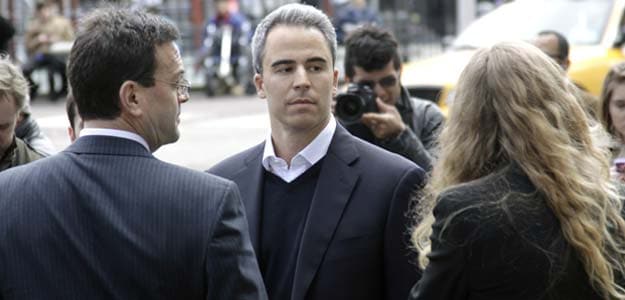
Prosecutors lacked the incriminating wiretaps that underpinned past insider trading cases. The emails pointed to no smoking gun. And the government's star witness, a felon who testified to avoid prison time, fumbled his way through five days of cross-examination.
And yet a federal jury in Manhattan on Wednesday still convicted Michael S. Steinberg, the highest-ranking employee at SAC Capital Advisors to stand trial for insider trading.
The verdict, delivered minutes after Steinberg, 41, fainted in the courtroom, underscored the futility of challenging the government's crackdown on some of Wall Street's most vaunted hedge funds.
On the eve of trial, prosecutors conceded that the case was not a slam dunk. But tapping into an anti-Wall Street sentiment - in opening arguments the lead prosecutor claimed that Steinberg broke the law "to get an illegal edge over ordinary investors who played by the rules" - apparently resonated with a jury of nine women and three men, including two accountants and a former Postal Service worker.
The verdict hands the government a signature victory in its pincerlike pursuit of SAC, the giant fund run by billionaire stock picker Steven A. Cohen. Coming just weeks after SAC pleaded guilty to insider trading charges and agreed to pay a record $1.2 billion penalty, Steinberg's conviction further clouds the future of a firm that was once the envy of Wall Street. And it may also embolden federal authorities in their decade-long investigation of SAC.
FBI agents are investigating whether some SAC employees used inside information to make trades in shares and options of Weight Watchers, Intermune and Gymboree, according to people briefed on the matter. Some investigators, the people said, are also holding out hope that Steinberg, staring at years in prison, will have a change of heart and cooperate with the broader investigation.
Even without the cooperation, Steinberg's conviction now raises the likelihood that Cohen, after avoiding criminal charges for years, will face continued scrutiny.
A spokesman for the hedge fund owner declined to comment.
Cohen, 57, has not been accused of any criminal wrongdoing, but a Securities and Exchange Commission lawsuit accuses him of failing to reasonably supervise his employees. The SEC, people briefed on the matter say, is expected to demand that Cohen never manage outside money at SAC or anywhere else.
The conviction of Steinberg is the latest victory by the U.S. attorney's office in Manhattan in its campaign to root out illegal conduct on Wall Street. Since 2009, the office has secured 77 insider trading convictions without losing a single trial. The government's marquee conviction came in 2011, when a jury found billionaire hedge fund manager Raj Rajaratnam guilty of insider trading.
"Like many other traders before him who, blinded by profits, lost their sense of right and wrong, Steinberg now stands convicted of federal crimes and faces the prospect of losing his liberty," Preet Bharara, the U.S. attorney in Manhattan, said in a statement.
After the monthlong trial in U.S. District Court, the jury took two days to find Steinberg guilty on four counts of securities fraud and one count of conspiracy.
"You can't take a man's freedom away in a day," Paul Skokandich, one of jurors, said in an interview after trial. A bookkeeper at Holiday Inn, he described the deliberations as a "fact-finding exercise."
Steinberg, a husband and father of a young family on the Upper East Side of Manhattan, appeared to faint briefly as the jury filed in to render their verdict.
Judge Richard J. Sullivan sent the jury back to the deliberation room as Steinberg's lawyers rubbed his back, his worried wife looking on from the front row. Steinberg's brother, who is a doctor, also checked on him.
The judge asked Steinberg, an imposing figure, if he could stand and walk.
Steinberg, his face ashen, said, "Yeah, I think I'm OK."
Sullivan freed Steinberg on bail until his April 25 sentencing. Steinberg faces a maximum of about 80 years in prison, but will almost certainly receive a sentence of only a few years. Steinberg's lawyer, Barry H. Berke, did not immediately comment on the verdict but is expected to appeal.
Steinberg was the first SAC employee to fight the government's investigation of the hedge fund. Of the eight SAC employees charged, six have pleaded guilty to securities fraud and are cooperating with the government. One employee, Mathew Martoma, is fighting the charges and faces a trial on Jan. 6.
Steinberg's case could alter the course of Martoma's. Prosecutors are holding out hope that Steinberg's loss at trial prompts Martoma, who also fainted when authorities first confronted him on his front yard in Boca Raton, Fla., to rethink his strategy and cooperate with the investigation.
After the verdict on Wednesday, Martoma's lawyer, Richard Strassberg, noted that "the facts in Steinberg's case are totally unrelated to the facts in the case against Mr. Martoma."
As for Cohen, the avid collector of art and real estate is well on his way to converting his 21-year-old hedge fund into a so-called family office that mainly will manage an estimated $9 billion of his personal fortune. Cohen, friends say, is weary of the investigation, though he believes that federal authorities have unfairly made him and some of his 900 employees targets.
Steinberg's name surfaced as person of interest in the investigation three years ago. He was arrested before dawn at his Park Avenue apartment after returning from a family trip to Disney World.
It was a significant move for the government, if only because Steinberg was personally close to Cohen, unlike the other SAC employees in the investigation. Cohen attended Steinberg's wedding at the Plaza Hotel years earlier. The pair also shared a hometown, Great Neck, on Long Island, and a love of art.
The investigation into SAC took its most serious turn in July, when prosecutors and the FBI announced an indictment of the hedge fund, pointing to a "systematic" insider trading scheme. After months of negotiating, SAC agreed to pay $1.2 billion and to wind down its business of managing outside money for investors. Prosecutors had threatened to raise the price of the deal if SAC declined to settle before Steinberg's trial opened last month.
Steinberg was accused of trading the stocks of the technology companies Dell and Nvidia after receiving confidential information about their earnings - trades that reportedly generated profits of $1.4 million. In opening arguments, the prosecutor leading the case, Antonia M. Apps, told jurors that the trial would provide a "unique window" into the world of insider trading.
Over the following weeks, Apps highlighted scores of emails and instant messages from Steinberg. She also called 13 witnesses, none more important than Jon Horvath, who once worked under Steinberg at SAC and was on the witness stand for nine days.
Horvath, a 44-year-old native Swede who potentially faces deportation, said he testified because "I hope to avoid jail time."
At the heart of the testimony was Horvath's claim that Steinberg pressured him to come up with "edgy" and "proprietary" information about the technology stocks.
"I thought he wanted me to cultivate sources of nonpublic information," that is, violate insider trading laws, Horvath said, adding that he feared for his job. "I thought he'd fire me."
Still, Steinberg, who did not testify, was at the end of a five-person chain of information that started with an insider at Dell and wound its way to Horvath and then Steinberg. And during a bruising cross-examination by Berke, Horvath conceded that Steinberg never explicitly told him to break the law by getting inside information.
But the testimony still proved damaging. Horvath recalled how, after other hedge funds were raided by federal authorities in fall 2010, Steinberg flew to a conference in Arizona to coach Horvath about answering questions from the FBI.
"He just walked straight up to me," Horvath said, adding that his then-boss didn't even say hello before bringing up the FBI.
© 2013, The New York Times News Service

-
Navigating Friction And Energy Realities: An Analysis Of Marco Rubio's October Visit To India

Occurring at a critical juncture marked by stalled trade negotiations and escalating geopolitical pressures over global energy supplies, the visit offers a profound window into modern US-India relations.
-
India Exports Capital. Why Not Export Trusteeship?
The big question, then, is whether India can build an institution that global borrowers, investors, banks, and lawyers can trust, even without an Indian connection.
-
France's Economy & Politics Are In Crisis | The Reason Why
Let's look at how the French economy and politics evolved under Nicolas Sarkozy, Franois Hollande and Emmanuel Macron.
-
You May Inherit The Business. You Must Earn Its Credibility.
Succession tests the founder's ability to share authority as much as it tests the next generation's readiness to assume it.
-
Signing Deals Is One Thing; Making Them Work Is Another | The Week In Whys
Sometimes, things don't turn out as planned. Indian companies have lost some bids to rivals, some projects won't produce until 2030.
-
FOMC Wall, PERM Suspension, Hospital Stocks | Talking Points This Week
A PERM suspension would directly affect green-card sponsorship rather than H-1B visas, so the near-term earnings impact could remain relatively limited. The key question is whether this marks a new phase in US scrutiny of Indian IT.
-
Everything, Everywhere, All At Once: Dalal Street's Week To Forget | Joining The Dots
Visa curbs, a Starlink spat and cancer drug caps: what connects this week's shocks for Indian markets
-
India Is Going Abroad For Critical Minerals. But It May Take Years To Pay Off | The Reason Why
Although India's steps are in the right direction, they remain modest compared with India's growing dependence.
-
When Everyone Has AI, What Gives You An Edge?
India's young workforce is entering an uncertain world of work where powerful AI tools are becoming widely accessible. The advantage will belong to those who combine deep expertise with digital fluency, and the distinctly human capabilities that technology cannot manufacture.
-
Wrong Labels, High Pesticide Residues Holding Back Agri Exports | The Reason Why
India needs stronger domestic food-safety and labelling standards, with best practices becoming part of everyday business for farmers, traders and food companies.










