It’s ‘Retail First’ For The IDFC Bank-Capital First Combine
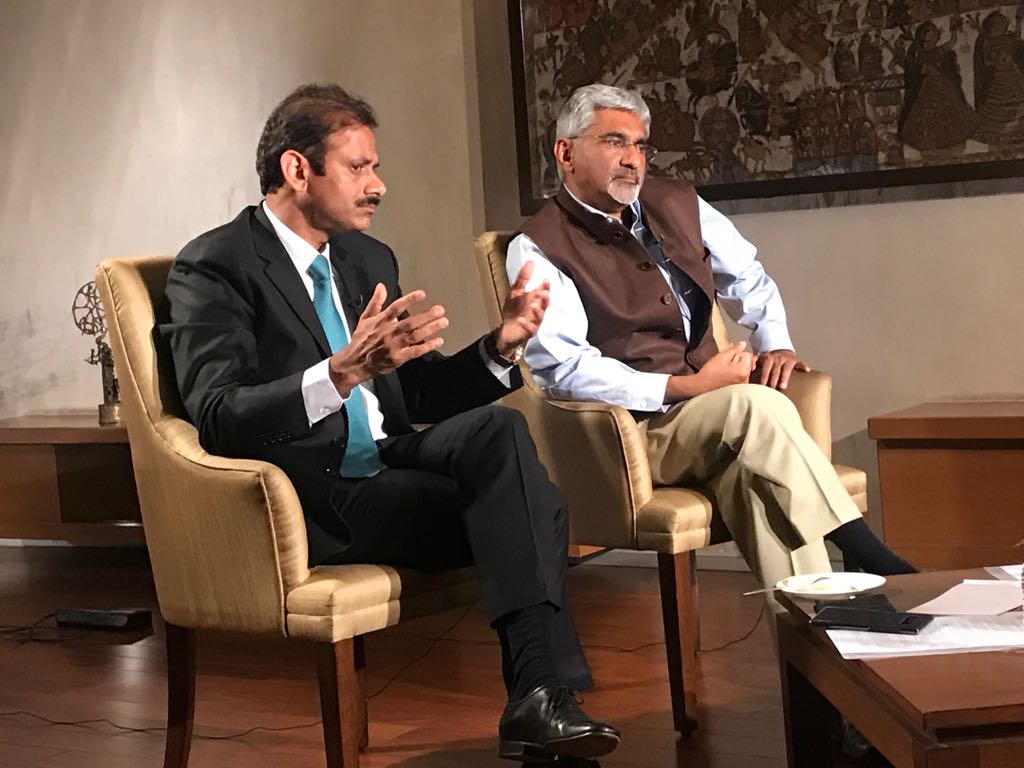
A retail bank to take on even the most blue-blooded of Indian retail lenders—that's the lofty ambition laid out by V. Vaidyanathan, currently chairman of Capital First Ltd. and soon-to-be chief executive officer of IDFC Bank Ltd.
Over the weekend, IDFC Bank and Capital First announced a plan to merge, creating a bank with an asset base of roughly Rs 90,000 crore. Rajiv Lall, who transitioned IDFC Ltd. into a bank and was its chief executive officer, will take on the role of non-executive chairman, while he lets Vaidyanathan take over the reins of the new entity which will be rechristened soon.
Vaidyanathan says he doesn't want to be compared or benchmarked to anyone but his ambitions are clear. Building a retail bank is the way to go. Lall agrees.
“Retail gives me peace of mind,” Vaidyanathan told BloombergQuint in an interview today. “Is it because I have done it all my life and I have a bias for it? Probably, yes. But I have seen cycles and I can tell you retail gives you peace of mind and that's what shareholders want.”
Retail assets currently make up about 35 percent of the IDFC Bank-Capital First combine. The merger has helped correct a skew towards wholesale loans that existed on the books of IDFC Bank. However, the large legacy book of the former infrastructure-financier means that the combined entity will still have a large chunk of wholesale loans.
Over time, the proportion of retail loans will move above 50 percent. Possibly much more than that, said Vaidyanathan while adding this does not mean that the bank will not pick-up on opportunities in the wider ‘ecosystem.'
To understand how ambitious the plan is, look at the current landscape. At present, only two private banks have retail books which are more than half the total loan book. HDFC Bank Ltd., which has 55 percent retail loans, and ICICI Bank Ltd., for whom retail loans make up 54 percent of the total book. Both have built their retail brand over decades.
Is the IDFC Bank-Capital First combine hoping to follow in the footsteps of these two private banking behemoths?
“I'm expecting Vaidya to build a bank like no other,” Lall joked but added that he believes that retail-focused banks have created more value in India. It was the same principle that had prompted Lall and IDFC Bank to pursue a complex merger with the Shriram Group in July last year. That one crashed and burned. Lall expects this deal to be ‘more elegant' and equally beneficial for IDFC Bank's shareholders.
You look at the banks that have sustainably created value over the last 15 years. They are banks which have eschewed big ticket financing for corporates. It's not that they don't do it but the proportion is quite different.Rajiv Lall, MD & CEO, IDFC Bank
Over the last few years, most other lenders, private and government-owned, have also shifted focus towards retail lending. This was partly due to a surge in corporate bad loans and limited demand for credit across industry. Between November 2016 and November 2017, gross bank credit grew at 8.3 percent, shows data from the Reserve Bank of India. Credit to industry grew at 1 percent, while personal loans grew at 17 percent. The pace of growth in retail credit has been well above overall credit growth for at least three years now, prompting regulators to throw in words of caution.
That's part of the regulator's duty, said Vaidyanathan shrugging off concerns that retail credit may be getting frothy. He sees enough room in the retail loan market to grow and grow fast.
I'm looking at (building) a bank that will give me peace of mind. That will grow between 15-20 percent a year for a long period of time. A bank that can increase its return on equity from a 5 percent to a 15 percent...If one can create a bank like that, there is tremendous value to be created.V Vaidyanathan, Chairman, Capital First

Delivering on the promise of consistent double-digit growth in an already crowded retail loan market will be tough. What will be tougher is matching those retail assets with retail liabilities.
As of the end of the September quarter, IDFC Bank had current account and savings account or CASA deposits of Rs 3200 crore. It's CASA ratio stood at 8.2 percent— among the lowest across private banks. Capital First comes with a retail loan book but no retail deposits.
In a note post the announcement of the merger, brokerage house Edelweiss said that a ramp up of the deposit base will be a key monitorable.
“IDFC Bank has been investing towards scaling up its retail franchise, but its liability base is still weak,” said the brokerage house. “Similarly, Capital First being an NBFC (non-banking financial company) is dependent on wholesale borrowings—with more than 50 percent bank borrowings,” it added.
Both Lall and Vaidyanathan are banking on the retail lending relationships that Capital First brings with it to grow the deposit base.
“Aggregating liabilities is a long-term task. It takes time. It's a marathon business,” said Lall. He expects the deposit base to be built by offering customers a holistic banking relationship. “The strategic calculus that we are making is that the resources required to build the liabilities franchise will be built by retailising the balancesheet, acquiring the customers to whom you can cross-sell liabilities,” Lall explained.
Most new private sector banks, however, have had to go beyond ‘relationship banking' to offer higher interest rates in order to draw depositors. Kotak Mahindra Bank Ltd. offers 6 percent on savings accounts. Yes Bank Ltd. offers 5 percent, while RBL Bank Ltd. offers between 6-7 percent. IDFC Bank offers 4 percent.
Presently ranked at number seven among private banks, will the IDFC Bank-Capital First combine grow organically or will it look for more acquisition to improve its standing. Let's first make this one work, said the duo.

Watch the full interview with Rajiv Lall and V Vaidyanathan:
With inputs from Shraddha Babla
Also Read: Here's Why Brokerages See IDFC Bank-Capital First Merger As A Positive Step

-
A New Samvat Wishlist: Inclusive Prosperity And Human Development

India has strengthened its economic foundations through infrastructure, digital access and enterprise. Its next growth chapter must deepen productivity, create better livelihoods and widen participation in prosperity.
-
Love, Sex Aur Dhokha: The Audacious Plot To Spy On Jensen Huang
A Taipei dinner, a Singapore chip buyer and a suspected Chinese asset: inside the alleged spy operation that got close to NVIDIA's Jensen Huang.
-
Ten Things I Learnt This Samvat
Patience can be a trap. Cheap stocks can stay cheap. Leverage can wipe you out. What did Samvat 2082 teach us? Niraj Shah writes on 10 lessons from the year gone by.
-
Talking Points This Week: Tech Nerves, FII Buying, And A Faraway Banking Shock
The global markets are not shining this Diwali. The exception in the large markets is, India.
-
Midterm Rally Lasted A Day. The Hard Reality Of A Divided US May Last Two Years | Opinion
Between a contested AI boom, a debt ceiling that arrives in 2027 and a president with every incentive to act alone, the next two years may prove more volatile than the first day's rally suggests.
-
Blue Wave Will Derail the AI Trade but Won't Dismantle the AI Era | Unhedged Position
The Democrats' sweep of the US Congress will see politics collide with economic forces both over the long and short term.
-
It's Time To Take The GST Council's Bet On Trust Global
Payment records can prove India's services exports, and clear, proportionate rules can bring foreign digital sellers into the tax net.
-
Opinion | India at 38: From Innovation Overperformer to Innovation Powerhouse
India now has 453 VC-backed deep science startups, 18 of them late-stage, after 117 percent growth since 2020. Laurus Labs, at USD 9.3 billion, is the most valuable deep science company in any middle-income economy outside China.
-
Navigating Energy Crossroads: S Jaishankar's Call For Diversified Supply Chains At G20 Ministerial Meeting
As geopolitical fault lines continue to test maritime trade routes and commodity flows, Jaishankar's message remains pertinent: true economic resilience requires open markets, protected transit lines, and a genuine commitment to multilateral cooperation rather than coercion.









