Is D-Mart Losing Its Lowest-Price Edge?
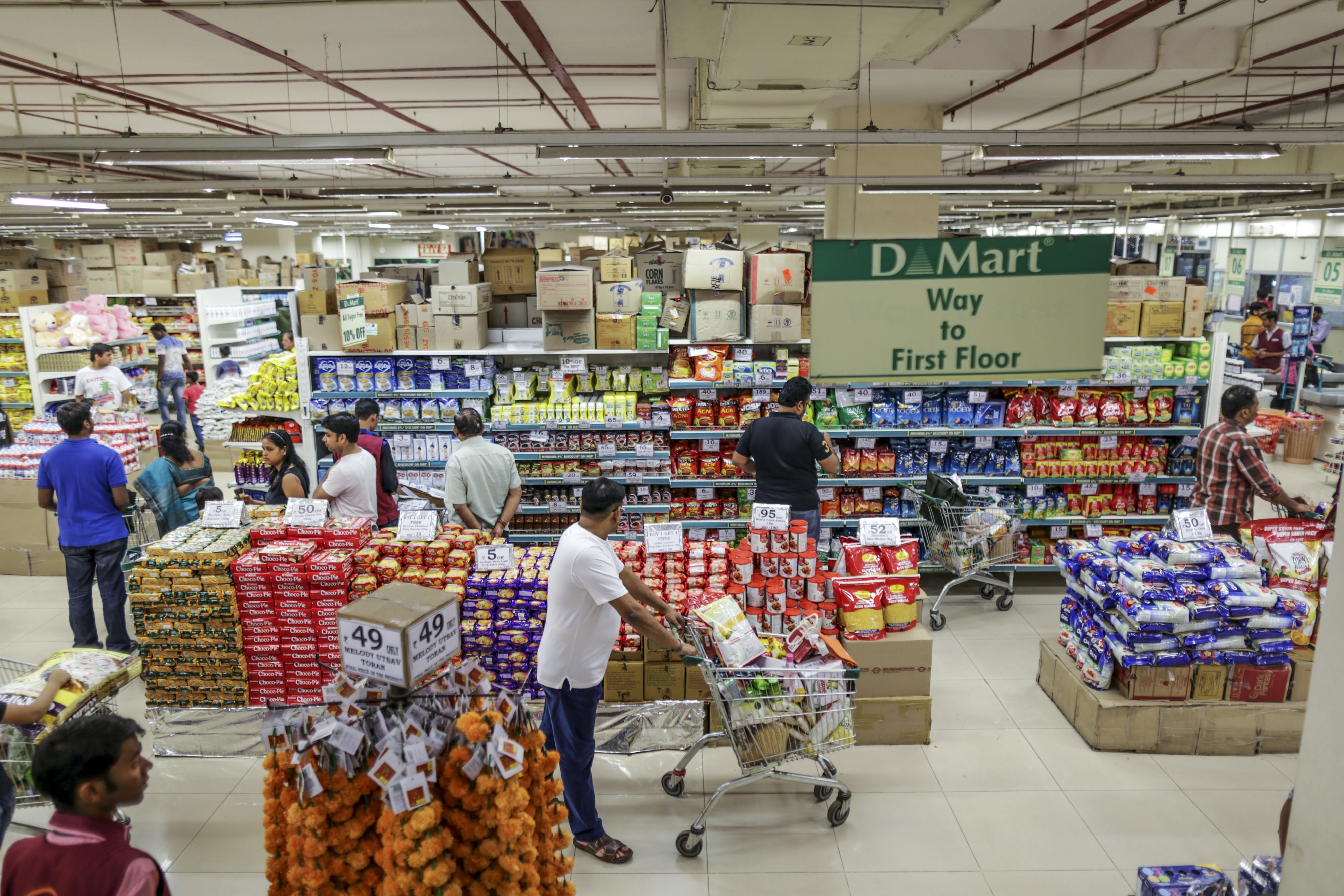
The online shopping boom has dented the ability of India's lowest-price retailer to offer staples to shampoos at cheaper rates.
D-Mart supermarket chain, operated by billionaire Radhakishan Damani-controlled Avenue Supermarts Ltd., now sells fewer products at lower prices than peers, according to a Kotak Institutional Equities report. In October last year, D-Mart offered the cheapest price for 21 of the 30 products under the brokerage's coverage. The count fell to 12 in March.
Competition from well-funded online players in the grocery space seems to be on the rise, resulting in some dilution of the retailer's lowest-price proposition, the report said. Besides Alibaba Group-backed BigBasket, Walmart's Flipkart Supermart and Amazon Pantry, offline peers such as Mukesh Ambani's Reliance Smart, and Kishore Biyani's Big Bazaar and EasyDay stores have also cut prices of several food and consumer items.
India's e-commerce market is expected to swell more than threefold in four years through 2021 to $84 billion, according to a report by Deloitte India and Retailers Association of India. That's aided by faster data speeds and increasing smartphone usage. Even Avenue Supermarts launched a hybrid model where it takes orders online and customers can pick them up from designated centres close to their homes.
Still, D-Mart's core customer base is loyal and less amenable to online shopping, Kotak Institutional Securities said. But competitors like Amazon, Reliance Retail and Flipkart are well funded and BigBasket also recently raised $160 million. These funds help them offer high discounts over a long period, according to the report. “This in turn could work against D-Mart's current pricing strategy.”
Price Comparison
The brokerage compared prices of staples such as flour, sugar, rice, dairy; packaged foods such as branded cornflakes, juices and biscuits; and personal care items including soaps, shampoos, detergents and toothpaste.
Staples And Packaged Food
- Of the 16 branded items under the brokerage's coverage, D-Mart charges 4 to 17 percent more for nine than the lowest price offered by competitors.
- The supermarket chain still offers the cheapest prices for the remaining seven.
Home And Personal Care
- Of the 15 items, the retailer offers the lowest prices for six.
- The remaining items at available a premium of 4 to 30 percent.
Is Avenue Supermarts Protecting Margins?
The company's earnings before interest, tax, depreciation and amortisation margin has fallen on a yearly basis for two straight quarters. While it attributed narrower margin in the three months ended December to longer working hours during the festive season, Edelweiss Securities and Motilal Oswal had then expressed concerns over competitive pricing by peers.
Avenue Supermarts is yet to respond to BloombergQuint's queries on why the company's prices have been higher than its peers', given its ‘Everyday Low Prices' strategy.
Kotak Institutional Securities, however, said margin may be down on its priority list, and the brokerage expects the retailer to push volumes. “We believe the Street's margin improvement expectation may not be met as D-Mart will remain focused on boosting sales, and will pass on most margin benefits (pricing benefits from suppliers) to customers in its bid to retain its position of the lowest-price retailer.”

-
High US Salaries, No Green Card Certainty: The Financial Calculation Facing Indian H-1B Families

The suspension of PERM processing at eight technology employers does not cancel existing H-1B visas. What it does is force a question many Indian families have been avoiding: is the US salary worth tying your career and family plans to one employer?
-
Swiggy vs Eternal: Food Delivery's Two Rivals Are No Longer In The Same Race
Eternal is building a private AI assistant, dark.ai. Swiggy is still working out how to make Instamart pay, with an operating loss of Rs 895 crore in the July-September quarter while Blinkit stayed profitable.
-
Where You Live Shapes How You Get To Work | The Reason Why
Two-wheelers are the most popular way to get to work in India, accounting for nearly 43% of workplace commutes.
-
Unhedged Position: Can India See An Indonesia-Style Time Correction?
The Nifty is trading below levels it first clocked in 2024. Is there, then, as I have suggested in the headline, potential that the current time correction drags on painfully for the next three-five, even ten years?
-
Navigating Friction And Energy Realities: An Analysis Of Marco Rubio's October Visit To India
Occurring at a critical juncture marked by stalled trade negotiations and escalating geopolitical pressures over global energy supplies, the visit offers a profound window into modern US-India relations.
-
India Exports Capital. Why Not Export Trusteeship?
The big question, then, is whether India can build an institution that global borrowers, investors, banks, and lawyers can trust, even without an Indian connection.
-
France's Economy & Politics Are In Crisis | The Reason Why
Let's look at how the French economy and politics evolved under Nicolas Sarkozy, Franois Hollande and Emmanuel Macron.
-
You May Inherit The Business. You Must Earn Its Credibility.
Succession tests the founder's ability to share authority as much as it tests the next generation's readiness to assume it.
-
Signing Deals Is One Thing; Making Them Work Is Another | The Week In Whys
Sometimes, things don't turn out as planned. Indian companies have lost some bids to rivals, some projects won't produce until 2030.
-
FOMC Wall, PERM Suspension, Hospital Stocks | Talking Points This Week
A PERM suspension would directly affect green-card sponsorship rather than H-1B visas, so the near-term earnings impact could remain relatively limited. The key question is whether this marks a new phase in US scrutiny of Indian IT.









