Is Credit Growth Really That Low In India? No, Says Nomura
One of the big mysteries (and there are many) in the Indian economy currently is the persistently low credit growth, which fell further after the government's demonetisation drive in November.
After struggling along at just under 10 percent for almost a year, credit growth fell to under 5 percent starting November, according to fortnightly data released by the Reserve Bank of India (RBI). It has stayed at those levels. For the fortnight ended February 17, non-food bank credit rose a meagre 4.7 percent.
Bankers blame low demand from industry and now from the mortgage sector. Economists have cited this low credit growth as one data point that makes the strong 7 percent GDP growth in the third quarter less believable.
What the headline number hides is the slow shift in sources from where credit is being raised. A shift towards the bond markets which started in 2014 has persisted, meaning that overall credit demand may be stronger that what bank credit suggests.
Nomura has put a number to this.
In a report dated March 2, Nomura said true credit growth is closer to 7 percent. That's not to say that it isn't weak. Just not as weak as what the bank credit data suggests.
RBI credit data(3.7 percent year-on-year growth in January '17) does not capture the impact of bond substitutionand State Electricity Board (SEB) loan conversions. The corporate bond book has been growing at 16-18 percent year-on-year for the past 12 months, and Rs 1.7 lakh crore of SEB loans have beenconverted into bonds under UDAY scheme over the past 6-7 months. Addingthis up, we estimate that overall credit growth is 6.7 percent year on year and industry andservices credit growth is 5.6 percent year on year (1 percent contraction as per RBI).Nomura Global Market Research
While saying that growth in bank loans may be understating the actual demand for credit in the economy, Nomura goes on to say that there are fundamental reasons for subdued credit demand. This includes the deleveraging of corporate balance sheets.
Three sectors – infrastructure, metals and textiles – contributed 30-25 percent of total incremental credit in the financial year (FY) 2007-08 to FY14 period, when bank credit was growing at 17 percent year on year. Adjusting for these sectors, credit growth was closer to 12-13 percent. Credit demand from these sectors (excluding SEBs) is now down to zero, which is bound to impact overall demand for loans.
From an effective 6-7 percent rate of growth now, we forecast growth to pick up to 9 percent over FY17-19 (including bonds/ECBs) reflecting the deleveraging cycle. With this industry growth, PSU banks should grow at 5-6 percent year on year, representing 17 percent year on year CAGR (compounded annual growth rate) for private banks.Nomura Global Market Research
Shift Away From Banks
Demand for credit typically shifts towards bonds when market rates are far lower than bank lending rates. This has certainly been the case since the start of 2015 when markets transmitted the RBI's rate cuts far quicker than banks. In a January 2016 report, Ambit Capital had pointed out that banks have lost nearly 5 percent points in market share to bond markets over the past two years. This was partly because of the rate advantage in the markets.
In a speech on September 30 2016, RBI Deputy Governor SS Mundra had highlighted this and also pointed to the fact that banks have also lost share to non-banking financial companies (NBFCs).
Data presented by Mundra (below) showed that the share of bank credit in total credit reduced from 64.7 percent in the year ended March 2014 to 61.4 percent in the year ended March 2016.
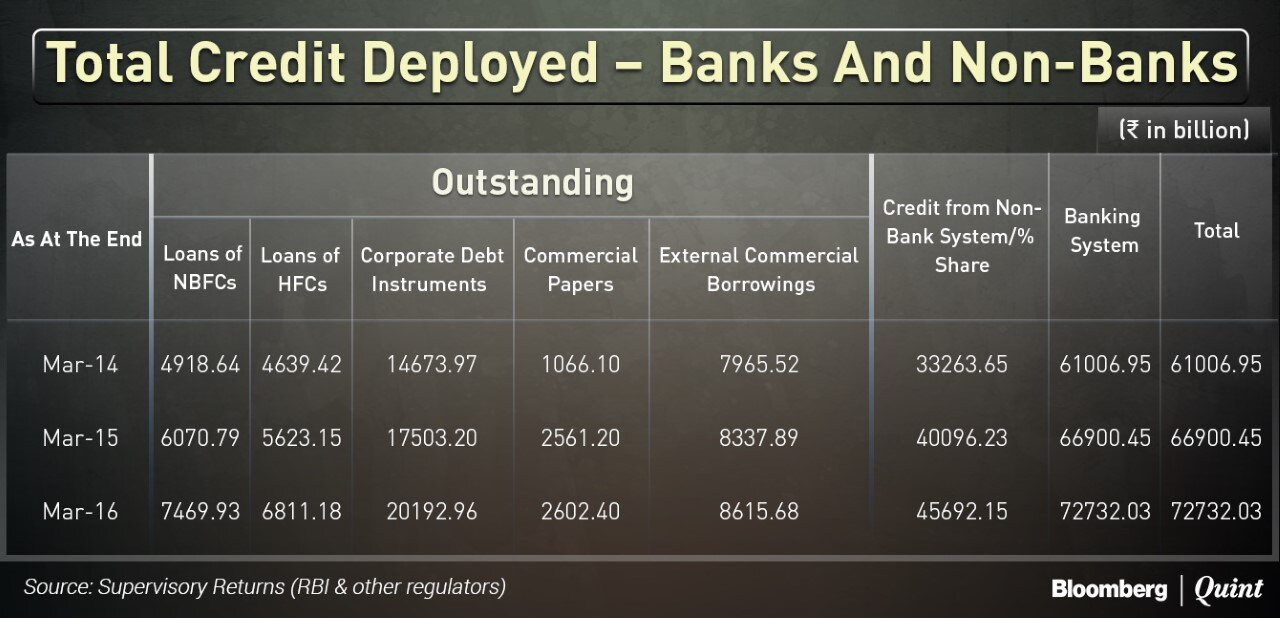
While credit from banking system has gone up by 19.22 percent between March 14 and March 16, the credit from the non-bank system during the same period has gone up by 37.4 percent.SS Mundra, Deputy Governor, RBI (Speech On September 30, 2016)
This shift could intensify starting next fiscal.
The RBI had put in place a new framework under which banks will have to set aside more provisions and assign a higher risk weight to ‘specified borrowers' who have more than Rs 25,000 crore in loans outstanding. This could make bank loans more expensive and push these firms towards the bond market – which was the idea behind the new framework. This limit will reduce to Rs 15,000 crore in FY19 and Rs 10,000 crore from the start of FY20.

-
Navigating Energy Crossroads: S Jaishankar's Call For Diversified Supply Chains At G20 Ministerial Meeting

As geopolitical fault lines continue to test maritime trade routes and commodity flows, Jaishankar's message remains pertinent: true economic resilience requires open markets, protected transit lines, and a genuine commitment to multilateral cooperation rather than coercion.
-
Indians Are Travelling, But Not Every Journey Is A Holiday | The Week In Whys
Pilgrims, patients and working women are the real travellers, and the system hasn't quite caught up with them.
-
Getting To Work Costs Women More | The Reason Why
It is not just about women paying more than men. It is about women paying much more in cities than in villages.
-
AI Bias In Investing Cannot Be Eliminated, But It Can Be Governed
Framing is a particularly important example as identical financial information presented in terms of gains rather than losses can lead an LLM to reach a different assessment.
-
Joining The Dots | Dark Skies, Steady Diya: Why Hope Holds This Diwali
With war, a weak rupee and foreign outflows weighing on sentiment, policymakers at the NDTV World Summit and market veterans at NDTV Profit Ignite: Diwali Edition offered the same advice: stay invested and filter out the noise.
-
The Curious Case of Equitas Small Finance Bank And A CEO Who Quit For Stock
PN Vasudevan believes persistent investor concerns over a perceived conflict of interest had become a governance overhang on Equitas Small Finance Bank's stock, even as the lender improved profitability and asset quality.
-
Talking Points This Week: AI Cash Burn, A Tiger Comeback And An India That Still Finds Its Own Path
India is not immune to higher oil or tighter global liquidity, yet its earnings base is broader, its domestic policy levers are still available.
-
Foreign Investors Own Half Of HDFC Bank and ICICI Bank. An LTCG Cut Could Matter Most Here
Foreign portfolio investors have US$115 billion parked in HDFC Bank, ICICI Bank. If the government cuts long-term capital gains tax, Jefferies says returning foreign money could land here first.
-
'Never Seen This Level Of Negativity': Sandeep Tandon Says The Next Rally May Be Closer Than You Think
Veteran investor Sandeep Tandon says foreign selling is easing, large-caps are due a comeback and mid-caps are crowded, while he turns positive on gold, power and pharma this Diwali.










