Train 18 Likely To Start Operations By December 15: 10 Things To Know
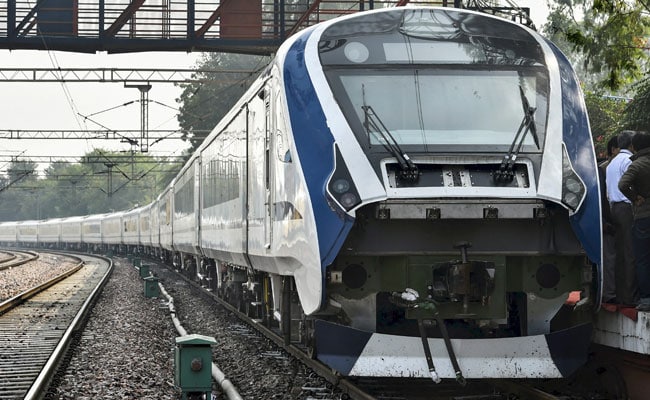
Train 18 -- the country's first engine-less semi-high speed train -- is likely to start operations by December 15, a senior railway ministry official was quoted as saying in a Press Trust of India (PTI) report. The train is currently undergoing trials in Moradabad. Train 18 will run at a maximum speed of 160 kilometres per hour (kmph) between either Delhi and Varanasi or Delhi and Bhopal, the report said. Train 18 was launched last month amid much fanfare by Railway Board Chairman Ashwani Lohani at the Integrated Coach Factory in Chennai.
Here are 10 things to know about Train 18:
1. Train 18 is a fully air-conditioned train which is driven by a self-propulsion module and comes with technical features for enhanced quick acceleration.
2. It is a gleaming, blue-nosed train with a cone-shaped frontage, similar to a bullet train.
3. Train 18 is regarded as a successor to the prestigious 30-year-old Shatabdi Express.
4. There are 16 coaches comprising of executive and non-executive classes. The seating capacity is 1,128.
5. There are two executive compartments in the middle with 52 seats each, whereas trailer coaches have 78 seats each.
6. The seats can rotate 360 degrees and can be aligned in the direction of travel.
7. The coach doors open only when the train is at zero kmph and the train starts only when all the coach doors are properly closed.
8. The footstep in a coach's doorway slides outward when the train stops at a station enabling passengers to alight safely with comfort in view of the variation in height between a train's floor and the platform.
9. Train 18 has amenities such as- on-board WiFi, GPS-based passenger information system, 'touch-free' bio-vacuum toilets, LED lighting, mobile charging points, and a climate control system that would adjust the temperature according to occupancy and weather.
10. Train 18 was built in 18 months. After finishing the trials in the city, Train 18 left for Delhi on November 11 and reached the capital two days later.

-
Ten Things I Learnt This Samvat

Patience can be a trap. Cheap stocks can stay cheap. Leverage can wipe you out. What did Samvat 2082 teach us? Niraj Shah writes on 10 lessons from the year gone by.
-
Talking Points This Week: Tech Nerves, FII Buying, And A Faraway Banking Shock
The global markets are not shining this Diwali. The exception in the large markets is, India.
-
Midterm Rally Lasted A Day. The Hard Reality Of A Divided US May Last Two Years | Opinion
Between a contested AI boom, a debt ceiling that arrives in 2027 and a president with every incentive to act alone, the next two years may prove more volatile than the first day's rally suggests.
-
Blue Wave Will Derail the AI Trade but Won't Dismantle the AI Era | Unhedged Position
The Democrats' sweep of the US Congress will see politics collide with economic forces both over the long and short term.
-
It's Time To Take The GST Council's Bet On Trust Global
Payment records can prove India's services exports, and clear, proportionate rules can bring foreign digital sellers into the tax net.
-
Opinion | India at 38: From Innovation Overperformer to Innovation Powerhouse
India now has 453 VC-backed deep science startups, 18 of them late-stage, after 117 percent growth since 2020. Laurus Labs, at USD 9.3 billion, is the most valuable deep science company in any middle-income economy outside China.
-
Navigating Energy Crossroads: S Jaishankar's Call For Diversified Supply Chains At G20 Ministerial Meeting
As geopolitical fault lines continue to test maritime trade routes and commodity flows, Jaishankar's message remains pertinent: true economic resilience requires open markets, protected transit lines, and a genuine commitment to multilateral cooperation rather than coercion.
-
Indians Are Travelling, But Not Every Journey Is A Holiday | The Week In Whys
Pilgrims, patients and working women are the real travellers, and the system hasn't quite caught up with them.
-
Getting To Work Costs Women More | The Reason Why
It is not just about women paying more than men. It is about women paying much more in cities than in villages.









