This Is India's Priciest Stock, And Investors Are Pouring Cash Into It
Surrounded by all the doom and gloom around the consumer sector, a paint producer got so much love from investors that it is now the most expensive stock in the country's benchmark index. Asian Paints' price-to-earnings ratio of 80.1 makes it the highest valued on the S&P BSE Sensex Index. The paint manufacturer has climbed 29.5 per cent in the last six months -- when the broader gauge was up 6.7 per cent -- and has hit a record high in the past month.
Investors value its ability to churn out a record profit at a time when management at other consumer-oriented companies have warned of the impact from an economic slowdown. Of the 39 analysts who cover the stock, just four have the equivalent of a sell call. Country's paint industry, which Asian Paints dominates with around 40 per cent market share, has been viewed as a haven.
"Asian Paints is likely to keep rising" thanks in large part to double-digit growth in its volume of paint sales, said Abhijeet Kundu, an analyst at Antique Stock Broking, who estimated the increase to be 15 per cent-17 per cent in the last quarter. "There are very few companies that are growing at that kind of rate."
Asian Paints's stellar performance is a contrast to its consumer peers. Titan Co, the country's biggest jeweler, plunged 10 per cent last week after nearly halving its growth guidance for the second half of the year. Srinivas Phatak, chief financial officer at Hindustan Unilever, country's biggest consumer goods company, said "the demand outlook is definitely challenging" in an earnings call last month.
Consumer businesses are suffering in India as economic expansion has slowed to a six-year low, exacerbated by a credit crunch amid a shadow banking crisis. Consumers have also tightened their belt as the unemployment rate hit the highest in 45 years. Even the recently concluded festival season doesn't seem to have lifted spending by much, with shopkeepers reporting a poor show.
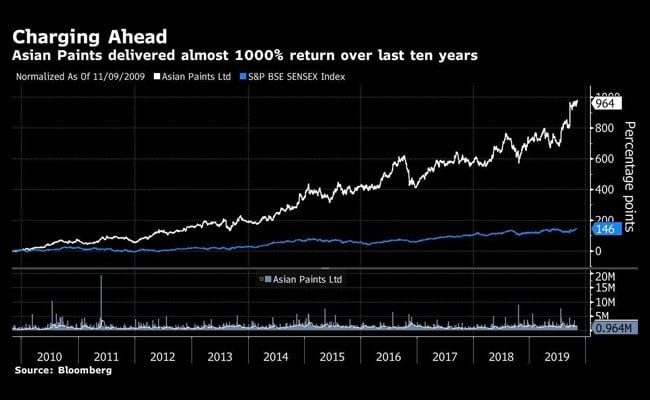
Defying weakening consumer confidence, Asian Paints's net income has risen for two straight quarters to a record Rs 830 crore ($117 million) in the July-September period. Over the past 10 years, the firm has returned investors almost 1,000 per cent, the third highest among stocks on the Sensex index.
To be sure, the company is not totally immune to the economic malaise. Its revenue growth has stalled this year, and an unexpectedly long rainy season also crimped demand. Asian Paints didn't respond to emails and calls requesting comment.
Analysts say the weakness in revenue is due to price cuts and popularity of cheaper products rather than a substantial decline in demand.
For bulls, the company also stands out on management track record. Its decades-old tradition of prioritizing corporate governance, rare in a country that's still dominated by family-run businesses, is valued by long-term investors.
Asian Paints is one of the rare companies in India that has always had a genuinely independent board, Saurabh Mukherjea, co-founder and chief investment officer at Marcellus Investment Managers, wrote in his book "The Unusual Billionaires."
"If you want to build an institution where changes in the external or internal environment don't matter, it has to start at the top with great corporate governance," said Rakshit Ranjan, co-founder and fund manager at Marcellus. "I don't think you could find 10 other companies in the country with the same level of corporate governance as Asian Paints."

-
High US Salaries, No Green Card Certainty: The Financial Calculation Facing Indian H-1B Families

The suspension of PERM processing at eight technology employers does not cancel existing H-1B visas. What it does is force a question many Indian families have been avoiding: is the US salary worth tying your career and family plans to one employer?
-
Swiggy vs Eternal: Food Delivery's Two Rivals Are No Longer In The Same Race
Eternal is building a private AI assistant, dark.ai. Swiggy is still working out how to make Instamart pay, with an operating loss of Rs 895 crore in the July-September quarter while Blinkit stayed profitable.
-
Where You Live Shapes How You Get To Work | The Reason Why
Two-wheelers are the most popular way to get to work in India, accounting for nearly 43% of workplace commutes.
-
Unhedged Position: Can India See An Indonesia-Style Time Correction?
The Nifty is trading below levels it first clocked in 2024. Is there, then, as I have suggested in the headline, potential that the current time correction drags on painfully for the next three-five, even ten years?
-
Navigating Friction And Energy Realities: An Analysis Of Marco Rubio's October Visit To India
Occurring at a critical juncture marked by stalled trade negotiations and escalating geopolitical pressures over global energy supplies, the visit offers a profound window into modern US-India relations.
-
India Exports Capital. Why Not Export Trusteeship?
The big question, then, is whether India can build an institution that global borrowers, investors, banks, and lawyers can trust, even without an Indian connection.
-
France's Economy & Politics Are In Crisis | The Reason Why
Let's look at how the French economy and politics evolved under Nicolas Sarkozy, Franois Hollande and Emmanuel Macron.
-
You May Inherit The Business. You Must Earn Its Credibility.
Succession tests the founder's ability to share authority as much as it tests the next generation's readiness to assume it.
-
Signing Deals Is One Thing; Making Them Work Is Another | The Week In Whys
Sometimes, things don't turn out as planned. Indian companies have lost some bids to rivals, some projects won't produce until 2030.
-
FOMC Wall, PERM Suspension, Hospital Stocks | Talking Points This Week
A PERM suspension would directly affect green-card sponsorship rather than H-1B visas, so the near-term earnings impact could remain relatively limited. The key question is whether this marks a new phase in US scrutiny of Indian IT.









