Rupee Ends At 2-Week High Against Dollar
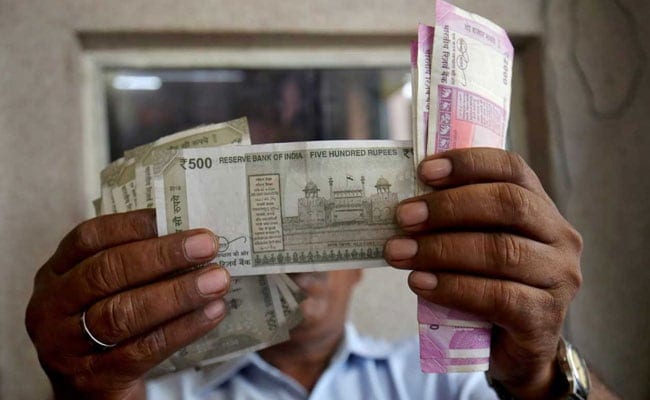
The rupee on Tuesday rose to a two-week high against the US dollar on hopes of partial trade deal between the US and China next month. The domestic currency closed at 70.94 to the dollar, a gain of 20 paise or 0.28 per cent over the previous close on Friday. Forex market was closed on Monday on account of assembly elections in Maharashtra.
Analysts said growing expectations of a partial trade deal between the US and China next month bolstered the appetite for riskier assets like emerging currencies. Also, Commerce Minister Piyush Goyal said India and the US will hopefully come out with the first set of agreements soon to address their trade issues.
Trade tensions have weighed on emerging and developing currencies as investors are looking for safe bets amid uncertainty over trade growth.
"Trade talks between the US and China have started to progress and the risk-on sentiment could further support the rupee. Brexit related uncertainty could continue as fresh updates on the same are likely to come in today's evening session. Parliament Brexit Vote is scheduled and we expect that could keep the volatility high for pound," Gaurang Somaiyaa, Forex & Bullion Analyst, Motilal Oswal Financial Services Private Ltd, said.
US President Donald Trump said he expects to sign the partial deal on the sidelines of the Asia-Pacific Economic Cooperation summit in Chile next month when he meets with Chinese President Xi Jinping.
China's Vice foreign minister Le Yucheng also said that progress was being made in talks and no problem was beyond resolution. The dollar strengthened against major global rivals as the British pound slipped from five-week highs due to Brexit uncertainty and a steady euro.
The US dollar index was up 0.13 per cent at 97.45. Crude oil prices also edged up on hopes of a US-China trade deal. Global benchmark Brent crude rose 0.29 per cent or 17 cents to $59.25 per barrel.
Meanwhile, domestic stocks declined on Tuesday, ending their six-day rally. Sensex dropped 0.85 per cent or 334.54 points while Nifty shed 73.50 points or 0.63 per cent mainly due to a sharp fall in Infosys.

-
Navigating Friction And Energy Realities: An Analysis Of Marco Rubio's October Visit To India

Occurring at a critical juncture marked by stalled trade negotiations and escalating geopolitical pressures over global energy supplies, the visit offers a profound window into modern US-India relations.
-
India Exports Capital. Why Not Export Trusteeship?
The big question, then, is whether India can build an institution that global borrowers, investors, banks, and lawyers can trust, even without an Indian connection.
-
France's Economy & Politics Are In Crisis | The Reason Why
Let's look at how the French economy and politics evolved under Nicolas Sarkozy, Franois Hollande and Emmanuel Macron.
-
You May Inherit The Business. You Must Earn Its Credibility.
Succession tests the founder's ability to share authority as much as it tests the next generation's readiness to assume it.
-
Signing Deals Is One Thing; Making Them Work Is Another | The Week In Whys
Sometimes, things don't turn out as planned. Indian companies have lost some bids to rivals, some projects won't produce until 2030.
-
FOMC Wall, PERM Suspension, Hospital Stocks | Talking Points This Week
A PERM suspension would directly affect green-card sponsorship rather than H-1B visas, so the near-term earnings impact could remain relatively limited. The key question is whether this marks a new phase in US scrutiny of Indian IT.
-
Everything, Everywhere, All At Once: Dalal Street's Week To Forget | Joining The Dots
Visa curbs, a Starlink spat and cancer drug caps: what connects this week's shocks for Indian markets
-
India Is Going Abroad For Critical Minerals. But It May Take Years To Pay Off | The Reason Why
Although India's steps are in the right direction, they remain modest compared with India's growing dependence.
-
When Everyone Has AI, What Gives You An Edge?
India's young workforce is entering an uncertain world of work where powerful AI tools are becoming widely accessible. The advantage will belong to those who combine deep expertise with digital fluency, and the distinctly human capabilities that technology cannot manufacture.
-
Wrong Labels, High Pesticide Residues Holding Back Agri Exports | The Reason Why
India needs stronger domestic food-safety and labelling standards, with best practices becoming part of everyday business for farmers, traders and food companies.










