Inflation A Bigger Concern From Ukraine War, Say Policymakers
A chorus is growing among Indian monetary policy officials that the central bank's outlook on inflation and growth is being overtaken by events, including the war in Ukraine, signaling a change of course is likely at its next meeting in April.
Shashanka Bhide, an external member in the six-member Monetary Policy Committee, is the latest rate-setter to say that the Reserve Bank of India's February predictions would need to be revised given the war-induced surge in energy and food prices and the threat to global economic growth.
“The conditions what we see now are quite different from what we saw at the beginning of February,” Bhide said in an interview Friday. “The projections will have to take into account the changed scenario.”
Bhide's comments follow similar statements from his MPC colleagues Jayanth Rama Varma, Ashima Goyal, and Michael Patra, who last week said the projections would require a “thorough re-assessment” at their meeting early next month.
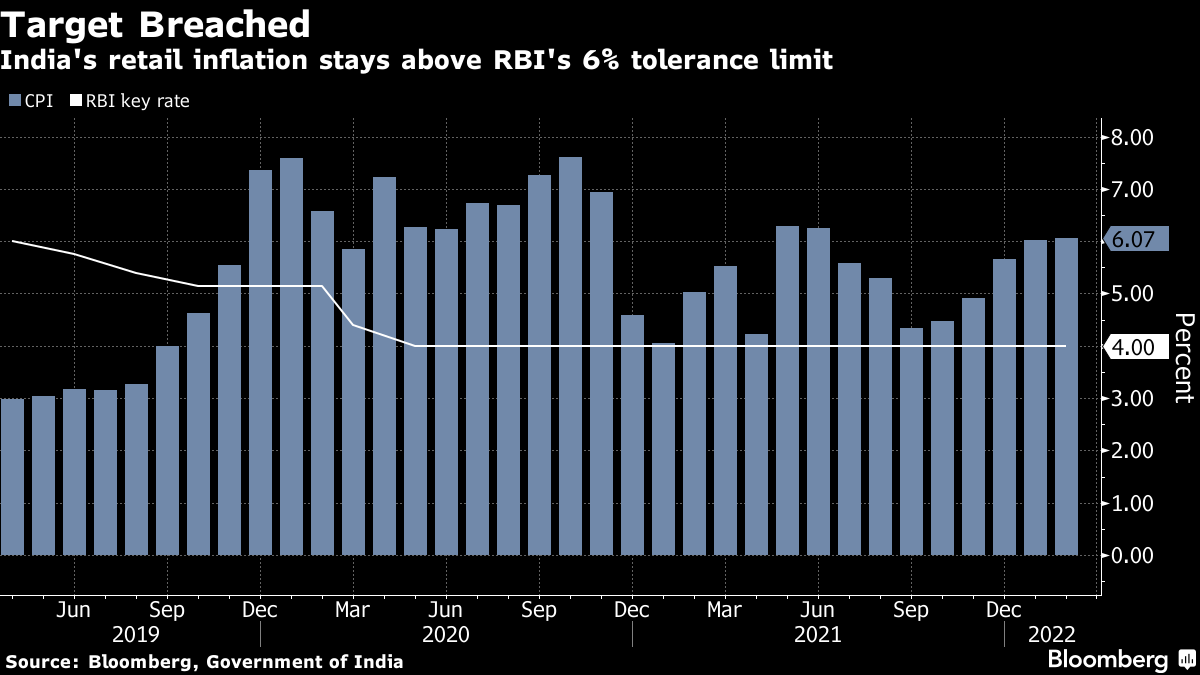
India's Retail Inflation Stays Above RBI's 6% Tolerance Limit
Even before the war, inflation was topping the RBI's 6% upper tolerance limit in 2022, and the supply disruptions that sent oil above $100 a barrel have since laid the ground for price-growth to overshoot the full-year target. That outcome will be difficult to ignore for the currently growth-obsessed policy panel led by Governor Shaktikanta Das, given its primary task is to maintain price stability.
Although the developments are unlikely to nudge the MPC to raise interest rates yet, they could force the panel to spell out its priorities given concerns surrounding the war have overtaken the Covid-19 pandemic's impact.
It doesn't matter if the central bank decides to go slow on policy normalization, or return to its old accommodative measures, Bhide said. “What will be important is to address gradually the concerns of the time,” he added.
Negative Shock
While the central bank last month cited softening food prices as a reason for its benign 4.5% inflation forecast for next year, the conflict presents a negative shock to that outlook. That's because the South Asian nation is the world's biggest importer of palm, soybean and sunflower oils, while Ukraine and Russia account for about 80% of global sunflower oil cargoes.
“Food inflation obviously will be affected by this crisis -- both in terms of prices and exchange rates,” said Bhide, an agricultural economist. It is hard to predict the trajectory of the inflation going forward, as it depends on how long prices would remain elevated, he said.
Here are some more excerpts from the interview:
“I don't think growth implications are going to be insulated from what is happening globally,” Bhide said. “The mandate for MPC remains inflation and ensuring that growth conditions are favorable,” he said, defending the panel's 5-1 vote to keep policy loose
Responding to criticism from the MPC's lone dissenter Varma that the central bank risks falling behind the curve by keeping policy loose for too long, Bhide said watching the curve is not the objective of the central bank. “Credibility certainly is important and the credibility is in terms of the outcomes,” he said.
--With assistance from Pratik Parija.
(This story has not been edited by NDTV staff and is auto-generated from a syndicated feed.)

-
High US Salaries, No Green Card Certainty: The Financial Calculation Facing Indian H-1B Families

The suspension of PERM processing at eight technology employers does not cancel existing H-1B visas. What it does is force a question many Indian families have been avoiding: is the US salary worth tying your career and family plans to one employer?
-
Swiggy vs Eternal: Food Delivery's Two Rivals Are No Longer In The Same Race
Eternal is building a private AI assistant, dark.ai. Swiggy is still working out how to make Instamart pay, with an operating loss of Rs 895 crore in the July-September quarter while Blinkit stayed profitable.
-
Where You Live Shapes How You Get To Work | The Reason Why
Two-wheelers are the most popular way to get to work in India, accounting for nearly 43% of workplace commutes.
-
Unhedged Position: Can India See An Indonesia-Style Time Correction?
The Nifty is trading below levels it first clocked in 2024. Is there, then, as I have suggested in the headline, potential that the current time correction drags on painfully for the next three-five, even ten years?
-
Navigating Friction And Energy Realities: An Analysis Of Marco Rubio's October Visit To India
Occurring at a critical juncture marked by stalled trade negotiations and escalating geopolitical pressures over global energy supplies, the visit offers a profound window into modern US-India relations.
-
India Exports Capital. Why Not Export Trusteeship?
The big question, then, is whether India can build an institution that global borrowers, investors, banks, and lawyers can trust, even without an Indian connection.
-
France's Economy & Politics Are In Crisis | The Reason Why
Let's look at how the French economy and politics evolved under Nicolas Sarkozy, Franois Hollande and Emmanuel Macron.
-
You May Inherit The Business. You Must Earn Its Credibility.
Succession tests the founder's ability to share authority as much as it tests the next generation's readiness to assume it.
-
Signing Deals Is One Thing; Making Them Work Is Another | The Week In Whys
Sometimes, things don't turn out as planned. Indian companies have lost some bids to rivals, some projects won't produce until 2030.
-
FOMC Wall, PERM Suspension, Hospital Stocks | Talking Points This Week
A PERM suspension would directly affect green-card sponsorship rather than H-1B visas, so the near-term earnings impact could remain relatively limited. The key question is whether this marks a new phase in US scrutiny of Indian IT.









