Industrial Output Growth Hits 5-Year High of 9.8%
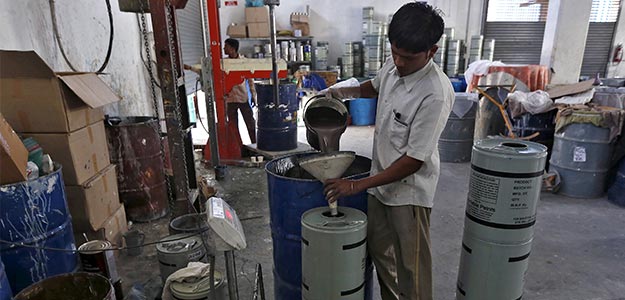
New Delhi: India's industrial output grew at its fastest pace in five years in October, powered by manufacturing, bringing some cheer to investors fretting about a gridlock in Parliament that has stalled vital reforms.
Output at factories, utilities and mines grew 9.8 per cent on year, its fastest pace since October 2010, compared with a 7.8 per cent expansion forecast by analysts in a Reuters poll and sharply higher than an upward revised figure of 3.8 per cent growth in September.
While the October output figures were bolstered by a favourable statistical base, double-digit growth in the manufacturing sector points to a strengthening industrial recovery.
Soumya Kanti Ghosh, chief economic advisor at State Bank of India, said Friday's data was likely to push overall economic growth for the year ending in March 2016 above 7.5 per cent.
The economy expanded at an annual rate of 7.4 per cent in the July-September quarter, outpacing China's economic growth.
"The base effect has played a role, but there is also a sequential momentum for manufacturing driving the index of industrial production, which is a good sign," Mr Ghosh said.
Still, investors are worried about a persistent logjam in parliament that has hurt expectations for the early passage of a new sales tax.
Aimed at creating a customs union for India's 1.2 billion people, the Goods and Service Tax (GST) is the biggest revenue shake-up since independence from Britain in 1947.
Supporters say it will add up to two percentage points to economic growth by replacing multiple federal and state tax levies, a chaotic structure that inflates costs for businesses.
The Nifty closed nearly 1 per cent lower on Friday to hit a three-month low.
While Asia's third-largest economy has emerged as the world's fastest growing major economy, it's still not firing on all cylinders. Much of the steam comes from public spending rather than private investment.
A lasting industrial recovery is less likely without fixing structural bottlenecks such as the domestic tax system, reckoned Shilan Shah, an economist at Capital Economics.
"We are less bullish on the prospects for a renaissance in Indian industry over the longer term," he added.
A government panel's recommendations to revise up salaries of millions of government employees are expected to buttress consumer demand and underpin manufacturing activity.
Bolstering the outlook, consumer goods output - a proxy for consumer demand - grew 18.4 per cent in October compared with a fall of 18.2 per cent a year ago. Capital goods, a barometer of investments, surged 16.1 per cent from a year earlier.

-
Ten Things I Learnt This Samvat

Patience can be a trap. Cheap stocks can stay cheap. Leverage can wipe you out. What did Samvat 2082 teach us? Niraj Shah writes on 10 lessons from the year gone by.
-
Talking Points This Week: Tech Nerves, FII Buying, And A Faraway Banking Shock
The global markets are not shining this Diwali. The exception in the large markets is, India.
-
Midterm Rally Lasted A Day. The Hard Reality Of A Divided US May Last Two Years | Opinion
Between a contested AI boom, a debt ceiling that arrives in 2027 and a president with every incentive to act alone, the next two years may prove more volatile than the first day's rally suggests.
-
Blue Wave Will Derail the AI Trade but Won't Dismantle the AI Era | Unhedged Position
The Democrats' sweep of the US Congress will see politics collide with economic forces both over the long and short term.
-
It's Time To Take The GST Council's Bet On Trust Global
Payment records can prove India's services exports, and clear, proportionate rules can bring foreign digital sellers into the tax net.
-
Opinion | India at 38: From Innovation Overperformer to Innovation Powerhouse
India now has 453 VC-backed deep science startups, 18 of them late-stage, after 117 percent growth since 2020. Laurus Labs, at USD 9.3 billion, is the most valuable deep science company in any middle-income economy outside China.
-
Navigating Energy Crossroads: S Jaishankar's Call For Diversified Supply Chains At G20 Ministerial Meeting
As geopolitical fault lines continue to test maritime trade routes and commodity flows, Jaishankar's message remains pertinent: true economic resilience requires open markets, protected transit lines, and a genuine commitment to multilateral cooperation rather than coercion.
-
Indians Are Travelling, But Not Every Journey Is A Holiday | The Week In Whys
Pilgrims, patients and working women are the real travellers, and the system hasn't quite caught up with them.
-
Getting To Work Costs Women More | The Reason Why
It is not just about women paying more than men. It is about women paying much more in cities than in villages.









