IndiGo Promoter Dispute: Unanswered Questions About Related Party Transactions

Why did Rakesh Gangwal hold his silence all these years if he thought the related party transactions at IndiGo were “questionable”? After all, the aviation veteran, with over three decades of experience at leading international airlines, owns a sizeable 37 percent of InterGlobe Aviation Ltd., making him the second largest shareholder in the company that runs India's largest airline with a 50 percent marketshare. Some of the RPTs between InterGlobe Aviation and various entities owned by co-promoter Rahul Bhatia (owns 38 percent) date back to before the airline company went public in 2015. That's when Gangwal joined the board, and though he's never been on the audit committee surely he reads the annual report each year.
So why raise such a stink now, I ask him.
Gangwal claims that for almost a year he's been working with the company and the board to address these issues to put in proper checks and balances that would be enduring. “These attempts were unsuccessful and now I had no choice but raise my concern with SEBI and other government entities”.
Bhatia claims that the call centre, IT, and shared services his companies provided IndiGo for years have recently ended, reducing the scope of RPTs to just four areas:
- real estate
- simulator training facilities
- general sales agreements
- crew accommodation
He claims that RPTs as a proportion of InterGlobe's revenue have declined from 0.53 percent to 0.5 percent between FY18 and FY19. The FY19 annual report isn't out yet but BloombergQuint's analysis suggests InterGlobe's RPTs with entities owned directly or indirectly by Bhatia amount to 1.3 percent of revenue in FY18 versus 0.8 percent in FY11.
Even if to some the amounts may not seem significant, Bhatia has some tough questions to answer about the RPTs themselves. Especially since he controls the board with three of six directors and the right to nominate the fourth – an independent chairman. He also has the right to nominate and appoint the managing director, chief executive officer and president.
1. The Nature Of RPTs
Maybe at its inception the aviation company needed the promoters to step in and find a way to procure goods and services otherwise not easily available. Say, for instance, the simulator training facilities that Bhatia set up with a Canadian partner in 2013. He says no comparable facility was available in northern India in terms of quality and capacity and so he invested in a joint venture that has a 15-year agreement with InterGlobe.
But what explains the Bhatia group leasing real estate to IndiGo or providing crew accommodation? Surely there are enough independent providers of such services.
In his defence, Bhatia claims InterGlobe has received “more favourable treatment” from his entities compared to their other customers. For instance, the real estate leases favour InterGlobe, he says, with lower security deposit, no lock-in period, lower rent escalation etc.
2. Who Approved These RPTs?
Because all the RPTs with Bhatia entities were claimed by InterGlobe to be in the “ordinary course of business” at “arm's length” and not “material”, they've only needed audit committee approval, not board approval or shareholder approval. That's as per company law and SEBI regulations.
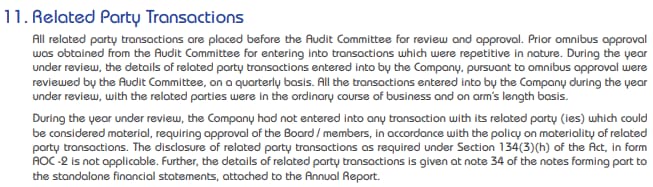
While ordinary course of business remains undefined in company law, a third party or auditor certification is often all companies need to provide as confirmation of arm's length. Material under SEBI regulations is defined to be 10 percent or more of annual turnover.

3. The Curious Case Of The EY Report
Given the disagreements around RPTs, an external report was recently commissioned by M Damodaran, the independent chairman of InterGlobe since January. Curiously that report, authored by consulting firm EY, was not shared with the rest of the board…because no one asked for it to be tabled, claims Bhatia.
The chairman apparently summarised the report at a board meeting held in March.
According to Bhatia, the report found nothing wrong with the transactions themselves but identified some procedural irregularities.
According to Gangwal, those procedural irregularities include;
- Some RPTs were not approved by audit committee
- Some RPTs were executed before audit committee approval
- Some RPTs were extended without audit committee approval
Gangwal claims InterGlobe acknowledged that...
- Numerous RPTs were done without seeking competitive bids
- Third parties provided arm's length representations primarily to meet tax requirements
- April 2016 onward, such third party representations were done only for international transactions
- “We have quite a few transactions that have been signed with retrospective effect.”
4. Code Of Conduct Violation?
Besides, Gangwal claims many of these RPTs could fall foul of InterGlobe's Code of Conduct which states that directors and senior management should avoid transacting company business with related parties unless such transaction is “unavoidable”. SEBI regulations require a company's directors to abide by its code of conduct.
The Directors and senior management shall not engage in any activity, business, or relationship, which may be in conflict with the interest of the Company or prejudicial to Company's interest. They should avoid transacting company business with their relative or with a firm / company in which either they themselves or their relative are interested or plays any significant role and in case such related party transaction is unavoidable, it must be made only after proper and fullest disclosure to the Board of the Company. - Code of Conduct
Curiously, in the March meeting the InterGlobe board seems to have determined that unavoidable means “being in the best interest of the Company”. Or so Bhatia says.
5. The Termination Of Two RPTs
Disagreements over RPTs do seem to date back a few years, even if they remained hidden so far. Bhatia's statement last week admits as much when it points out that in 2015, a domestic cargo GSA arrangement with his group was “terminated arbitrarily” by InterGlobe. The following year “when the domestic passenger GSA arrangement came up for renewal, InterGlobe Aviation decided not to renew it”.
It's curious that a Bhatia-dominated board and management approved such a termination without valid reasons.
What's even odder is that in a letter to the board, dated Oct. 25, 2018, the Bhatias have alleged the contract termination hurt InterGlobe's business.
Domestic cargo GSA was unlawfully terminated in March 2015, and the Domestic passenger GSA expired in 2016. Management in its own wisdom (under directions from a shareholder) chose to take these decisions. The adverse impact of not having a GSA (be it with IGE Group or indeed any other party) on the revenues of the Company is obvious, and perhaps this Board could spend some time deliberating over the loss of revenue, and the cost benefit analysis of not having a GSA. Additionally, most of the Shared Services agreements have either been terminated already, or are in the process of being terminated.Letter To InterGlobe Aviation Board - By Rahul Bhatia, Rohini Bhatia
The RPT Cancer
India's corporate history is littered with promoters trying to make an extra buck by doing private business with their public, listed companies.
Fifty years ago one of the justifications for bank nationalisation was that privately-held banks dominated the industry and often gave loans to business funded by their owners.
Ten years ago it was a failed related party transaction, Satyam-Maytas, that blew the lid of India's then largest corporate fraud.
Since then specific provisions in a new company law and SEBI regulations have tightened disclosure standards, board scrutiny and shareholder approval of such related party transactions. But the problem refuses to go away.
Last year Sun Pharmaceutical Industries Ltd.'s stock fell sharply when it came to light that the pharma giant's main India distributor, Aditya Medisales, was in fact owned by Sun's promoter Dilip Shanghvi. Sun has since bought out the distribution business but the stock hasn't full recovered.
More recently home loan company Dewan Housing Finance Corporation Ltd. was found to have extended loans to companies that were connected to DHFL's promoters.
Investigations show that failed infrastructure financier IL&FS Financial Services Ltd. repeatedly diluted its RPT policy to hide bad loans to group companies.
Often, wily promoters escape RPT disclosure by hiding their ownership through a maze of companies with constantly changing shareholding. Or boards use “ordinary course of business” and “arm's length” to shield some RPTs from shareholder approvals. Omnibus approvals by the audit committee add to the opacity.
Every possible loophole in the law is exploited by the controlling shareholder to avoid scrutiny of such transactions by the Audit Committee and the Board, a leading corporate lawyer explains on condition of anonymity.
That lawyer points to three things
- The threshold of 10 percent of annual consolidated turnover of the listed entity prescribed under Regulation 23 of the SEBI Listing Obligations is too high and hence a large number of RPTs fall outside the purview of the requirement of approval of such transactions by the majority of minority shareholders.
- Similarly, MCA has also prescribed a sufficiently high threshold for mandatory approval by minority shareholders. The definition of RPT under Section 188 is not comprehensive enough, and many transactions escape scrutiny in case of unlisted companies.
- Independent directors do not have the wherewithal to ascertain whether such transactions are done on an arm's length basis, and many a time, it is approved on the assurance of the management team, which is working under the control of the promoter.
Maybe it'll never be fully clear why Rakesh Gangwal remained silent so long. Or whether he's using the RPT issue to settle other scores with his old friend Rahul Bhatia. Or whether Bhatia unjustly gained from the RPTs.
There's no doubt, the two have created a world-class airline and immense wealth for all stakeholders. But Gangwal's not wrong when he warns that “In India there is a related party transactions ecosystem that has built around airlines which is not good in the long term and history has spoken to it.”
Except that it isn't just about airlines.
Menaka Doshi is Managing Editor at BloombergQuint.

-
Navigating Energy Crossroads: S Jaishankar's Call For Diversified Supply Chains At G20 Ministerial Meeting

As geopolitical fault lines continue to test maritime trade routes and commodity flows, Jaishankar's message remains pertinent: true economic resilience requires open markets, protected transit lines, and a genuine commitment to multilateral cooperation rather than coercion.
-
Indians Are Travelling, But Not Every Journey Is A Holiday | The Week In Whys
Pilgrims, patients and working women are the real travellers, and the system hasn't quite caught up with them.
-
Getting To Work Costs Women More | The Reason Why
It is not just about women paying more than men. It is about women paying much more in cities than in villages.
-
AI Bias In Investing Cannot Be Eliminated, But It Can Be Governed
Framing is a particularly important example as identical financial information presented in terms of gains rather than losses can lead an LLM to reach a different assessment.
-
Joining The Dots | Dark Skies, Steady Diya: Why Hope Holds This Diwali
With war, a weak rupee and foreign outflows weighing on sentiment, policymakers at the NDTV World Summit and market veterans at NDTV Profit Ignite: Diwali Edition offered the same advice: stay invested and filter out the noise.
-
The Curious Case of Equitas Small Finance Bank And A CEO Who Quit For Stock
PN Vasudevan believes persistent investor concerns over a perceived conflict of interest had become a governance overhang on Equitas Small Finance Bank's stock, even as the lender improved profitability and asset quality.
-
Talking Points This Week: AI Cash Burn, A Tiger Comeback And An India That Still Finds Its Own Path
India is not immune to higher oil or tighter global liquidity, yet its earnings base is broader, its domestic policy levers are still available.
-
Foreign Investors Own Half Of HDFC Bank and ICICI Bank. An LTCG Cut Could Matter Most Here
Foreign portfolio investors have US$115 billion parked in HDFC Bank, ICICI Bank. If the government cuts long-term capital gains tax, Jefferies says returning foreign money could land here first.
-
'Never Seen This Level Of Negativity': Sandeep Tandon Says The Next Rally May Be Closer Than You Think
Veteran investor Sandeep Tandon says foreign selling is easing, large-caps are due a comeback and mid-caps are crowded, while he turns positive on gold, power and pharma this Diwali.
-
Indians Stay With Family, Not In Hotels | The Reason Why
India still lacks enough clean, reliable and affordable hotels for budget-conscious travellers.










