India’s Payroll Debate: What Employee Provident Fund Data Tells Us

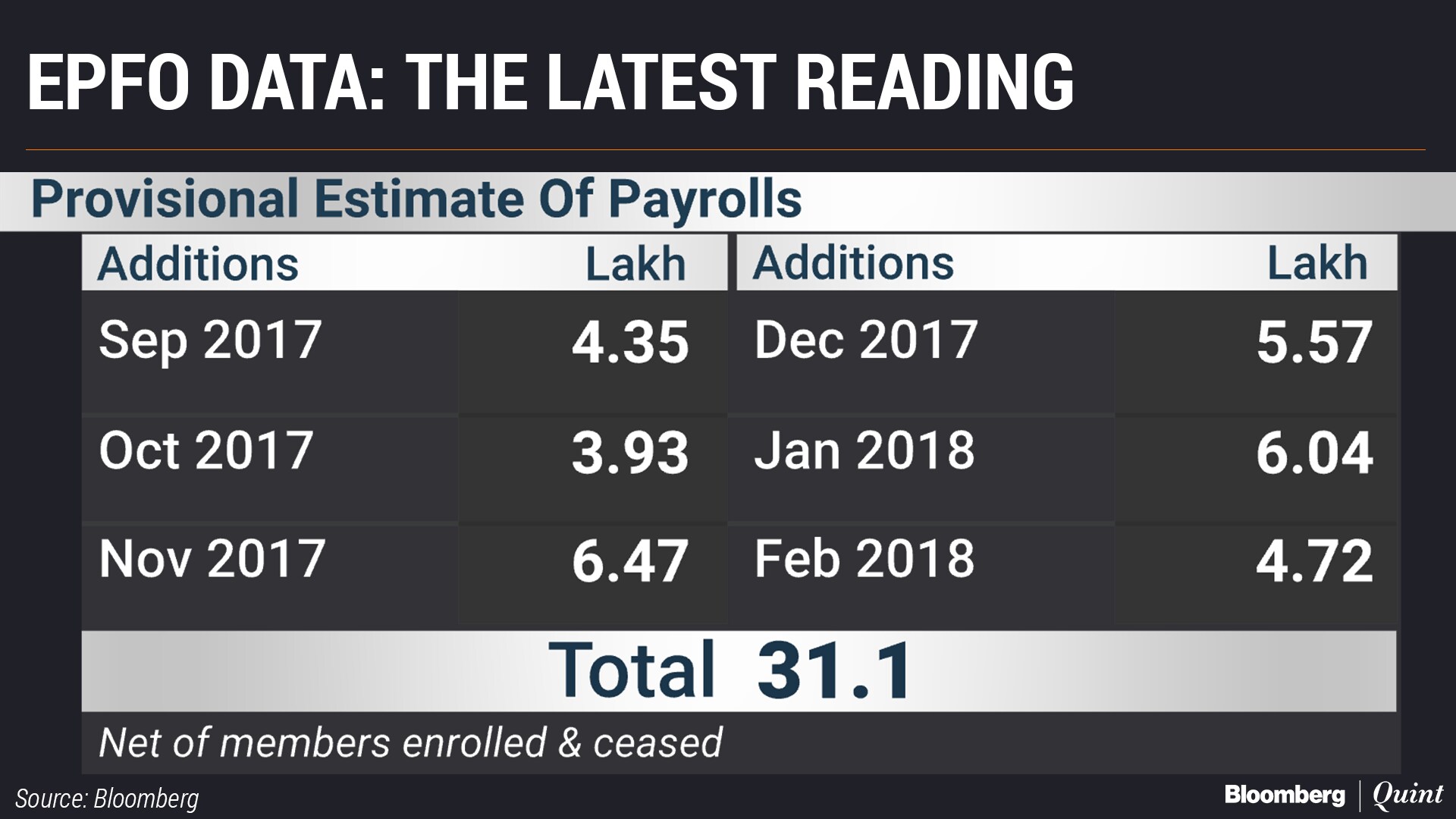
Earlier this week, the Indian government released provident fund data, which, it said, showed that 31 lakh jobs were created in the six months between September 2017 and February 2018. The data, according to NITI Aayog chief Rajiv Kumar, dispels concerns that the Indian economy is witnessing jobless growth.
The government's contention has met with some skepticism from those who believe that the Employee Provident Fund Organisation data is more a reflection of the extent of formal jobs in the economy rather than new jobs created.
What Is The EPFO Data?
An understanding of formal employment in the Indian economy can be gleaned from the data which rests with the Employee Provident Fund Organisation, the Employee State Insurance Corp. and the National Pension System. These jobs are considered ‘formal' because employers provide some kind of social security to their employees. The EPFO data captures companies with more than 20 employees.
The data released by the government this week tells you what the payroll additions were each month in different age brackets. The numbers put out are ‘net of members enrolled and ceased during the month', the data release said.
Essentially what the data is telling you is the number of net subscribers added to EPFO fold each month. Overall, between September and February, 31 lakh employees were added to the payrolls, shows the data.
Formal Jobs vs New Jobs?
The question is whether these additions to payrolls are a reflection of formalisation of jobs which may have already existed or a creation of new jobs. The debate had started earlier this year when Pulak Ghosh, a professor at Indian Indian Institute of Management, Bangalore, and Soumya Kanti Ghosh, chief economic adviser at State Bank of India, analysed the EPFO data and forecast that India will add 70 lakh jobs in 2017-18.
At the time, their claim was countered by those who pointed out that the EPFO data does not necessarily point to new jobs due to the following reasons:
- Duplication of accounts.
- Inactive accounts.
- Payrolls added due to companies moving above the threshold of more than 20 employees.
Indeed, even the government's own Economic Survey had used the data to judge formalisation of jobs rather than job creation. A committee of the government's NITI Aayog had, in 2017, also noted that the data may not reflect new jobs.
...additions to these databases may not necessarily represent additional jobs. Instead, such additions may simply represent enrollment of individuals already working but not previously enrolled in the plans or programmes.NITI Aayog Task Force On Improving Employment Data (2017)
The Two Sides Of The Debate
The debate has been reignited now with the government deciding to release this data as an indication of job creation in the economy.
In a conversation with BloombergQuint, Soumyakanti Ghosh of SBI said that, with reasonable assumptions, the data can give a picture of new job creation. Ghosh chooses to focus on the addition to payrolls in the 18-25 age bucket, the age when people typically begin working. He adds that duplication in the EPFO data has been eliminated to a large extent due to linkage with Aadhaar.
If you look into the payroll estimates that the EPFO has put out, you will find that 31 lakh payrolls were added across all age groups. Out of this, the number of people added in the age group of 18-25, is around 19 lakh....When we had looked at the data, there was very close clustering at the median age of 22. I believe that a large part of this 19 lakh could be a proxy for the new jobs.Soumya Kanti Ghosh, Chief Economist, State Bank of India
Rupa Subramanya, an independent economist, disagrees. Every addition to the EPFO does not mean a new job is being generated in the economy, said Subramanya.
What it (EPFO data) does point to is that there is greater formalisation happening. But even there, I would be cautious because NITI Aayog itself says that even to count these jobs as a sign of formalisation, you would have to define what formalisation is.Rupa Subramanya, Independent Economist
She adds that there is no reason to believe that this analysis changes when you look at the 18-25 age group.
Subramanya also questioned whether the data on job creation is consistent with other economic indicators in the economy. India's gross domestic product grew at 6.6 percent in 2017-18, according to estimates released by the government's statistical arm in January. Over the past four-six quarters, the economy has been hit by the twin shocks of demonetisation and GST, which led to a slowdown in sectors like real estate, financial services and manufacturing. Many of these sectors are large employers.
Ghosh counters this argument and points to the consistent strength in consumption in the Indian economy. Indeed, private consumption is seen growing by 6.3 percent in 2017-18. This, according to Ghosh, suggests that there has been some job creation in the economy, absent which strain in consumer spending would have been visible.
While this might be the case, the question is whether jobs are being created at the pace required by the Indian economy, said Subramanya.
Watch the full debate here:

-
High US Salaries, No Green Card Certainty: The Financial Calculation Facing Indian H-1B Families

The suspension of PERM processing at eight technology employers does not cancel existing H-1B visas. What it does is force a question many Indian families have been avoiding: is the US salary worth tying your career and family plans to one employer?
-
Swiggy vs Eternal: Food Delivery's Two Rivals Are No Longer In The Same Race
Eternal is building a private AI assistant, dark.ai. Swiggy is still working out how to make Instamart pay, with an operating loss of Rs 895 crore in the July-September quarter while Blinkit stayed profitable.
-
Where You Live Shapes How You Get To Work | The Reason Why
Two-wheelers are the most popular way to get to work in India, accounting for nearly 43% of workplace commutes.
-
Unhedged Position: Can India See An Indonesia-Style Time Correction?
The Nifty is trading below levels it first clocked in 2024. Is there, then, as I have suggested in the headline, potential that the current time correction drags on painfully for the next three-five, even ten years?
-
Navigating Friction And Energy Realities: An Analysis Of Marco Rubio's October Visit To India
Occurring at a critical juncture marked by stalled trade negotiations and escalating geopolitical pressures over global energy supplies, the visit offers a profound window into modern US-India relations.
-
India Exports Capital. Why Not Export Trusteeship?
The big question, then, is whether India can build an institution that global borrowers, investors, banks, and lawyers can trust, even without an Indian connection.
-
France's Economy & Politics Are In Crisis | The Reason Why
Let's look at how the French economy and politics evolved under Nicolas Sarkozy, Franois Hollande and Emmanuel Macron.
-
You May Inherit The Business. You Must Earn Its Credibility.
Succession tests the founder's ability to share authority as much as it tests the next generation's readiness to assume it.
-
Signing Deals Is One Thing; Making Them Work Is Another | The Week In Whys
Sometimes, things don't turn out as planned. Indian companies have lost some bids to rivals, some projects won't produce until 2030.
-
FOMC Wall, PERM Suspension, Hospital Stocks | Talking Points This Week
A PERM suspension would directly affect green-card sponsorship rather than H-1B visas, so the near-term earnings impact could remain relatively limited. The key question is whether this marks a new phase in US scrutiny of Indian IT.









