ONGC Faces Difficulty In Finding A Vessel To Get Russian Oil: Report
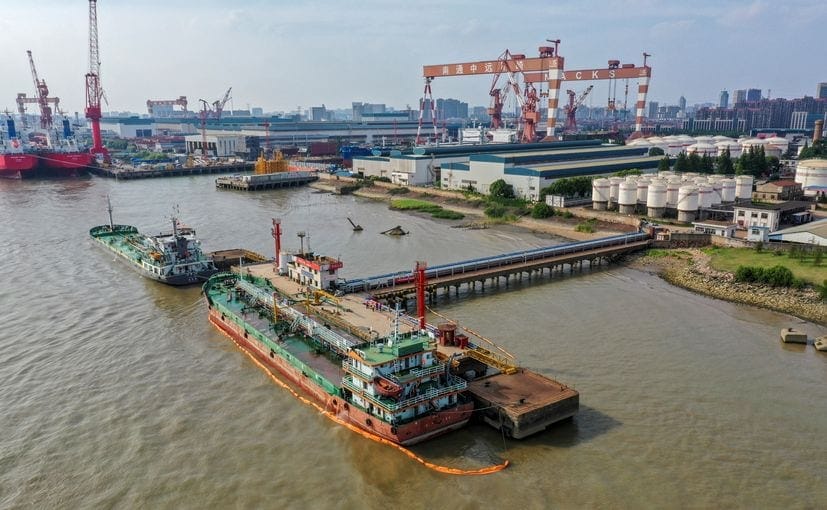
India's Oil and Natural Gas Corp (ONGC) is struggling to find a vessel to ship 700,000 barrels of crude from Russia's Far East, in a growing sign that complex trades involving one of Moscow's biggest partners are being interrupted by Western sanctions, sources say.
Several Indian companies including ONGC have stakes in Russian oil and gas assets, and India has been buying more Russian crude since Moscow invaded Ukraine, snapping up the popular Urals crude grade, while other buyers have shunned Russian exports.
ONGC has a 20% stake in the Sakhalin 1 project that produces a Russian grade known as Sokol, which ONGC exports through tenders. Sokol is mostly bought by North Asian buyers and loaded from South Korea.
However, Moscow's ability to ship that grade, which requires vessels that can break through ice, is becoming harder due to concerns from shippers over reputational risk and the increasing difficulty for Russian assets to find insurance coverage.
Normally, cargoes of Sokol oil are first shipped from the De-Kastri terminal in Russia's Far East using ice class vessels to South Korea, where they are then reloaded onto a conventional tanker.
Indian refiners rarely buy the Sokol grade, as difficult logistics make the crude costly. There are a limited number of ice class vessels in the global merchant fleet that can be deployed at any time.
ONGC relies on ice-class vessels provided by Russia's state-owned Sovcomflot (SCF) for the transportation of crude to Yoesu port in South Korea, and from there the Indian company exports to buyers, mostly in North Asia.
However, sanctions imposed on Russia by the United States, Britain, the European Union and Canada after Moscow's invasion of Ukraine, in addition to specific restrictions on SCF, are making it harder for Russian ships including SCF's fleet to maintain insurance and reinsurance cover for voyages, shipping sources said.
Shipping companies are also less willing to move Russian oil in Asia, fearing the potential reputational risks involved with charters, the shipping sources added.
Last month, ONGC did not receive any bids in its tender for export of Sokol as buyers backed out due to Western sanctions.
That led to ONGC selling one cargo each to Indian state refiner Hindustan Petroleum Corp and Bharat Petroleum Corp (BPCL).
BPCL's cargo was scheduled for lifting early next month from Yeosu port in South Korea, while HPCL was awarded the cargo for lifting in end-May, according to shipping sources.
BPCL had floated an enquiry to charter a vessel from the South Korean port and sought to book the vessel Atlantis for early May shipments, shipping reports show.
The fixture failed, however, as ONGC could not arrange a vessel to Yeosu port partly due to issues with securing insurance for the voyage, sources said.
ONGC, HPCL and BPCL did not respond to Reuters emails seeking comment.
This year, India has bought more than twice as much crude from Russia in the two months since its invasion of Ukraine as it did in all of 2021.
Russia's maritime sector is grappling with the winding down of services including ship certification by leading foreign providers such as Britain's LR and Norway's DNV.
Marine fuel sellers have stopped serving vessels flying the Russian flag at major European hubs including Spain and Malta in another blow to Moscow's exports, sources with knowledge of the matter told Reuters.
The EU in March listed SCF among Russian state-owned companies with which it was "prohibited to directly or indirectly engage in any transaction" after a wind down period ends on May 15.
(Except for the headline, this story has not been edited by NDTV staff and is published from a syndicated feed.)

-
The Economic Imperative: Analysing The Material Driving Force Behind India-Canada Strategic Reset

This economic complementarity is further reinforced by deep institutional investment ties and talent mobility, which form the bedrock of the bilateral framework.
-
Medicine Pricing: Where Must Profit Stop?
India must confront excessive margins, hidden incentives and regulatory gaps that threaten the integrity of medicine.
-
Why Amazon And Flipkart Are Struggling To Beat Meesho In India's Smaller Cities
With 274 million users and lowest-cost logistics, Meesho is defending its value commerce crown against giants like Amazon and Flipkart.
-
High US Salaries, No Green Card Certainty: The Financial Calculation Facing Indian H-1B Families
The suspension of PERM processing at eight technology employers does not cancel existing H-1B visas. What it does is force a question many Indian families have been avoiding: is the US salary worth tying your career and family plans to one employer?
-
Swiggy vs Eternal: Food Delivery's Two Rivals Are No Longer In The Same Race
Eternal is building a private AI assistant, dark.ai. Swiggy is still working out how to make Instamart pay, with an operating loss of Rs 895 crore in the July-September quarter while Blinkit stayed profitable.
-
Where You Live Shapes How You Get To Work | The Reason Why
Two-wheelers are the most popular way to get to work in India, accounting for nearly 43% of workplace commutes.
-
Unhedged Position: Can India See An Indonesia-Style Time Correction?
The Nifty is trading below levels it first clocked in 2024. Is there, then, as I have suggested in the headline, potential that the current time correction drags on painfully for the next three-five, even ten years?
-
Navigating Friction And Energy Realities: An Analysis Of Marco Rubio's October Visit To India
Occurring at a critical juncture marked by stalled trade negotiations and escalating geopolitical pressures over global energy supplies, the visit offers a profound window into modern US-India relations.
-
India Exports Capital. Why Not Export Trusteeship?
The big question, then, is whether India can build an institution that global borrowers, investors, banks, and lawyers can trust, even without an Indian connection.
-
France's Economy & Politics Are In Crisis | The Reason Why
Let's look at how the French economy and politics evolved under Nicolas Sarkozy, Franois Hollande and Emmanuel Macron.










