India’s New Fiscal Framework: Are We Choosing The Right Targets?

In the course of presenting Budget 2017-18, Finance Minister Arun Jaitley highlighted some of the recommendations of a committee set up to review the Fiscal Responsibility and Budget Management (FRBM) Act.
The committee has recommended that a “sustainable debt path must be the principal macro-economic anchor of our fiscal policy”. A debt-to-GDP ratio of 60 percent by 2023 has been recommended, Jaitley revealed. The full report is yet to be put out in public domain but it may be worth kicking off a debate on whether the recommendations of the NK Singh headed committee fit the needs of an economy like India.
The Economic Survey published before the Budget provided a crisp section on the Fiscal Framework and tried to orient fiscal thinking towards the measure- Total Government Debt to Nominal GDP ratio. This opens up room to debate the question of what constitutes ‘sustainable' government debt and whether it is the right metric to target for India.
While in no way undermining the need for budget discipline and fiscal prudence, it must be mentioned that fiscal policy based on dogmatic and popular interpretations of the fiscal deficit may be detrimental in the long run. There can be levels of fiscal discipline, which may prove to be “rather-too-much-of-a-good-thing”.
It may be worth mentioning here that the 60 percent debt-to-GDP ratio suggested by the NK Singh committee is the same as the requirement set for European nations as per the Maastricht Treaty. European countries that were aspiring for Euro membership were required to contain national debt at below that level(Euro-Convergence Criteria).
Some deliberation may be justified on why India should target and set future expectation around a debt metrics, which a lot of Euro members are struggling with. One may argue, that India, with a much younger population and much higher infrastructure needs, coupled with a much higher level of nominal GDP growth (9 percent to 13 percent over last 5 years) than Europe, may have different requirements from its fiscal policy. Besides, the jury is still out on whether the lender-imposed fiscal austerity helped Euro members or aggravated their economic issues.
Also Read: IMF Wants India Ready to Tighten as RBI Signals Easing Pause
Understanding Sustainable Debt
The popular narrative used to highlight problems of unsustainable government debt compares sovereign debt with the debt of non-governmental sector (households or corporates). This is a misleading comparison since the debt servicing ability of non-governmental parties is limited by their earnings and asset ownership.
However, a sovereign which prints its own currency and can create money to service its debt, is not per se limited by the available revenue to service its debt. The risk for a sovereign borrower is one of triggering uncontrollable inflation rather than defaulting on its debt.
It is also important to understand how government debt moves in relation to the fiscal deficit:
- Every year the total government debt increases by the size of the fiscal deficit.
- The fiscal deficit in turn is constituted of two components: Primary Budget Deficit and Interest Expense. Primary Deficit represents the excess of government spending on goods and services over government revenue.
- Now, let's introduce the level of nominal GDP growth into the equation. As long as the interest paid on government debt is lower than the nominal GDP growth, the debt-to-GDP ratio will continue to decline in absence of a widening primary deficit.
A mathematical representation of this can be found here.
What Is The Indian Scenario?
The primary deficit for India averages at around 3.2 percent of nominal GDP. In fiscal 2016, it was estimated at 2.1 percent. Interestingly, Budget 2017-18, did not put out a number for the revised estimate for primary deficit for fiscal 2017 and also did not give a budget estimate for primary deficit for fiscal 2018. The primary deficit is the worrisome aspect, which has also been highlighted in the economic survey.
However, even if the primary deficit is not zero (which is a fair assumption), the overall debt dynamics for India do not change. The current cost of government debt is hovers around 6.5 percent. Going forward, if nominal GDP remains at or above 10 percent and interest expense at around 6.5 percent, India's debt level does not look worrisome.
The impact of primary deficit needs to be explored further. A glance at various scenarios listed below, shows that even under the most pessimistic of nominal GDP growth assumptions, the interest rate paid by the government on its borrowings will remain lower. This is assuming a zero primary deficit. This, in turn, will bring down the debt to GDP ratio to 60 percent even before the 2023 deadline suggested by the FRBM review committee.
However, if the primary deficit remains at the current level, it may take atleast two to three years longer to achieve the 60 percent target. Is it then not more sensible to target the primary deficit?
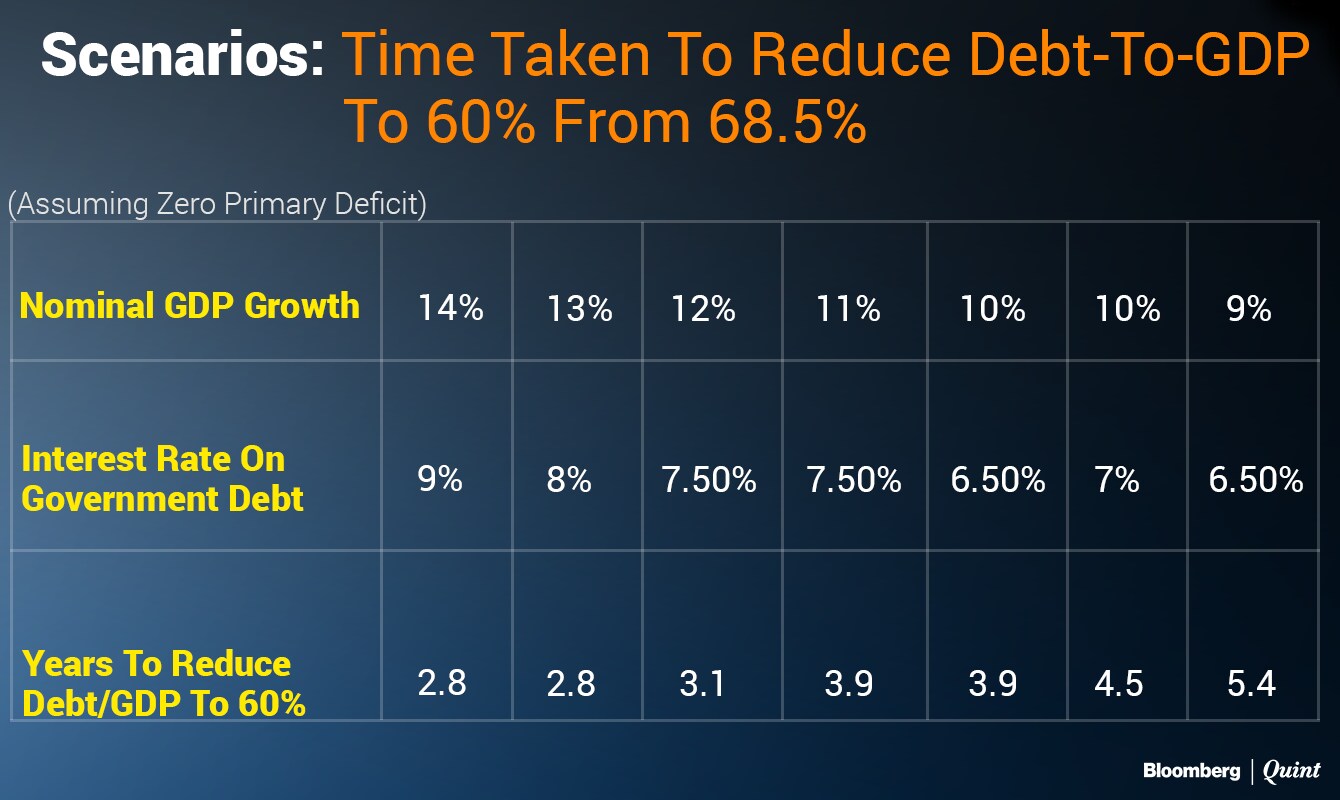
In all of this, the wildcard is inflation. For sustainability of debt at current level, India needs to control inflation. The gravy train may be toppled by surging inflation, which will push down real interest rate and possibly weaken the Rupee. This, in turn, will increase the primary deficit (by increasing the cost of imports), to control which interest rate would need to be increased, ultimately increasing fiscal deficit and debt levels.
Thus, the institutional independence of the RBI with respect to inflation control is critical to ensuring sustainability of government debt. Even perceived interference from the government in setting interest rates may prove detrimental.
Also Read: Consolidated State Deficit On Course To Hit A 13-Year High, Warns JPMorgan
What Is The Right Metric To Target?
As detailed above, the debt-to-GDP ratio is driven by a number of factors, many of which are not in the control of the government. As such, the adoption of only a target debt ratio driven by orthodox economics thinking may not be the best course of action.
Instead, the fiscal framework should focus on aspects over which the government has more control and thus can be targeted. For instance, GDP growth is not under the government's control; neither is the interest expectation of the markets. As such, a policy framework limited to targeting either the debt-to-GDP ratio or the fiscal deficit may have unintended consequences. For instance, a forced cut in capital expenditure to meet a fiscal deficit target, which may be under threat due to an inflation shock which could push interest expense.
Instead, the fiscal framework should focus on putting down an explicit target for the primary deficit, since the government has greater control over its own spending and its ability to collect taxes.
Similarly, the fiscal framework may set a target for revenue expenditure as a proportion of total government expenditure. A higher proportion of capital expenditure will ensure that for same level of fiscal deficit, more real assets get created. In short the framework must focus on the quality of fiscal deficit and not just quantity.
Equally, the government must be provided elbow room to revive the economy in the event of a downturn. So, instead of a broad brush 0.5 percent ‘escape clause' linked to the fiscal deficit, the framework should focus on the level of response given the observed or expected differential between nominal GDP and interest rate.
As the analysis above shows, India's debt levels are currently sustainable and are unlikely to burgeon (exception being a scenario of severe stagflation). So there is no need for a sudden surgical strike on the fiscal deficit by adopting a framework overnight without public debate. It would be advisable to put the NK Singh committee report in the public domain for wider debate before a new framework is adopted.
Also Read: Rs 10,290 Crore Boost For Health Hides Funding Cuts For Key Programmes
Deep Narayan Mukherjee is a financial services professional and visiting faculty of finance at IIM Calcutta.
The views expressed here are those of the author's and do not necessarily represent the views of BloombergQuint or its editorial team.

-
Navigating Energy Crossroads: S Jaishankar's Call For Diversified Supply Chains At G20 Ministerial Meeting

As geopolitical fault lines continue to test maritime trade routes and commodity flows, Jaishankar's message remains pertinent: true economic resilience requires open markets, protected transit lines, and a genuine commitment to multilateral cooperation rather than coercion.
-
Indians Are Travelling, But Not Every Journey Is A Holiday | The Week In Whys
Pilgrims, patients and working women are the real travellers, and the system hasn't quite caught up with them.
-
Getting To Work Costs Women More | The Reason Why
It is not just about women paying more than men. It is about women paying much more in cities than in villages.
-
AI Bias In Investing Cannot Be Eliminated, But It Can Be Governed
Framing is a particularly important example as identical financial information presented in terms of gains rather than losses can lead an LLM to reach a different assessment.
-
Joining The Dots | Dark Skies, Steady Diya: Why Hope Holds This Diwali
With war, a weak rupee and foreign outflows weighing on sentiment, policymakers at the NDTV World Summit and market veterans at NDTV Profit Ignite: Diwali Edition offered the same advice: stay invested and filter out the noise.
-
The Curious Case of Equitas Small Finance Bank And A CEO Who Quit For Stock
PN Vasudevan believes persistent investor concerns over a perceived conflict of interest had become a governance overhang on Equitas Small Finance Bank's stock, even as the lender improved profitability and asset quality.
-
Talking Points This Week: AI Cash Burn, A Tiger Comeback And An India That Still Finds Its Own Path
India is not immune to higher oil or tighter global liquidity, yet its earnings base is broader, its domestic policy levers are still available.
-
Foreign Investors Own Half Of HDFC Bank and ICICI Bank. An LTCG Cut Could Matter Most Here
Foreign portfolio investors have US$115 billion parked in HDFC Bank, ICICI Bank. If the government cuts long-term capital gains tax, Jefferies says returning foreign money could land here first.
-
'Never Seen This Level Of Negativity': Sandeep Tandon Says The Next Rally May Be Closer Than You Think
Veteran investor Sandeep Tandon says foreign selling is easing, large-caps are due a comeback and mid-caps are crowded, while he turns positive on gold, power and pharma this Diwali.
-
Indians Stay With Family, Not In Hotels | The Reason Why
India still lacks enough clean, reliable and affordable hotels for budget-conscious travellers.










