Akasa Air's First Flight Takes Off From Mumbai To Ahmedabad
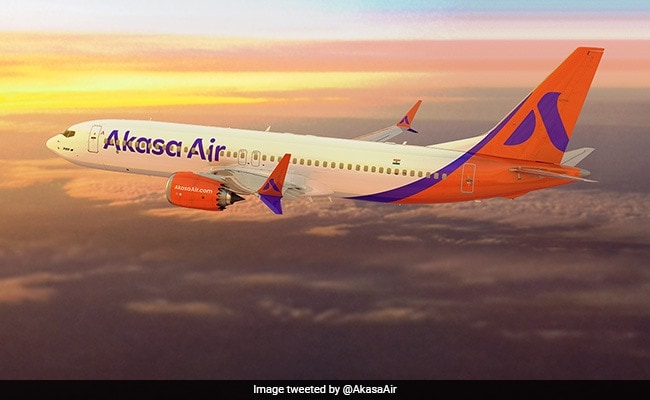
Akasa Air is finally in Indian skies as the first flight took off on Sunday between the Mumbai-Ahmedabad route, which was inaugurated by Union Minister for Civil Aviation Jyotiraditya M Scindia along with MoS General Vijay Kumar Singh (Retd.)
On July 22, India's newest airline Akasa Air on Friday opened ticket bookings for its first commercial flights with an initial network in Ahmedabad, Bengaluru, Mumbai, and Kochi.
In the inaugural phase, Akasa Air, whose airline code is QP, will launch its operations by offering 28 weekly flights between Mumbai and Ahmedabad starting August 7, 2022.
Subsequently, starting August 13, the airline will start operating an additional 28 weekly flights between Bengaluru and Kochi. Tickets for all are open for sale with immediate effect.
"We are extremely excited to finally be able to offer up our flights for sale. We are also excited to reveal our product which promises to be unlike anything experienced in the category thus far. With Akasa employees providing warm and efficient customer service, a reliable and dependable network, and affordable fares - we look forward to serving our customers with a flying experience that I am sure they will find delightful", Vinay Dube, Founder and Chief Executive Officer, Akasa Air, had said.
Bookings for flights are available via the mobile app, and its website www.akasaair.com.
"Akasa Air's network strategy is focused on establishing a strong pan-India presence and providing linkages from metro to tier 2 and tier 3 cities across the country," Praveen Iyer, Co-founder and Chief Commercial Officer, Akasa Air, had said.
In July, ace investor Rakesh Jhunjhunwala-backed airline received the Air Operator Certificate (AOC) from the civil aviation regulator Directorate General of Civil Aviation (DGCA).
The grant of the AOC is the final step of a comprehensive and rigorous process laid down by the DGCA and marks the satisfactory completion of all regulatory and compliance requirements for the airline's operational readiness.

-
Unhedged Position: Can India See An Indonesia-Style Time Correction?

The Nifty is trading below levels it first clocked in 2024. Is there, then, as I have suggested in the headline, potential that the current time correction drags on painfully for the next three-five, even ten years?
-
Navigating Friction And Energy Realities: An Analysis Of Marco Rubio's October Visit To India
Occurring at a critical juncture marked by stalled trade negotiations and escalating geopolitical pressures over global energy supplies, the visit offers a profound window into modern US-India relations.
-
India Exports Capital. Why Not Export Trusteeship?
The big question, then, is whether India can build an institution that global borrowers, investors, banks, and lawyers can trust, even without an Indian connection.
-
France's Economy & Politics Are In Crisis | The Reason Why
Let's look at how the French economy and politics evolved under Nicolas Sarkozy, Franois Hollande and Emmanuel Macron.
-
You May Inherit The Business. You Must Earn Its Credibility.
Succession tests the founder's ability to share authority as much as it tests the next generation's readiness to assume it.
-
Signing Deals Is One Thing; Making Them Work Is Another | The Week In Whys
Sometimes, things don't turn out as planned. Indian companies have lost some bids to rivals, some projects won't produce until 2030.
-
FOMC Wall, PERM Suspension, Hospital Stocks | Talking Points This Week
A PERM suspension would directly affect green-card sponsorship rather than H-1B visas, so the near-term earnings impact could remain relatively limited. The key question is whether this marks a new phase in US scrutiny of Indian IT.
-
Everything, Everywhere, All At Once: Dalal Street's Week To Forget | Joining The Dots
Visa curbs, a Starlink spat and cancer drug caps: what connects this week's shocks for Indian markets
-
India Is Going Abroad For Critical Minerals. But It May Take Years To Pay Off | The Reason Why
Although India's steps are in the right direction, they remain modest compared with India's growing dependence.
-
When Everyone Has AI, What Gives You An Edge?
India's young workforce is entering an uncertain world of work where powerful AI tools are becoming widely accessible. The advantage will belong to those who combine deep expertise with digital fluency, and the distinctly human capabilities that technology cannot manufacture.









