India’s Biggest Retailer Is Buying Less From Consumer Goods Makers
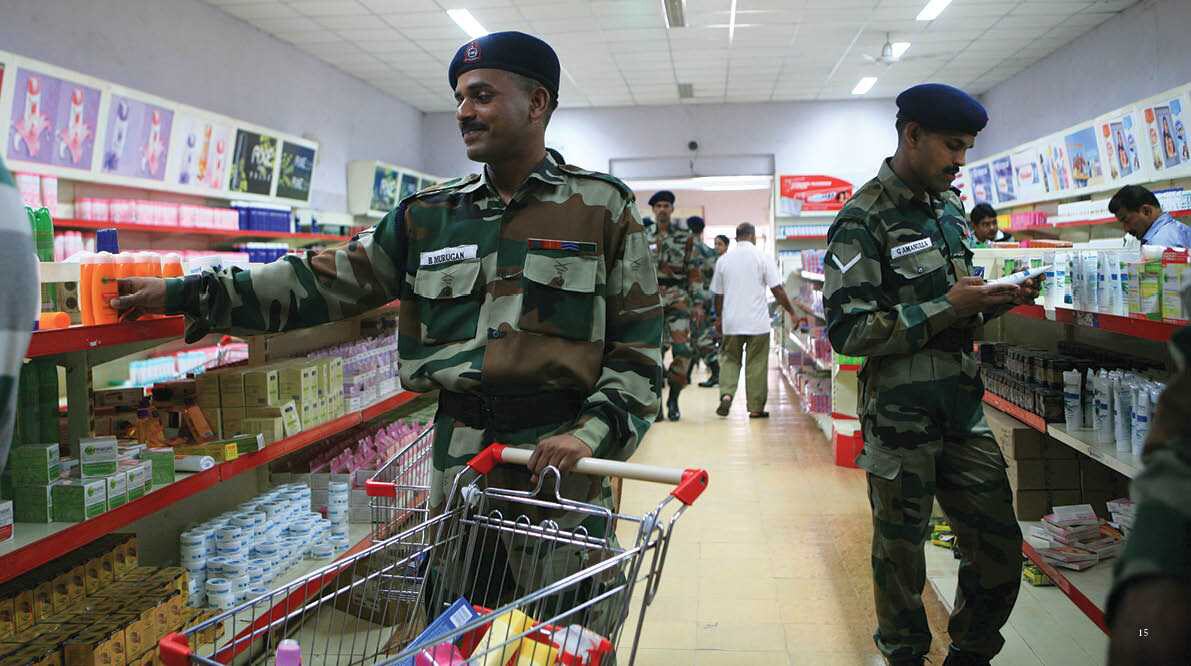
As demand continues to recover from the twin shocks of note ban and goods and services tax, consumer goods makers face a concern. Sales to India's largest retailer, the Canteen Stores Department of the Ministry of Defence, are falling.
The CSD, which reported a revenue of Rs 18,000 crore in the year ended March, contributes 5-8 percent to the revenue of Indian fast-moving consumer goods companies. That's a substantial chunk from a single buyer. The CSD provides supplies to armed forces and their families through more than 4,500 department stores across the country—the most for a retail chain in India.
Lower demand from the canteens can be partly attributed to smart cards issued to armed forces' personnel and their families. The cards introduced this year allow monitoring of procurement and is aimed at curbing the practice of people buying more than their quota and to check pilferage. Companies felt the impact.
Hindustan Unilever Ltd., in its July-September earnings press conference, said the contribution from the CSD has been on the decline for the last few quarters. The canteens now contribute 6 percent to its revenue of the country's largest FMCG company compared with more than 7 percent before demonetisation. There has been a shift as consumers now buy from modern trade, said Sanjiv Mehta, chairman of HUL.
While Godrej Consumer Products Ltd. didn't give the reasons for a fall in its sales from canteen stores, the maker of Good Knight mosquito repellent said in its earnings presentation that floods in Kerala and a decline in demand from CSD had a 1 percent impact on its revenue.
Emami Ltd.'s sales from canteens fell 3 percent compared to an 11 percent rise in the year-ago quarter, according to the company's presentation post announcing its July-September results.
Marico Ltd., in its earnings call, blamed lower demand on lesser stock kept at the canteens as buying pattern changed after the introduction of smart cards among defence personnel and their families. “There is a stock correction,” Saugata Gupta, managing director and chief executive officer of Marico, told investors. Moreover, procurement by canteens has been centralised instead of individual stores ordering stock depending on the requirement earlier, he said.
The maker of Parachute coconut oil, however, expects the demand to return to normal in the second half of the financial year.
The restrictions after the introduction of smart cards has had an impact on the quantity that the armed forces buy, admitted Brigadier Amir Singh, officiating chairman and general manager of CSD. “[That] has caused us to order less from FMCG companies,” he told BloombergQuint. Sales, however, picked up in the ongoing quarter.
(Corrects an earlier version that misstated the designation of Saugata Gupta)

-
Where You Live Shapes How You Get To Work | The Reason Why

Two-wheelers are the most popular way to get to work in India, accounting for nearly 43% of workplace commutes.
-
High US Salaries, No Green Card Certainty: The Financial Calculation Facing Indian H-1B Families
The suspension of PERM processing at eight technology employers does not cancel existing H-1B visas. What it does is force a question many Indian families have been avoiding: is the US salary worth tying your career and family plans to one employer?
-
Unhedged Position: Can India See An Indonesia-Style Time Correction?
The Nifty is trading below levels it first clocked in 2024. Is there, then, as I have suggested in the headline, potential that the current time correction drags on painfully for the next three-five, even ten years?
-
Navigating Friction And Energy Realities: An Analysis Of Marco Rubio's October Visit To India
Occurring at a critical juncture marked by stalled trade negotiations and escalating geopolitical pressures over global energy supplies, the visit offers a profound window into modern US-India relations.
-
India Exports Capital. Why Not Export Trusteeship?
The big question, then, is whether India can build an institution that global borrowers, investors, banks, and lawyers can trust, even without an Indian connection.
-
France's Economy & Politics Are In Crisis | The Reason Why
Let's look at how the French economy and politics evolved under Nicolas Sarkozy, Franois Hollande and Emmanuel Macron.
-
You May Inherit The Business. You Must Earn Its Credibility.
Succession tests the founder's ability to share authority as much as it tests the next generation's readiness to assume it.
-
Signing Deals Is One Thing; Making Them Work Is Another | The Week In Whys
Sometimes, things don't turn out as planned. Indian companies have lost some bids to rivals, some projects won't produce until 2030.
-
FOMC Wall, PERM Suspension, Hospital Stocks | Talking Points This Week
A PERM suspension would directly affect green-card sponsorship rather than H-1B visas, so the near-term earnings impact could remain relatively limited. The key question is whether this marks a new phase in US scrutiny of Indian IT.
-
Everything, Everywhere, All At Once: Dalal Street's Week To Forget | Joining The Dots
Visa curbs, a Starlink spat and cancer drug caps: what connects this week's shocks for Indian markets









