India’s 27 ARCs Make A Small Dent In Bad Loan Clean-Up

Back in 2015, when the bad loan clean-up began, the plan looked something like this:
- Push banks to recognise bad loans.
- Increase the level of provisioning against these stressed assets.
- Get these assets off the books of banks by selling them to specialists like asset reconstruction companies at the right price.
The plan always envisaged an important role for private asset reconstruction companies. For a host of reasons, it hasn't played out quite that way.
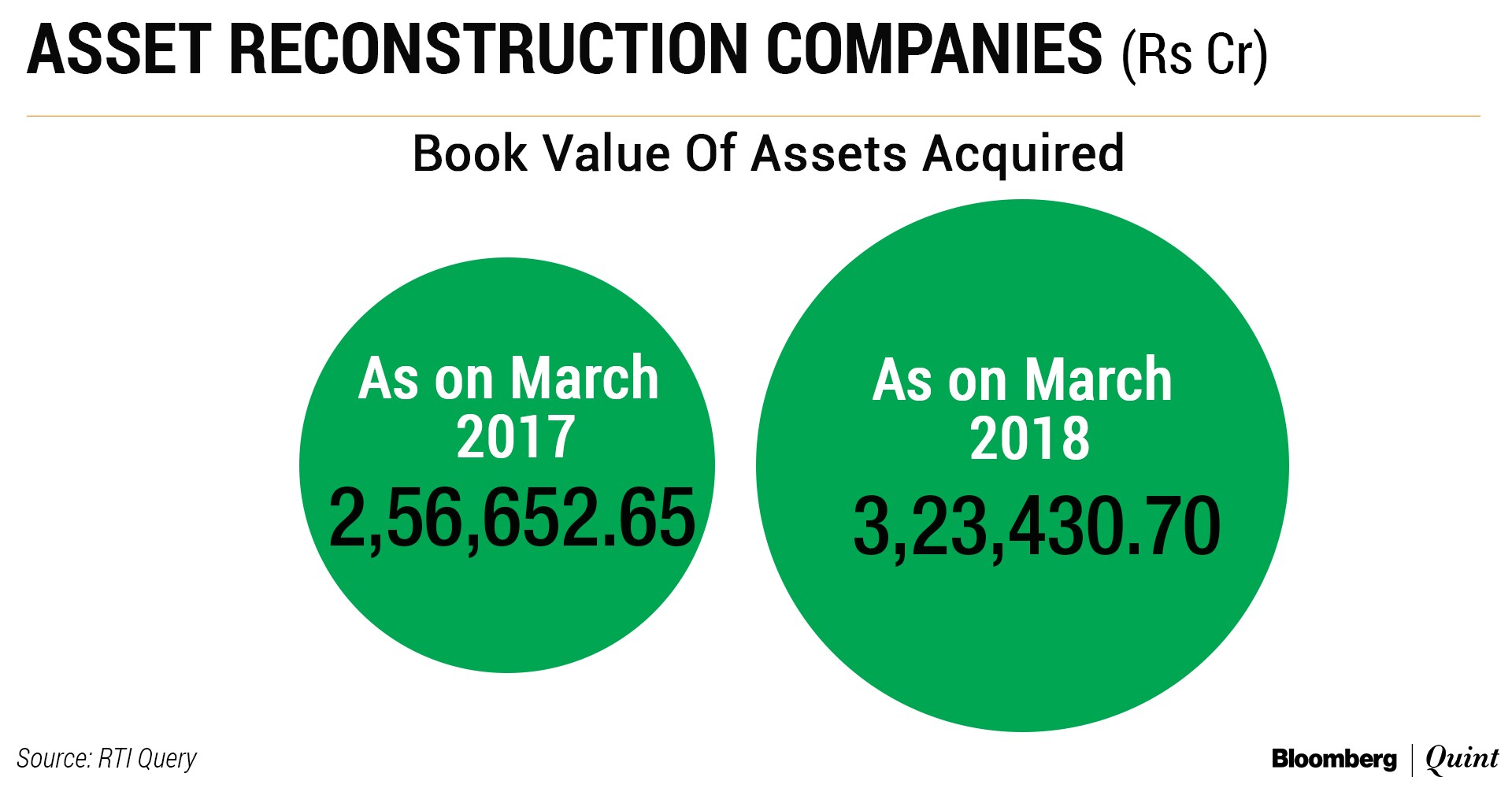
Data sourced from the Reserve Bank of India via an RTI shows that the book value of loans purchased by the country's 27 ARCs as of March 2018 was Rs 3.23 lakh crore. Gross bad loans still held by banks stood at over Rs 10 lakh crore as of March 2018. Assets that have already been sold to ARCs would no longer reflect in the bad loan numbers of banks.
While the two numbers are not comparable, they provide a view of the scale of the problem and the role played by ARCs in resolving it.
Between March 2017 and March 2018, the book value of loans held by ARCs increased by Rs 66,778 crore, showed the RBI data. Over this period, gross non performing loans rose by Rs 2.6 lakh crore.
The reasons for ARCs staying on the sidelines are well known. As often explained by ARC officials, banks are unwilling to take adequate haircuts and are unable to come together and sell 100 percent of the outstanding loans of a company.
In a conversation with BloombergQuint, K M Jayarao at Ambit ARC, listed out the factors he believes are responsible for the relatively low amount of loans purchased by ARCs.
“There is lack of coordination between banks on when they choose to sell their share of the NPA. This way these assets will always hold lower value than the sum of their parts,” said Jayarao. “Pricing an asset requires deep understanding and they should hire valuation experts to do so, instead of going by the business value of the asset,” he added.
Bankers argue the reverse.
“Which ARC offered me a cash solution? And who has been able to show to us that there indeed is an ability to turn around the asset,” asked PS Jayakumar, chief executive officer of state-run Bank of Baroda in an interview to BloombergQuint on July 5.
Most ARCs purchase bad loans with a mix of cash and security receipts. Under the current rules, ARCs must offer a minimum of 15 percent in cash. Banks, however, prefer a larger chunk upfront since the RBI's new rules require a periodic mark-to-market adjustment of security receipts.
RK Bansal, CEO of Edelweiss ARC -- the country's largest -- says that this is slowly starting to happen. “ARCs are increasingly collaborating with international funds to raise capital that is sufficient to fund the purchase. However, this development is recent and is being seen over the past six months,” he said.
Bankers, however, are getting impatient.
As part of the recent Shashakt bad loan resolution plan, bankers are proposing to set up an asset management company, which then raises alternative investment funds. These AIFs can then invest in stressed assets.
Banks are trying to create an ecosystem of AMCs/ARCs, which can join the resolution process, Sanjeev Sanyal, principal economic adviser to the Government of India in a recent interview.
This story has been updated to delete an inaccurate quote from an ARC official.

-
Navigating Friction And Energy Realities: An Analysis Of Marco Rubio's October Visit To India

Occurring at a critical juncture marked by stalled trade negotiations and escalating geopolitical pressures over global energy supplies, the visit offers a profound window into modern US-India relations.
-
India Exports Capital. Why Not Export Trusteeship?
The big question, then, is whether India can build an institution that global borrowers, investors, banks, and lawyers can trust, even without an Indian connection.
-
France's Economy & Politics Are In Crisis | The Reason Why
Let's look at how the French economy and politics evolved under Nicolas Sarkozy, Franois Hollande and Emmanuel Macron.
-
You May Inherit The Business. You Must Earn Its Credibility.
Succession tests the founder's ability to share authority as much as it tests the next generation's readiness to assume it.
-
Signing Deals Is One Thing; Making Them Work Is Another | The Week In Whys
Sometimes, things don't turn out as planned. Indian companies have lost some bids to rivals, some projects won't produce until 2030.
-
FOMC Wall, PERM Suspension, Hospital Stocks | Talking Points This Week
A PERM suspension would directly affect green-card sponsorship rather than H-1B visas, so the near-term earnings impact could remain relatively limited. The key question is whether this marks a new phase in US scrutiny of Indian IT.
-
Everything, Everywhere, All At Once: Dalal Street's Week To Forget | Joining The Dots
Visa curbs, a Starlink spat and cancer drug caps: what connects this week's shocks for Indian markets
-
India Is Going Abroad For Critical Minerals. But It May Take Years To Pay Off | The Reason Why
Although India's steps are in the right direction, they remain modest compared with India's growing dependence.
-
When Everyone Has AI, What Gives You An Edge?
India's young workforce is entering an uncertain world of work where powerful AI tools are becoming widely accessible. The advantage will belong to those who combine deep expertise with digital fluency, and the distinctly human capabilities that technology cannot manufacture.
-
Wrong Labels, High Pesticide Residues Holding Back Agri Exports | The Reason Why
India needs stronger domestic food-safety and labelling standards, with best practices becoming part of everyday business for farmers, traders and food companies.










