Indian Economy Bounces Back, Grows 6.1% In September Quarter

The Indian economy bounced back after five straight quarters of decline in growth, suggesting that the impact of twin shocks – demonetisation and the Goods and Services Tax – has started to fade, albeit slowly.
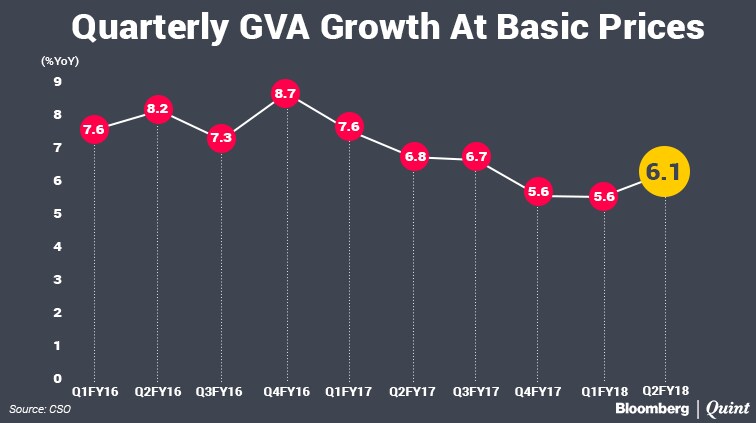
The economy grew at 6.1 percent in gross value added (GVA) terms in the second quarter ended September, data released by the Ministry of Statistics and Programme Implementation showed. Growth picked up from a three-year low of 5.6 percent in the first quarter, but remained lower than the 6.8 percent a year ago.
The number was largely in line with estimates. A Bloomberg poll of 46 economists had pegged GVA growth at 6.2 percent. GVA has become a preferred measure of economic growth as it strips out the impact of indirect taxes and subsidies.
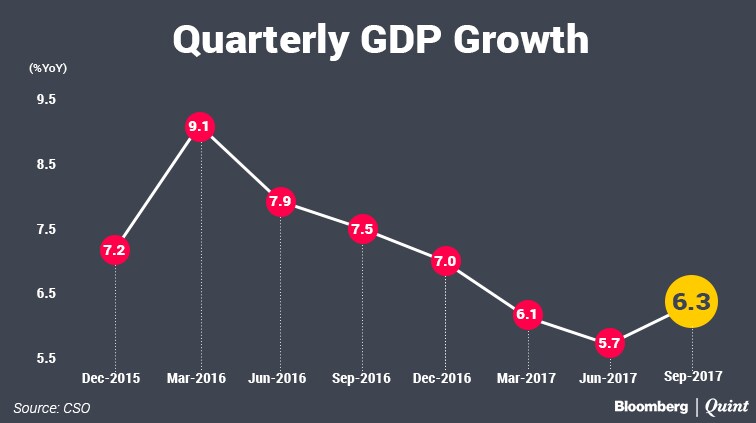
Gross domestic product (GDP) growth, the more commonly used measure, stood at 6.3 percent compared to 5.7 percent in the first quarter of the financial year.
Commenting on the data, Finance Minister Arun Jaitley said that the second quarter marks the reversal of a five quarter declining trend in growth. “This additionally indicates that the impact of two significant reforms - demonetisation and GST - is behind us,” said Jaitley. He added that movement in GDP growth in the next two quarters should be upwards.
Among key sectors, growth picked up in manufacturing and mining, but slowed in agriculture.
- The agriculture sector grew at 1.7 percent in Q2 compared to 2.3 percent in Q1
- The manufacturing sector grew at 7 percent compared to 1.2 percent
- The construction sector grew at 2.6 percent compared to 2 percent
- The financial services sector grew at 5.7 percent compared to 6.4 percent
- The government spending linked public administration segment grew at 6 percent in Q2 compared to 9.5 percent in Q1
While the overall numbers are a touch below expectations, core GVA growth, excluding agriculture and government spending, improved to 6.8 percent in the second quarter which is encouraging, said Shubhada Rao, chief economist at Yes Bank. Rao added that while growth is not as strong as what the markets had expected, directionally there have been no negative surprises.
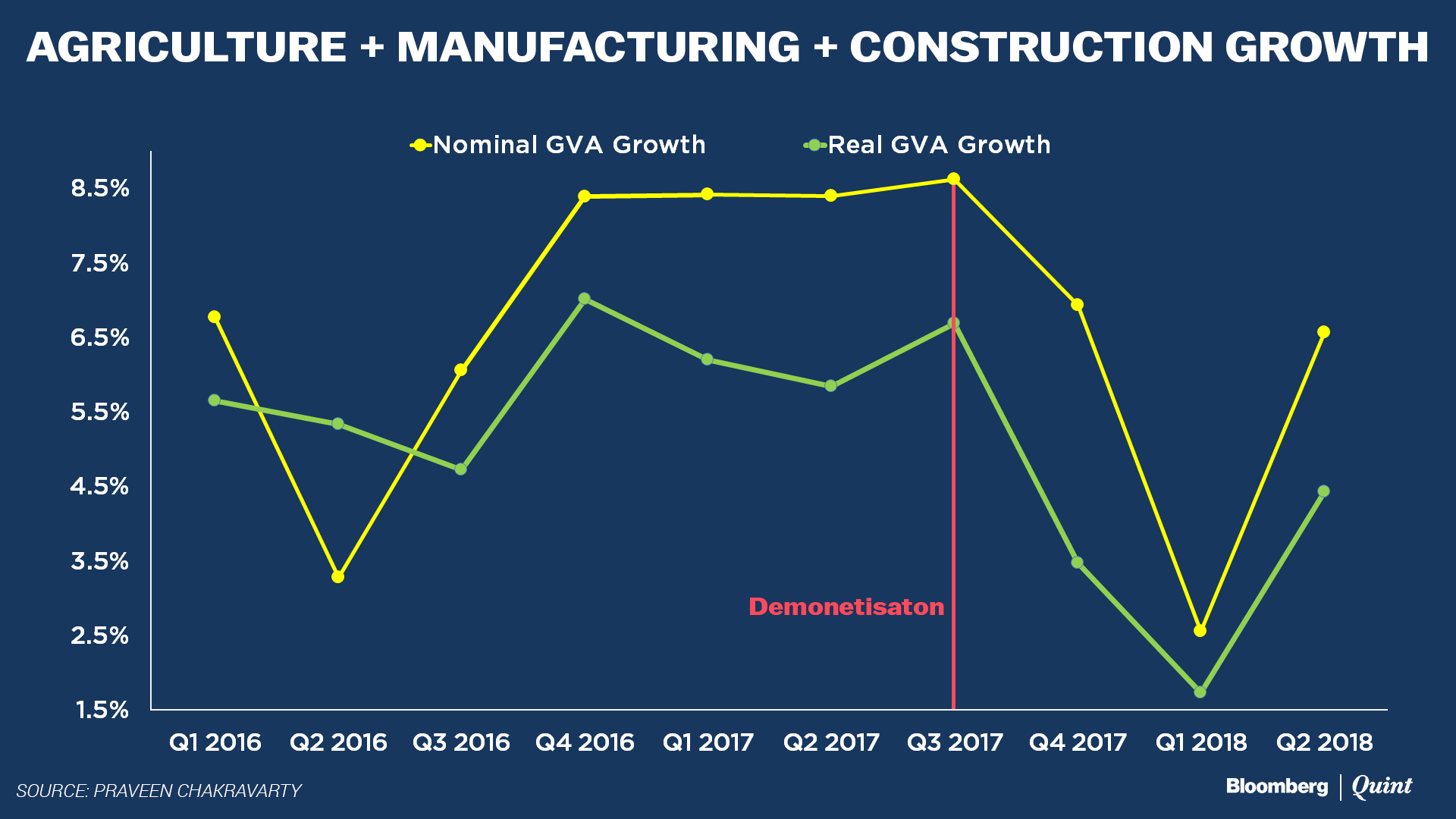
Praveen Chakravarty, economist and visiting fellow at IDFC Institute pointed out that three key employment generating sectors - agriculture, construction and manufacturing - have still not recovered to pre-demonetisation level although there has been a rebound compared to previous quarters. “Trends are right but not the levels,” Chakravarty said in a discussion with BloombergQuint while adding that this suggests that a recovery is not complete.
A break-up of the expenditure side of the national income data suggested slower growth in private consumption and government spending. The Indian economy has been plagued by weak private investment for some time now, while government spending and private consumption have held steady. In the second quarter, private investment, as represented by growth in gross fixed capital formation, picked up to a five quarter high. Private consumption, however, weakened.
- Gross fixed capital formation grew at 4.7 percent in Q2, the highest in the last five quarters.
- In Q2, private consumption expenditure at constant prices grew by 6.5 percent, the lowest in the last eight quarters.
- Government consumption expenditure grew at a weak 4.1 percent in Q2.
While growth in fixed capital formation picked up, Dharmakirti Joshi, chief economist at CRISIL pointed out that investment as a percentage of GDP continues to fall which is not a good sign. In the second quarter, gross fixed capital formation contributed 28.9 percent to GDP, lower than a year ago.
“For investment to truly turn around and become a driver, that ratio needs to bottom out,” he said. Capacity utilisation in the manufacturing sector is still on a downward trajectory and that too needs to change for a full scale reversal in investments, Joshi added. He also pointed to the declining capacity of the government to support growth due to its fiscal position. The government has utilised 96.1 percent of its fiscal deficit target for the current year in the April-October period.
The government's ability to support growth is in question right now as the fiscal deficit numbers have also come in quite high.Dharmakirti Joshi, Chief Economist, CRISIL
The higher growth will be a relief for Prime Minister Narendra Modi's administration which has been on the defensive due to weakening economic activity. Some fear that demonetisation and the implementation of GST, in quick succession, have weakened an already slowing economy.
While growth has come off its lows, it may remain slower than the pace of expansion seen in previous years. Speaking ahead of the GDP release on Thursday, the Finance Minister said that growth in India has ‘standardised' between 7-8 percent.
Watch this conversation with India's Chief Statistician TCA Anant.

-
Navigating Friction And Energy Realities: An Analysis Of Marco Rubio's October Visit To India

Occurring at a critical juncture marked by stalled trade negotiations and escalating geopolitical pressures over global energy supplies, the visit offers a profound window into modern US-India relations.
-
India Exports Capital. Why Not Export Trusteeship?
The big question, then, is whether India can build an institution that global borrowers, investors, banks, and lawyers can trust, even without an Indian connection.
-
France's Economy & Politics Are In Crisis | The Reason Why
Let's look at how the French economy and politics evolved under Nicolas Sarkozy, Franois Hollande and Emmanuel Macron.
-
You May Inherit The Business. You Must Earn Its Credibility.
Succession tests the founder's ability to share authority as much as it tests the next generation's readiness to assume it.
-
Signing Deals Is One Thing; Making Them Work Is Another | The Week In Whys
Sometimes, things don't turn out as planned. Indian companies have lost some bids to rivals, some projects won't produce until 2030.
-
FOMC Wall, PERM Suspension, Hospital Stocks | Talking Points This Week
A PERM suspension would directly affect green-card sponsorship rather than H-1B visas, so the near-term earnings impact could remain relatively limited. The key question is whether this marks a new phase in US scrutiny of Indian IT.
-
Everything, Everywhere, All At Once: Dalal Street's Week To Forget | Joining The Dots
Visa curbs, a Starlink spat and cancer drug caps: what connects this week's shocks for Indian markets
-
India Is Going Abroad For Critical Minerals. But It May Take Years To Pay Off | The Reason Why
Although India's steps are in the right direction, they remain modest compared with India's growing dependence.
-
When Everyone Has AI, What Gives You An Edge?
India's young workforce is entering an uncertain world of work where powerful AI tools are becoming widely accessible. The advantage will belong to those who combine deep expertise with digital fluency, and the distinctly human capabilities that technology cannot manufacture.
-
Wrong Labels, High Pesticide Residues Holding Back Agri Exports | The Reason Why
India needs stronger domestic food-safety and labelling standards, with best practices becoming part of everyday business for farmers, traders and food companies.










