Indian Companies Capable Of Meeting Higher Road Construction Targets, Says Feedback Infra
Construction companies in India have the capability to meet the additional order inflow if the government sets higher target, according to Vinayak Chatterjee, co-founder and chairman of Feedback Infra Pvt. Ltd.
“Over the last five years, there have been many companies that have shown remarkable entrepreneurial ability and galvanised themselves to take on bigger road projects,” he told BloombergQuint.
Though the companies failed to meet Union Highways Minister Nitin Gadkari's “inspirational target” of completing 42 kilometres of road construction daily during the financial year ended March, Chatterjee said that shouldn't deter the government from setting higher targets. He was responding to a question on the Bharatiya Janata Party's pledge to build 60,000 km of national highways in the next five years. The roads push was part of the party's promise to spend Rs 100 lakh crore on infrastructure by 2024.
“If you see an economy growing between 7 percent and 9 percent, just look at the traffic growth that will happen. India needs this scale of road construction,” Chatterjee said.
Lower Debt
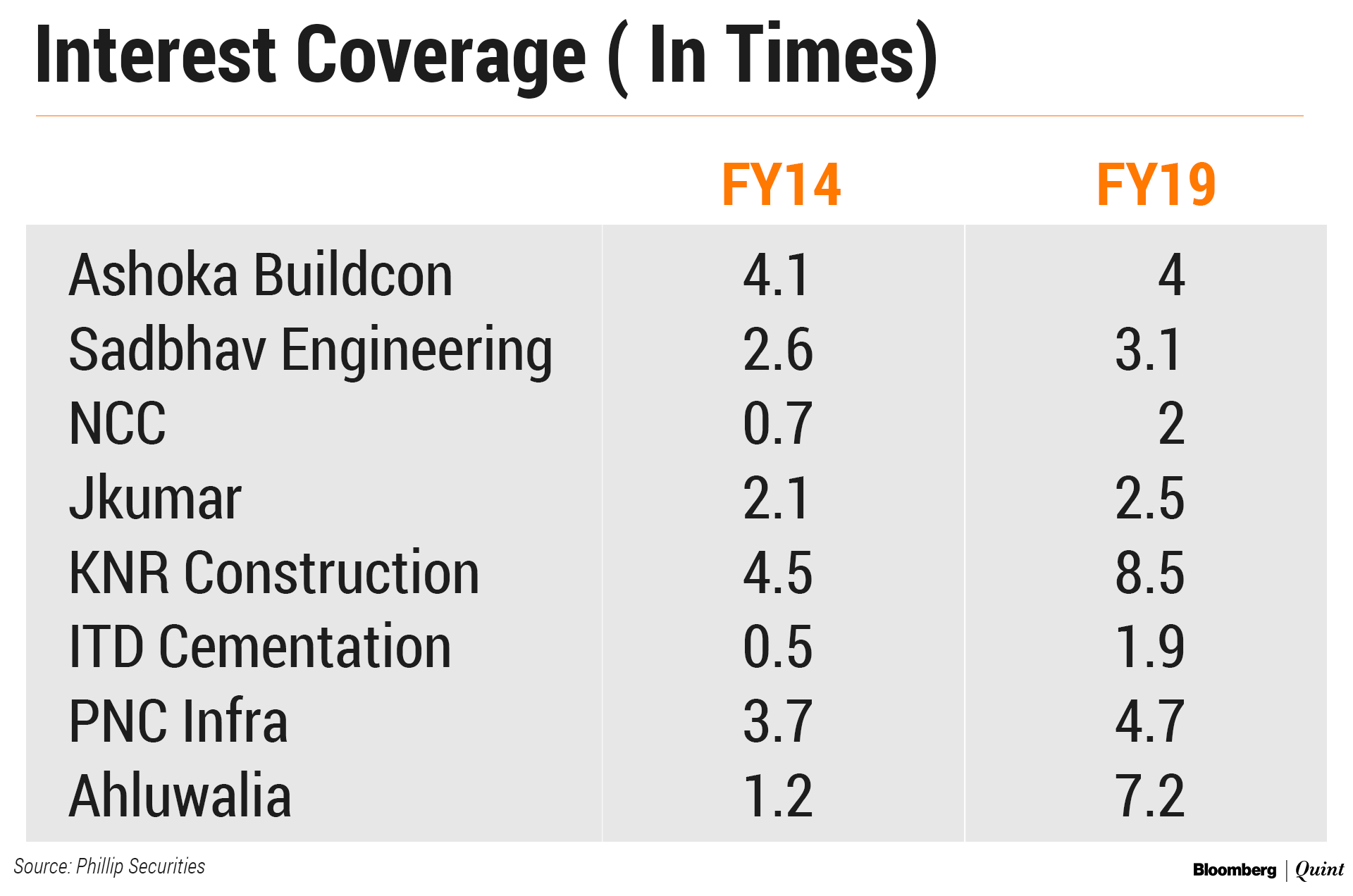
Gadkari's “personal interest”, according to Chatterjee, helped to avert a “potential bad loan tsunami”. Mid-size infrastructure companies have reduced their net debt-to-equity and focused on keeping strong control over working capital that increased their ability to service their debts better, he said, adding the companies balance sheets are in much better shape today.
The EPC Advantage
The strength of the balance sheets matters in build-operate-transfer projects, which require companies to put up equity and borrow to meet the capex requirement of the project. But that's no longer the case, since Gadkari stopped the BOT model and shifted to the engineering, procurement and construction, and hybrid annuity models.
For EPC projects, companies only need to generate 20-25 percent liquidity for working capital requirements, Chatterjee said.
New Projects
Chatterjee said he expects the new government to shift away from the existing alignments and announce greenfield road projects.
“I also see a push towards the hinterlands, the northeast and to areas that have previously been neglected.”
Watch the full interview here:

-
High US Salaries, No Green Card Certainty: The Financial Calculation Facing Indian H-1B Families

The suspension of PERM processing at eight technology employers does not cancel existing H-1B visas. What it does is force a question many Indian families have been avoiding: is the US salary worth tying your career and family plans to one employer?
-
Unhedged Position: Can India See An Indonesia-Style Time Correction?
The Nifty is trading below levels it first clocked in 2024. Is there, then, as I have suggested in the headline, potential that the current time correction drags on painfully for the next three-five, even ten years?
-
Navigating Friction And Energy Realities: An Analysis Of Marco Rubio's October Visit To India
Occurring at a critical juncture marked by stalled trade negotiations and escalating geopolitical pressures over global energy supplies, the visit offers a profound window into modern US-India relations.
-
India Exports Capital. Why Not Export Trusteeship?
The big question, then, is whether India can build an institution that global borrowers, investors, banks, and lawyers can trust, even without an Indian connection.
-
France's Economy & Politics Are In Crisis | The Reason Why
Let's look at how the French economy and politics evolved under Nicolas Sarkozy, Franois Hollande and Emmanuel Macron.
-
You May Inherit The Business. You Must Earn Its Credibility.
Succession tests the founder's ability to share authority as much as it tests the next generation's readiness to assume it.
-
Signing Deals Is One Thing; Making Them Work Is Another | The Week In Whys
Sometimes, things don't turn out as planned. Indian companies have lost some bids to rivals, some projects won't produce until 2030.
-
FOMC Wall, PERM Suspension, Hospital Stocks | Talking Points This Week
A PERM suspension would directly affect green-card sponsorship rather than H-1B visas, so the near-term earnings impact could remain relatively limited. The key question is whether this marks a new phase in US scrutiny of Indian IT.
-
Everything, Everywhere, All At Once: Dalal Street's Week To Forget | Joining The Dots
Visa curbs, a Starlink spat and cancer drug caps: what connects this week's shocks for Indian markets
-
India Is Going Abroad For Critical Minerals. But It May Take Years To Pay Off | The Reason Why
Although India's steps are in the right direction, they remain modest compared with India's growing dependence.









