Budget "A Giant Step" For Economy: Indian Business Leaders In Singapore
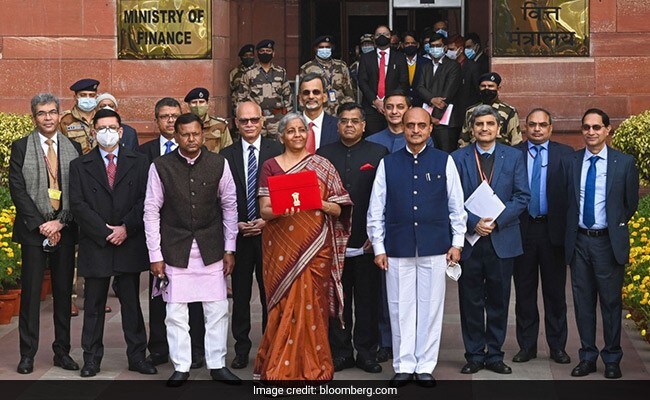
Indian business leaders in Singapore lauded the Union Budget for 2022-23 presented by Finance Minister Nirmala Sitharaman today, saying it is in tune with the global trends and a "giant step" towards making India a $5 trillion economy in the next few years.
Finance Minister Sitharaman on Tuesday unveiled a Rs 39.45 lakh crore Budget, with higher spending on highways to affordable housing with a view to fire up the key engines of the economy to sustain a world-beating recovery from the pandemic.
While she primed up spending on infrastructure to create jobs and boost economic activity, Ms Sitharaman did not tinker with income tax slabs or tax rates.
Her Budget for the fiscal year beginning April 2022 proposed a massive 35 per cent jump in capital expenditure to Rs 7.5 lakh crore, coupled with the rationalisation of customs duty, an extension of time for setting up new manufacturing companies and plans for starting a digital currency and tax crypto assets.
Girija Pande, Chairman of the Singapore-based Apex Avalon Consulting Pte Ltd, said the 34.5 per cent increase in infrastructure capital expenditure is a very welcome announcement and will have a multiplier impact on incomes and employment.
He welcomed the launch of the Central Bank Digital Currency (digital rupee) by the Reserve Bank of India, terming it a "very bold step that follows global trends".
Mr Pande, whose company provides Management Consulting and Business Research to businesses in the fast-growing Asia Pacific market, however, said the 30 per cent tax on digital assets is heavy and may have to be reduced.
"Two areas of missed opportunities are lack of major thrust in exports or youth employment. India needs to become a major exporter if it wants to become a major economic power. That's how East Asia developed," he said in response to the Budget presented by Ms Sitharaman.
"The budget is a giant step to get our economy on track and propel it to reach a target of $5 trillion in the next few years," said Atul Temurnikar, Chairman and Co-founder, of Singapore-based Global Schools Foundation.
He said the aim of the budget was to give support and push to agriculture and small businesses, which it has managed to do.
"In the bargain, it has also given a major thrust to India's greater initiatives like Digital India, Make in India and Startup India. It is also great to see the budget, under the guidance of Prime Minister Narendra Modi, giving due focus to new-age economic thrusters like the electric vehicles industry and crypto. The plans for the digital rupee, for instance, have come at the right time," said Mr Temurnikar.
The Budget 2022 has hit the nail on the head when it comes to education initiatives and shows that the government has its finger on the pulse of the nation as it charges into the digital age of education, he said.
"The focus of digital learning, formation of digital universities and the promise of bringing training and digital infrastructure to the education sector - all this just goes to show that the government has one eye on the future even as it deals with current pandemic-related problems. In addition, I am very excited about the announcements on new e-learning content delivery platforms on handheld devices," he said.
"This is good news for educational institutions who can deal with external disruptions with more ease and confidence in the future. This is also a reflection of how the Modi government is thinking ahead of the curve as we charge into the 21st century with the full force of youth behind us," said Mr Temurnikar, whose Singapore-headquartered foundation has 26 campuses in 9 countries including Japan, South Korea, the UAE, Saudi Arabia and Malaysia.
Strengthening the digital education programme via digital university and supporting the MSMEs' to promote Atma Nirbhar Bharat and job creation for 60,000 youth via Atma Nirbhar Bharat programmes are very positive announcements, said Mamta Mandal, a business consultant and promoter of Hindi language among Indian Diaspora under Global Hindi Foundation.
"Digital university programme is the need of the hour and timely execution will be key for filling the urban-rural education divide which has widened due to Covid situation," said Ms Mandal.
"Domestic consumption and manufacturing, however, are still declining though the reconfiguration in many sectors has been phenomenal," she said, calling for a focus on employment generation.
(Except for the headline, this story has not been edited by NDTV staff and is published from a syndicated feed.)

-
High US Salaries, No Green Card Certainty: The Financial Calculation Facing Indian H-1B Families

The suspension of PERM processing at eight technology employers does not cancel existing H-1B visas. What it does is force a question many Indian families have been avoiding: is the US salary worth tying your career and family plans to one employer?
-
Unhedged Position: Can India See An Indonesia-Style Time Correction?
The Nifty is trading below levels it first clocked in 2024. Is there, then, as I have suggested in the headline, potential that the current time correction drags on painfully for the next three-five, even ten years?
-
Navigating Friction And Energy Realities: An Analysis Of Marco Rubio's October Visit To India
Occurring at a critical juncture marked by stalled trade negotiations and escalating geopolitical pressures over global energy supplies, the visit offers a profound window into modern US-India relations.
-
India Exports Capital. Why Not Export Trusteeship?
The big question, then, is whether India can build an institution that global borrowers, investors, banks, and lawyers can trust, even without an Indian connection.
-
France's Economy & Politics Are In Crisis | The Reason Why
Let's look at how the French economy and politics evolved under Nicolas Sarkozy, Franois Hollande and Emmanuel Macron.
-
You May Inherit The Business. You Must Earn Its Credibility.
Succession tests the founder's ability to share authority as much as it tests the next generation's readiness to assume it.
-
Signing Deals Is One Thing; Making Them Work Is Another | The Week In Whys
Sometimes, things don't turn out as planned. Indian companies have lost some bids to rivals, some projects won't produce until 2030.
-
FOMC Wall, PERM Suspension, Hospital Stocks | Talking Points This Week
A PERM suspension would directly affect green-card sponsorship rather than H-1B visas, so the near-term earnings impact could remain relatively limited. The key question is whether this marks a new phase in US scrutiny of Indian IT.
-
Everything, Everywhere, All At Once: Dalal Street's Week To Forget | Joining The Dots
Visa curbs, a Starlink spat and cancer drug caps: what connects this week's shocks for Indian markets
-
India Is Going Abroad For Critical Minerals. But It May Take Years To Pay Off | The Reason Why
Although India's steps are in the right direction, they remain modest compared with India's growing dependence.









