To Opposition's 'Budget Forgot Poor' Argument, Union Minister's Rebuttal
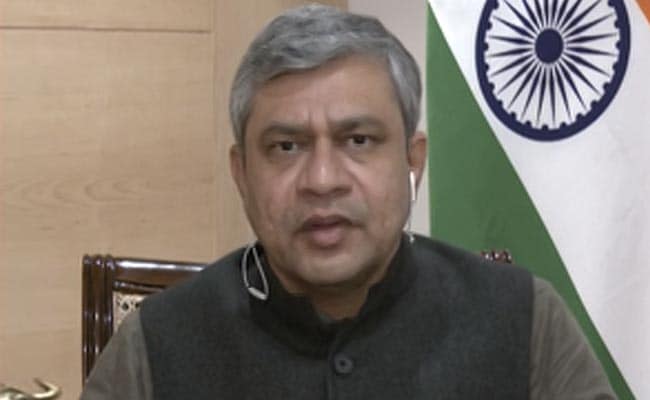
Union Railway minister Ashwini Vaishnaw brushed aside the opposition's claim that the Union budget presented today does not have anything for the poor or the unemployed, with a big picture argument.
"I am really surprised if the Opposition is saying this. During Covid, when the whole world was reeling under uncertainty, it was Prime Minister Narendra Modi who ensured that 800 million people get food grain, all facilities, free vaccinations on time and people who would have otherwise gone into abysmal poverty are today in good condition," the minister told NDTV in an exclusive interview.
"PM Modi got Jan Dhan accounts for 40 crore people. He got them cooking gas cylinders under the Ujjwala scheme. Isn't that inclusive growth? He is giving a tap water connection in every house... Imagine the power of Ayushman Bharat, which prevents people from getting back into poverty if a disease happens in the family. If this is not inclusive growth, what is?" he added.
The opposition has argued that the last full budget before next year's general election, does not factor in the poor or underprivileged or hunger and unemployment. A budget for elections with no vision, was how the Congress, Trinamool Congress and the Aam Aadmi Party put it.
Congress's P Chidambaram said in the 90-minute speech, Finance Minister "Nirmala Sitharaman "did not think it necessary to utter even once the words 'unemployment, poverty, inequality'. She said the word 'poor' twice."
"Now what is there in this budget for the poor? Have indirect taxes been cut? Has GST been cut? Have the prices of petrol, diesel, fertiliser, cement, which poor middle classes use, been cut?" he had said.
Shashi Tharoor, another former Union Minister of the Congress, argued that while capital expenditure was being expanded and digitisation was going on for the last few years, there has been no change in unemployment figures. Around 16 per cent of young people across the country are unemployed, he said.
"The very things the government was talking about with pride are potential problems," he said, pointing out that the government did not spend 22,000 crores of capex money last year. "Can they now add 2.5 lakh crores to it and spend it? This government has a record of announcing targets and failing to fulfill," he said.
Mr Tharoor also pointed out that the big outlay on infrastructure and other areas, including railways, are coming from cuts in the social sector.
"You are seeing a massive cut in women and child development, integrated child development, minority affairs, labour affairs, and most shocking of all there is a record low figure in MNREGA, which has been slashed to 60,000 crores," he said.
The demand for Mahatma Gandhi Rural Employment Guarantee Scheme -- a flagship programme of the UPA government -- has been expanding over the since the pandemic years, he said.
Mr Vaishnaw argued that when the UPA was in power, "India became one of the fragile five economies".
"In the last eight years, PM Modi has brought that fragile economy into a bright spot despite the global headwinds," he added.

-
High US Salaries, No Green Card Certainty: The Financial Calculation Facing Indian H-1B Families

The suspension of PERM processing at eight technology employers does not cancel existing H-1B visas. What it does is force a question many Indian families have been avoiding: is the US salary worth tying your career and family plans to one employer?
-
Swiggy vs Eternal: Food Delivery's Two Rivals Are No Longer In The Same Race
Eternal is building a private AI assistant, dark.ai. Swiggy is still working out how to make Instamart pay, with an operating loss of Rs 895 crore in the July-September quarter while Blinkit stayed profitable.
-
Where You Live Shapes How You Get To Work | The Reason Why
Two-wheelers are the most popular way to get to work in India, accounting for nearly 43% of workplace commutes.
-
Unhedged Position: Can India See An Indonesia-Style Time Correction?
The Nifty is trading below levels it first clocked in 2024. Is there, then, as I have suggested in the headline, potential that the current time correction drags on painfully for the next three-five, even ten years?
-
Navigating Friction And Energy Realities: An Analysis Of Marco Rubio's October Visit To India
Occurring at a critical juncture marked by stalled trade negotiations and escalating geopolitical pressures over global energy supplies, the visit offers a profound window into modern US-India relations.
-
India Exports Capital. Why Not Export Trusteeship?
The big question, then, is whether India can build an institution that global borrowers, investors, banks, and lawyers can trust, even without an Indian connection.
-
France's Economy & Politics Are In Crisis | The Reason Why
Let's look at how the French economy and politics evolved under Nicolas Sarkozy, Franois Hollande and Emmanuel Macron.
-
You May Inherit The Business. You Must Earn Its Credibility.
Succession tests the founder's ability to share authority as much as it tests the next generation's readiness to assume it.
-
Signing Deals Is One Thing; Making Them Work Is Another | The Week In Whys
Sometimes, things don't turn out as planned. Indian companies have lost some bids to rivals, some projects won't produce until 2030.
-
FOMC Wall, PERM Suspension, Hospital Stocks | Talking Points This Week
A PERM suspension would directly affect green-card sponsorship rather than H-1B visas, so the near-term earnings impact could remain relatively limited. The key question is whether this marks a new phase in US scrutiny of Indian IT.









