India Unwilling To Bend For Global Bond Index Inclusion To Bring In Billions
India has ruled out any changes to tax policies that will make it easier for the nation's bonds to be included in global indexes, according to people familiar with the matter.
The government doesn't plan to waive capital gains taxes, and it's concerned that foreign inflows will increase the volatility of local markets, said the people, who didn't want to be identified discussing policy matters. Those taxes have been a stumbling block in previous negotiations.
FTSE Russell and JPMorgan Chase & Co. are due to unveil the results of their index reviews in coming weeks, with investors piling into Indian bonds on bets the country will replace Russian debt.
While the index compilers could proceed to include the securities without changes, discussions earlier fell apart over the government's demand to retain the right to tax capital gains, dashing analysts' predictions of $30 billion of foreign inflows.
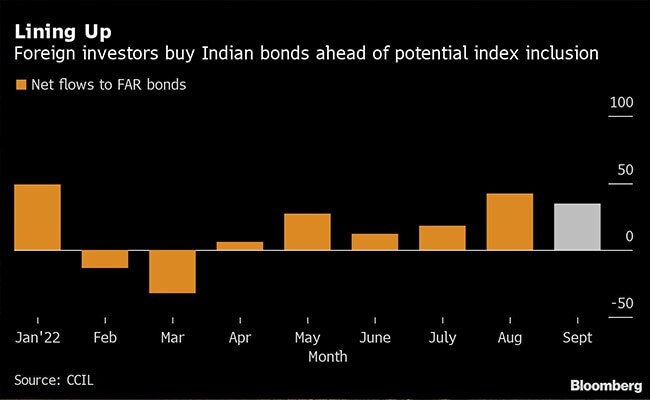
“Unlike equities, Indian bonds have failed to attract any sizable pool of foreign capital,” said Pankaj Pathak, a fixed-income fund manager at Quantum Asset Management Co. “India's inclusion would add diversification to the index, enhance the yield and expand the market opportunities for global debt investors. So, the benefits might outweigh the concerns.”

India's bond market is the largest in the emerging world that's not already included in global indexes.
The nation's benchmark 10-year bond yield has dropped around 30 basis points since the middle of June as local banks and foreign investors boosted their holdings. The yield fell seven basis points on Tuesday to 7.29%.
Money managers frequently track global bond indexes when making allocation decisions, and inclusion often lead to billions of dollars of inflows.
The government wants to be self-reliant in its funding, and is prepared to handle any selloff in its debt market should inclusion fail to happen, the people said. The nation is borrowing a record 14.3 trillion rupee ($176 billion) this fiscal year.
JPMorgan Survey
A JPMorgan investor survey found that funds want India to replace Russia, which was excluded after the invasion of Ukraine, said a money manager with access to the results.
Still, the survey also showed investors wanted the government to ease some rules, the person said, asking not to be identified as the discussions are private.
The ability to access India's debt market through an international central security depository, such as Euroclear, better transaction efficiency and clarity on taxes were cited as some of the key remaining hurdles to index inclusion, the fund manager said.
The people didn't say if JPMorgan had made any specific requests for its review. A finance ministry spokesperson didn't respond to calls seeking comments, while JPMorgan declined to comment.
“For passive foreign investors, it will be very important to get a solution to trade on standard platforms,” said Rajeev De Mello, a global macro portfolio manager at GAMA Asset Management in Geneva. Still, “not all investors are operationally ready but the largest active investment firms have already set up their infrastructure to support their emerging market teams who have been investing in India for many years.”
Unrelenting Stance
India's bonds will likely only be included in JPMorgan's index early next year as the government still needs to address operational issues, Reuters reported, citing people with knowledge of the matter.
“The market was expecting inclusion of Indian bonds into key global bond indexes,” said Arnob Biswas, a strategist at SMC Global Securities. A delay “brings more downside risk to the rupee and we are possibly heading below 82.30-82.50 to a dollar in coming weeks.”
The rupee has declined almost 9% this year, and closed at 81.5762 to the dollar on Tuesday.
India's introduction of the so-called Fully Accessible Route in 2020, which removed limits on foreign ownership on some bonds, and other changes had bolstered investor optimism over index inclusion.
The unrelenting stance on a tax waiver, that would facilitate settlement on a platform such as Euroclear, may undermine the attractiveness of Indian bonds even if they're included.
FTSE Russell will unveil the results of its review on Thursday, a spokesperson said. JPMorgan hasn't revealed a date as yet for its announcement.
Bloomberg LP is the parent company of Bloomberg Index Services Ltd, which administers indexes that compete with those from other service providers.
--With assistance from Subhadip Sircar.
(Except for the headline, this story has not been edited by NDTV staff and is published from a syndicated feed.)

-
Unhedged Position: Can India See An Indonesia-Style Time Correction?

The Nifty is trading below levels it first clocked in 2024. Is there, then, as I have suggested in the headline, potential that the current time correction drags on painfully for the next three-five, even ten years?
-
Navigating Friction And Energy Realities: An Analysis Of Marco Rubio's October Visit To India
Occurring at a critical juncture marked by stalled trade negotiations and escalating geopolitical pressures over global energy supplies, the visit offers a profound window into modern US-India relations.
-
India Exports Capital. Why Not Export Trusteeship?
The big question, then, is whether India can build an institution that global borrowers, investors, banks, and lawyers can trust, even without an Indian connection.
-
France's Economy & Politics Are In Crisis | The Reason Why
Let's look at how the French economy and politics evolved under Nicolas Sarkozy, Franois Hollande and Emmanuel Macron.
-
You May Inherit The Business. You Must Earn Its Credibility.
Succession tests the founder's ability to share authority as much as it tests the next generation's readiness to assume it.
-
Signing Deals Is One Thing; Making Them Work Is Another | The Week In Whys
Sometimes, things don't turn out as planned. Indian companies have lost some bids to rivals, some projects won't produce until 2030.
-
FOMC Wall, PERM Suspension, Hospital Stocks | Talking Points This Week
A PERM suspension would directly affect green-card sponsorship rather than H-1B visas, so the near-term earnings impact could remain relatively limited. The key question is whether this marks a new phase in US scrutiny of Indian IT.
-
Everything, Everywhere, All At Once: Dalal Street's Week To Forget | Joining The Dots
Visa curbs, a Starlink spat and cancer drug caps: what connects this week's shocks for Indian markets
-
India Is Going Abroad For Critical Minerals. But It May Take Years To Pay Off | The Reason Why
Although India's steps are in the right direction, they remain modest compared with India's growing dependence.
-
When Everyone Has AI, What Gives You An Edge?
India's young workforce is entering an uncertain world of work where powerful AI tools are becoming widely accessible. The advantage will belong to those who combine deep expertise with digital fluency, and the distinctly human capabilities that technology cannot manufacture.









